Valuation · 2022
$25M
2024 Revenue
$1.8M(Est.)
Customers · 2022
50
Funding
$5M
Team
7
Founded
2016
Gruntify Revenue, Valuation & Funding (2024)
Gruntify is a field workforce automation platform founded in 2016 in Australia by Igor Stjepanovic, who serves as CEO. The company helps organizations manage and automate field operations by delivering real-time task routing and data collection through cloud and mobile applications, with a particular focus on geospatial workflows.
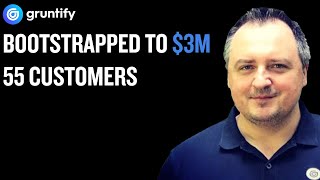
As of early 2022, Gruntify reported an annualized revenue run rate of approximately $3 million, up from roughly $1.5 million a year prior, representing 100 percent year-over-year growth. The company serves approximately 55 clients, including the City of San Jose, CoreLogic, and Modus, and has grown entirely through word-of-mouth referrals without a dedicated sales team or paid marketing spend.
Gruntify is 100 percent bootstrapped and wholly owned by Stjepanovic, who spun the product out of his earlier professional services firm, GIS People. The company was targeting a fundraise of $5 million to $10 million in 2022, with Stjepanovic indicating a willingness to sell 20 to 25 percent equity at an implied pre-money valuation of approximately $20 million.
Last updated
Gruntify Revenue
Gruntify reported an annualized revenue run rate of approximately $3 million as of early 2022, up from roughly $1.5 million a year prior. Stjepanovic confirmed to host Nathan Latka that the company was generating approximately $250,000 per month in revenue at the time of the interview, compared to approximately $125,000 per month a year earlier, implying 100 percent year-over-year growth.
| Year | Milestone | Source |
|---|---|---|
| 2024 | Gruntify Hit $1.8m revenue in October 2024 | Estimated |
| 2023 | Gruntify Hit $976.5k revenue in November 2023 | Estimated |
| 2022 | Gruntify Hit $3m revenue in January 2022 | Watch[1] |
| 2021 | Gruntify Hit $1.5m revenue in January 2021 | Watch[2] |
| 2020 | Gruntify Hit $907.2k revenue in January 2020 | |
| 2019 | Gruntify Hit $600k revenue in January 2019 | |
| 2016 | Launched with $0 revenue |
The host noted that 55 customers at an average of $6,000 per month would imply roughly $330,000 in monthly revenue, but Stjepanovic clarified the actual figure was closer to $250,000 per month. Growth has been driven entirely by word-of-mouth referrals, with no dedicated sales team and no paid marketing investment at the time of the interview. Stjepanovic identified expansion into Europe and Singapore as the primary near-term revenue growth opportunities.
A GetLatka forward estimate, applying the stated 100 percent trailing growth rate as a ceiling and a deceleration-adjusted rate as a floor, suggests 2023 annualized revenue could fall in a range of approximately $4.5 million to $6 million. This is a GetLatka estimate based on the trailing growth rate stated by Stjepanovic and should not be treated as a company projection.
Gruntify Valuation, Funding Rounds
Gruntify reached a $25M valuation in 2022, set during its Raising now round.
Gruntify has raised $5M in total funding across 1 round, most recently a $5M Raising now round in 2022.
| Year | Round | Amount | Valuation | % Sold | Source |
|---|---|---|---|---|---|
| 2022 | Raising now | $5M | $25M | 20% |
Founder / CEO
Igor Stjepanovic
CEO
Igor Stjepanovic is the founder and CEO of Gruntify. He is 46 years old as of early 2022, is married with four children, and is based in Australia. He describes himself as a lone wolf, having built Gruntify without co-founders.
Sjepanovic comes from a technical background as a geospatial computer programmer. Before Gruntify, he founded GIS People, a professional services firm serving oil and gas and mining clients that was generating $3 million to $4 million in annual revenue at the time Gruntify was spun out in 2016. GIS People provided the initial funding and team for Gruntify's development. Stjepanovic retains 100 percent ownership of Gruntify.
A GetLatka net worth estimate is not possible from the available data. The implied pre-money valuation discussed in the interview was approximately $20 million, and Stjepanovic owns 100 percent of the business, which would imply a paper value of approximately $20 million at that valuation. However, this valuation was host-derived and not independently confirmed, and no transaction has occurred. Net worth was not discussed in the interview beyond this context.
Q&A
| Question | Answer |
|---|---|
| What's your age? | 49 |
Customers
Gruntify had approximately 55 paying clients as of early 2022. Named customers include the City of San Jose, which uses the platform for emergency response to fires and housing-related use cases; CoreLogic, a property data company; and Modus, a company rolling out 5G hardware across the United States.
The company's business plan is priced at $49 per person per month. For larger clients, an enterprise plan is priced on application. Stjepanovic described the typical sweet spot as $5,000 to $7,000 per month, which corresponds to approximately 500 to 600 seats. Volume discounts apply, with per-seat pricing declining as seat counts increase. The company also noted a client expansion example in which a customer grew from 100 licenses to more than 1,000 licenses over time. Stjepanovic indicated the company was shifting focus toward small and medium-sized clients as a growth priority.
Gruntify serves 50 customers.
Gruntify Business Model
Gruntify operates a seat-based SaaS model with tiered pricing. The entry-level professional plan covers inspections, the business plan at $49 per seat per month supports advanced field workflows, and an enterprise plan is priced on application for the largest clients. The typical monthly contract value falls between $5,000 and $7,000, representing approximately 500 to 600 seats, with volume discounts applied at higher seat counts.
Sjepanovic reported zero gross churn as of early 2022, stating that once a client is won, they do not leave. He also described meaningful net expansion, with clients frequently adding projects and teams over time. One cited example involved a client growing from 100 licenses to more than 1,000 licenses. The company has no dedicated sales team and no paid marketing spend, with all growth attributed to word-of-mouth referrals at the time of the interview.
Profitability was not explicitly discussed in the interview. The company has been fully bootstrapped since inception, reinvesting revenue from operations, which implies it has not been operating at a significant loss, but no margin, burn rate, or profitability figures were stated. Gross margin, CAC, LTV, and payback period were not discussed.
Point-in-time figures shared on the GetLatka podcast, each linked to the exact moment it was said on camera.
Customers (2022)
50
“Nathan Latka: And how many paying customers do you have now today? Igor Stjepanovic: We target the predominantly larger clients, so we have about fifty, sixty clients, so not that many, but we are currently focusing on the small to medium sized clients and that's where we see a lot of growth and a lot of interest lately.”
WatchGruntify Employees & Team Size
Gruntify had 22 employees as of early 2022. Of those, approximately 18 are software engineers, testers, scrum masters, and product owners. The remaining roles include Stjepanovic, a Chief Financial Officer, and a Chief Operating Officer.
The team grew from an initial group of three, adding two to five people per year over the prior four to five years. The company had no sales team and no paid marketing staff at the time of the interview, with Stjepanovic identifying sales and marketing headcount as the primary intended use of any capital raised.
Gruntify employs approximately 7 people as of 2026, including 1 sales reps that carry a quota. It serves 50 customers that rely on its solutions.
| Year | Milestone | Source |
|---|---|---|
| 2024 | Reached 7 employees (October 2024) | |
| 2023 | Reached 7 employees (November 2023) | |
| 2022 | Reached 22 employees (January 2022) | |
| 2021 | Reached 17 employees (November 2021) | |
| 2020 | Reached 11 employees (November 2020) | |
| 2020 | Reached 11 employees (January 2020) |
Frequently Asked Questions about Gruntify
What is Gruntify's revenue?
Gruntify generates an estimated $1.8M in annual revenue.
Who founded Gruntify?
Gruntify was founded by Igor Stjepanovic.
Who is the CEO of Gruntify?
The CEO of Gruntify is Igor Stjepanovic.
How much funding does Gruntify have?
Gruntify raised $5M across 1 round.
How many employees does Gruntify have?
Gruntify has 7 employees.
Where is Gruntify headquarters?
Gruntify is headquartered in Newstead, Australia.
Compare Gruntify to the industry
Gruntify operates across multiple industries. Browse revenue, funding, and growth data for Gruntify in each sector below.
Full Interview Transcripts
Bootstrapped to $3m, Now Raising to Grow Field Operations Management SaaSJan 26, 2022
[00:00] Hey folks, my guest today is Igor Stjepanovic. He loves solving real problems with innovative and creative solutions. His specialty is geospatial technology and real time delivery of cloud and mobile applications. Now building a field workforce automation tool at gruntify.com. Igor, you ready to take us to the top? [00:16] >> I am, Nathan. [00:18] Alright, what does field workforce automation mean? [00:21] >> Well, we help our clients effectively be more productive in the field. So we automate their field operations through technology, make sure the right person receives the right information at the right time. And our aim is really to boost productivity and save money for our clients. [00:43] And who are these clients? Can you name a couple of them? [00:46] >> Yeah, sure. We have clients in The United States and in Australia. For example, we have Modus, a company in The United States that's rolling out 5G hardware all over this country. We have CoreLogic as one of our property clients and we have multiple government clients in Australia and in The United States, for example, the city of San Jose. [01:11] Oh, wow. And so city of San Jose, if they have like repair people, they'll use your tool to manage their repair people? Or how does that work? [01:18] >> Yeah, well, they actually have multiple uses for our technology, including responses to the fires in the city and emergencies, as well as various housing related use cases. [01:31] Very interesting. Okay. So what do these companies and cities pay you on average to use your technology per month? [01:38] >> Well, look, that varies. Of course, we have a range of plans. Obviously, professional is our entry level plan and provides for inspections and then if you want to go to more advanced field workflows, you go up to a business plan, which is a charge of $49 per person per month and obviously for our largest clients, we provide a premium service, we call the enterprise plan and that's usually priced on application. [02:06] Okay. But what would you say? I know there's a lot of different options here, but what would you say a sweet spot? Is the sweet spot like a thousand bucks a month or 3,000 a month or what? [02:14] >> Based on the number of seats, obviously, that varies, but most fit within about 5,000 to about 7,000 a month. [02:22] I see. And that's usually about how many seats? 6,000 a month? [02:26] >> That's that's approximately 500, 600 seats. [02:30] Interesting. Okay. 6 k per month is five okay. Per month is is do you said 50 seats or 500 seats? [02:37] >> 500. But we provide obviously, you know, for for higher volumes, we provide discounts. So we basically charge less. The more users you have, the less you pay. [02:49] Mhmm. And tell me more of the backstory here. When did you launch the company, Igor? [02:53] >> We actually launched in Australia out of an innovation challenge. One of our early clients posted a challenge trying to solve a problem for their graffiti and vandalism issues and we pitched our solution and built a prototype, an early prototype which we took from there and then basically modified [03:16] What year what year was that? [03:19] >> That was 2016. That was the earliest version of gruntify. We are now in version four of the platform and we've expanded and built a lot of the additional capabilities which of course we didn't have early on, but since our early days, we've expanded across different industries and different geographies as well. [03:42] And how many paying customers do you have now today? [03:46] >> We target, as I said, the predominantly larger clients, so we have about fifty, sixty clients, so not that many, but we are currently focusing on the small to medium sized clients and that's where we see a lot of growth and a lot of interest lately. [04:05] Oh, what's going on there, YouTube? Good to see you guys. Now imagine this, you love watching these interviews with SaaS founders. But imagine if we took all of the valuation data out from over 2,807 interviews I've done manually saves you a lot of time. Well, we've done this. We've built it into the beautiful interface inside of Founderpath. Check this out. I'll show you how you can access this in a second, but you log in, you connect [04:28] your Stripe account, you see your valuation real time. You can see what it changed over the past eighty eight days and even set goals for valuation this year. Now the secret evaluation is there's many different ways to value a SaaS business. So the reason you're gonna see three or four different valuations inside of your Founderpath dashboard, this is all free by the way, is because depending on who's doing the buying of your SaaS company, you're gonna [04:53] get a different valuation. A VC is gonna pay a different valuation. Private equity firm is different. If you're gonna do a minority sale, that's different. And if you sell the whole business, that's a different valuation. You can see all those when I hover over here. Right? So the teal is what a VC would pay. Yellow is what private equity and red is if you sold the whole thing outright. Now what's cool about this is this is [05:15] not built off random data. Again, you guys hear these interviews on YouTube. All these datas are built from real time valuation data points founder share with us on the show. So traction, 1,200,000 seed round, 3.7 raise. They sold 22% of their business. Go in here and filter by the event. Maybe you only wanna see companies that have sold the whole business. Well, here are a bunch that have been acquired, the valuation and the multiple. Maybe you're [05:40] going out right now and you're raising your seed round. We'll go in here and look at all this recent seed deals that went down, what they raised, what valuation they raised at, and what percent that they sold. There's never been a larger dataset of SaaS valuations than what you can get now inside of Founderpath. And we're thrilled to bring it to you. Alright. We're gonna go back to the YouTube video here in a second. But if [06:02] you wanna check this tool out, if you wanna jump in and sign up, you can check it out for free to get your valuation at this link. This link, founderpath.com/products/valuations. Or if you go to founderpath.com and hover over products, click on get your valuation here, and go ahead and sign up to give it a whirl. Again, all that valuation data live right inside the platform. I hope to see you there. Alright. Let's jump back into the [06:29] interview. I mean, if I take, you know, what it would you say 55 customers times 6,000 a month on average, what you guys are doing about $330,000 a month right now in revenue? [06:39] >> Yeah. Well, yes. Sort of. It's more about $250 at the moment, $250 k, but that's growing and we are obviously this year also launching in Europe, which is a big market opportunity for us, as well as we are starting to grow in Singapore, so across Asia, Asian market there. So we see a lot of opportunities this type of technology [07:08] >> this year and beyond. [07:09] And if you're doing $250,000 a month in revenue today, Igor, what were you doing about a year ago? [07:16] >> Probably about a half, if that. [07:19] About a half, so $125,000 a month? [07:21] >> Yep. [07:22] And what's driven most of the growth? Is it the current 50 customers buying more seats? Or is it brand new customers coming in? [07:30] >> Well, we are growing through mostly at the moment word-of-mouth. So our happy customers are referring us to other customers. We don't have we are not investing a lot in marketing and sales, which is something we would like to change this year. We are also investing in our partner partner sort of program, but the growth is coming mostly through an organic sort of word-of-mouth growth. [07:54] It's the best way to do it. And have you done this all bootstrapped or did you decide to raise capital? [07:58] >> Now we are 100% bootstrapped at the moment, but [08:01] Hey, I love that. That's awesome. [08:05] >> And we've done that for a number of years. Obviously, we are very conservative with with our money. So with the money that we earn, we invest and reinvest back into the business. So that's that's been working okay. But we are hitting the stage where I think we should really accelerate our growth because the platform is starting to be very mature. We have validated it in the marketplace. So it's all about growth now and Uh-oh. [08:29] Raising round. Uh-oh. The raise is coming. Alright. So how you you might you might go to the dark side then. How much would you look at raising this year? [08:37] >> We're looking to raise between 5 and 10,000,000, hopefully, to grow internationally. So that's really our aim. And, that's that's what we're working on the moment. [08:49] But right now, Art, you're the sole founder? Do you own a 100% of the business? [08:52] >> Yes. [08:53] That's amazing. [08:54] >> No co founders, No, [08:57] >> unfortunately not. I've been a lone wolf for for a while now. But How'd [09:03] you get the MVP live? Did you code it yourself? [09:06] >> No. No. Well, actually, we had a team of three early on, so I was I did not code it myself, but I do come from technical background, as you might appreciate. I used to be a geospatial computer programmer back in the day. So I come from that dark side. Yeah, you're right. [09:24] Okay. But what happened to the other three peep two people though? [09:27] >> They're still here. They are still with me. Now we have about 22. So we have grown, you know, slightly over the last four or five years and every year we would put on, you know, two or three, five people depending on what was needed. But we are growing organically, as I said. [09:45] But, Igor, how did you get those first two people to do work for you without giving them equity? Did you have a bunch of money you could pay them, like a full salary? [09:52] >> That's a great question. No, we gruntify was born out of another company, which I started called GIS People, and that's a professional services company servicing oil and gas and mining clients. That company actually is the one that developed gruntify and then gruntify was spun out of that company and became an entity of its own. It became it took over our other operations really, became our primary focus, but it that startup, if you like, was really part [10:25] >> of of GIS people business initially. [10:28] So that consulting business back in 2016, how much revenue did it do that year? Was it a big agency? [10:34] >> No, it was about 3 or $4,000,000 at the time. So we invested part of that, I guess, revenue in this gruntify business because we noticed, we started receiving a lot of inquiries about field operations and helping clients automate their workflows And we didn't really find a great solution and so we decided to build our own. And that's how really gruntify emerged and it went from there. [11:05] That's amazing. Yeah. So agency, you take the way you are to pay pay these other two people as you pay them as agency employees and then spun the IP out. You own a 100% of the of the new IP, gruntify. [11:16] >> 100%. Correct. Yes. [11:18] I see. Okay. So you want to raise 5 to 10,000,000. It sounds like this year to put the pedal to the metal, you know, go a little bit faster. How much equity are you willing to sell for $5,000,000? [11:28] >> Well, that really, I guess, you know, depends on the arrangements that we negotiate with our investors. You're looking probably about 20% of the business, 20%, 25% maximum, again depending on what other than the money, what else they can bring to the table because some people might be able to open some doors and create introductions and sometimes that's a lot more valuable than the money itself. At the moment, money is somewhat cheap as they say, you know, [11:59] >> and and there's plenty of it around, but good connections and introductions are to me worth more than than just money itself. [12:07] So if someone's listening right now and they're a top tier VC and they think you'd get a longer have Igor and you're comfortable writing a $5,000,000 check at a 20,000,000 pre-money valuation, 25,000,000 post, buying about 20% of the business, Igor they should email you. [12:19] >> They should reach out to me right now. [12:23] Very cool. Alright. And you definitely want to go through the equity route. I mean, if someone offered you 2 or $3,000,000 in debt, but you keep all your equity, would you look at doing that or no? [12:33] >> We would consider that, but like I said, it depends what else they can bring to the table. We are able to source money from the banks and whatnot. Yeah. That's a problem, but they're really looking for strategic partners and potentially bigger businesses that can, you know, facilitate introductions and help us win more work as well as just, you know, help us kind of tool up in our marketing and sales departments which is where most of the [13:00] >> money would be invested in. [13:02] You mentioned 22 folks on your team right now, how many of them are engineers? [13:08] >> Other than myself, the Chief Financial Officer and the Chief Operational COO, there would be effectively all of them are software engineers, testers. We have we use the scrum methodology and and agile. So we have, you know, scrum masters and product owners and those kinds of folks. But yeah, there would be about eighteen, nineteen of them. [13:33] No sales team, no paid marketing spend, all organic? [13:37] >> At the moment, no. Correct. All organic. [13:39] Interesting. And what's net dollar retention over the past twelve months? [13:43] >> Our we literally don't lose any clients. Once we win them, they stick with us. [13:48] What about expansion though? If someone pays you $5 a month from a year ago, were you able to upsell them to $6 a month in 2022? [13:55] >> Yes, yes. We see especially from our larger clients, they start off with one project and then they introduce additional projects and additional teams. So we've had with some of our large clients, we've had basically clients come in and purchase say 100 licenses, now they're over a thousand. [14:16] Wow. [14:16] >> So it's, you know, really depends, but most of the clients grow over time quite significantly. [14:24] Hey, Igor, I love this story. Congrats. Let's wrap up here with the famous five. Number one, favorite business book. [14:30] >> Yeah. Well, it's thank you for your nice words, Nathan. Really appreciate it. [14:34] You bet. Let's wrap up here. Favorite business book, number one. [14:39] >> Look, I don't know. You got me now on the spot that there are so many [14:47] >> can't think of them, but anything to do with startups, anything to do with innovation and not necessarily IT centric, read a lot. [14:56] Number two, is there a CEO you're following or studying? [15:01] >> Not a single one again, there are many. I followed, you know, Elon Musk's of the world and CEOs of Google, Microsoft, and so on. But again, not a single person. I follow multiple people. [15:15] Number three, Igor, is there a favorite online tool that you use to build gruntify? [15:22] >> We do use again a lot of tools, but we we love Trello. Trello and Atlassian software called Jira. We use those tools a lot, so we love that. [15:32] Number number four, how many hours of sleep do you get every night? [15:35] >> Can you repeat that? Sorry. [15:36] How many hours of sleep do you get on the average Not many. [15:41] >> Usually about six to seven. That's that's sort of enough for me. Yeah. I get get by. [15:47] And Igor, what's your situation? Married? Single? Kids? [15:51] >> I'm married with four children. Live in Australia. Great place. [15:56] Wow. Four kids. And how old are you? [16:00] >> I'm 46 and so soon to be 47. So heading towards the fifties, unfortunately. [16:08] Happy early birthday. Last last question, Igor, something you wish you knew when you were 20. [16:17] >> Well, I wish I knew how much I didn't know at the time. So, you know, you're all all all those things you think you know and makes all those assumptions. So I think I I wish I had more of an open mind back then, but I guess you learn as you as you grow older that, hey, the world is a wonderful place and there's a lot of things you really don't know. And the more you you [16:40] >> you experience the world, the more you realize how much more there is to know. [16:44] Guys, gruntify.com is a bootstrap SaaS coming out of Australia with $3,000,000 in terms of run rate, up from 1,500,000 just a year ago. Saying, you know what, it's time to raise and grow faster, targeting a 5 ish million dollar raise at selling 20% of the business. They help customers like Modus in the city of San Jose here in The United States manage their field sales teams. Really sharp technical team of 22, mainly engineers of 18. We'll [17:07] see what happens next. Igor, thanks for taking us to the top. [17:10] >> Nathan, thanks for this opportunity. Take care. [17:14] One more thing before you go. We have a brand new show every Thursday at 1PM central. It's called Shark Tank for SaaS. We call it deal or bust. One founder comes on, three hungry buyers, they try and do a deal live, the founder shares back end dashboards, their expenses, their revenue, ARPU, CAC, LTV, you name it, they share it and the buyers try and make a deal live. It is fun to watch every Thursday 1PM Central. [17:40] Additionally, remember these recorded founder interviews go live. We release them here on YouTube every day at 2PM Central. To make sure you don't miss any of that, make sure you click the subscribe button below here on YouTube, the big red button, and then click the little bell notification to make sure you get notifications when we do go live. I wouldn't want you to miss breaking news in the SaaS world, whether it's an acquisition, a big fundraise, [18:02] a big sale, a big profitability statement or something else. I don't want you to miss it. Additionally, if you want to take this conversation deeper and further, we have by far the largest private Slack community for B2B SaaS founders. You want to get in there. We've probably talked about your tool if you're running a company or your firm if you're investing. You can go in there and quickly search and see what people are saying. Sign up [18:23] for that at nathanlatka.com/slack. In the meantime, I'm hanging out with you here on YouTube. I'll be in the comments for the next thirty minutes. Feel free to let me know what you thought about this episode and if you enjoyed it, click the thumbs up. We get a lot of haters that are mad at how aggressive I am on these shows, but I do it so that we can all learn. We have to counter those people. We [18:43] got to push them away. Click the thumbs up below to counter them and know that I appreciate your guys'support. All right. I'll be in the comments. See you.
Data and Sources
All figures on this page are taken directly from interviews or are estimates from public sources and proprietary models. Not financial advice. Read full disclaimer.
Claim this profilePeople Also Viewed
Zingle AI Lab
Data pipelines break. Dashboards drift. Warehouse costs explode. And every data engineer still...
MySchool Limited
MySchool is a software ecosystem that helps independent K12 schools manage their data, streamline...
Articence Inc
Enabling Contextual Intelligence for unstructured text data
Knowingo+
Provider of a cloud-based learning platform intended to revolutionize the way people learn. The...
CollectiveCrunch
Provider of a data analytics platform intended to model technical data in the climatic context. The...
Inspace XR
Developer of augmented reality software designed for real estate industry. The company software...