Latka logo
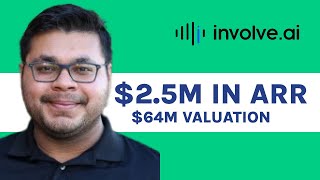
involve.ai logo

involve.ai

Santa Monica, California, United States

Valuation

$64M

2023 Revenue

$2.2M

Customers

70

Funding

$19.2M

Avg ACV

$31.4K

Team

12

Founded

2017

involve.ai Revenue, Valuation & Funding (2023)

involve.ai is an AI-powered customer intelligence platform that helps mid-market and enterprise companies predict customer churn, identify upsell opportunities, and automate follow-up sequences. Founded in 2017 by Gaurav Bhattacharya and a co-founder, the company spent its first four years as a community-events platform before pivoting to AI-driven customer health analytics after nearly running out of money.

As of June 2023, involve.ai was generating approximately $185,000 per month in revenue, equivalent to a roughly $2.2 million annualized run rate, up from $1.5 million in full-year 2022 and $250,000 in 2021. The company serves 70 paying customers at an average contract value of $52,000, with a 12-person team and more than $10 million in cash remaining from a $16 million Series A led by Sapphire Ventures in 2022.

The company is not yet profitable, running a net cash burn of approximately $90,000 per month against gross annual expenses of $2.5 million. Bhattacharya has stated the company aims to reach $10 million to $20 million in ARR without raising additional capital, leaning heavily on AI tooling, with 70 percent of its coding now done using AI.

Last updated

involve.ai Revenue

involve.ai reported approximately $2.2 million in annualized recurring revenue as of June 2023, based on $185,000 in monthly revenue that month. That figure was up from $1.5 million in full-year 2022 ARR and $250,000 in full-year 2021 revenue from the legacy community platform. The company took roughly four years from its 2017 founding to reach that first $250,000 in annual revenue.

involve.ai Revenue GrowthReported revenue / ARR over time$0$500K$1M$1.5M$2M$2.5M2017201820192020202120222023$0$250K$1.5M$2.2MSource: GetLatka.com interview on Jul 19, 2023 with Gaurav Bhattacharya
YearMilestoneSource
2023involve.ai Hit $2.2m revenue in June 2023Watch[1]
2022involve.ai Hit $1.5m revenue in January 2022Watch[2]
2021involve.ai Hit $250k revenue in January 2021Watch[3]
2017Launched with $0 revenue

Bhattacharya told Latka in July 2023 that the company was targeting $5 million in revenue by the end of 2023, driven in part by a new self-serve product called R2D2 launched as a Chrome extension. Year-over-year growth from 2022 to the June 2023 annualized run rate represents an increase of roughly 47 percent on the ARR base. Growth from 2021 to 2022 was substantially faster, moving from $250,000 to $1.5 million, a gain of 500 percent, though the 2021 figure reflected the old product and the 2022 figure reflected the new AI platform from a near-zero base.

As a GetLatka forward estimate, applying a conservative deceleration from the trailing growth rate, involve.ai could reach between $3 million and $5 million in ARR by year-end 2023. The $5 million figure is the ceiling Bhattacharya himself cited; the floor assumes growth decelerates meaningfully from the pace implied by the June run rate. Both figures are estimates and have not been confirmed by the company.

involve.ai Valuation, Funding Rounds

involve.ai reached a $64M valuation in 2022, set during its Series A round.

involve.ai has raised $19.2M in total funding across 3 rounds, most recently a $16M Series A round in 2022.

involve.ai Capital Raised & ValuationCumulative capital raised and post-money valuation by roundCapital raised (cum.)Valuation$0$0$15M$5M$30M$10M$45M$15M$60M$20M$75M$25M201720182019202020212022$6M$64MSource: GetLatka.com interview on Jul 19, 2023 with Gaurav Bhattacharya
YearRoundAmountValuation% SoldSource
2022Series A$16M$64M25%Watch[1]
2017Pre Seed$1.7M--Watch[2]
2017Seed$1.5M$6M25%Watch[2]

Founder / CEO

Gaurav Bhattacharya

CEO

Gaurav Bhattacharya, confirmed as CEO of involve.ai, is 29 years old as of the July 2023 interview. He grew up in Delhi, India, and lost his father to cancer at a young age, an experience he has cited as the motivation behind his first venture, a patient-experience platform for doctors. After that company, he moved to the United States and founded involve.ai in 2017 alongside a co-founder, who handles product and design and holds a 50 percent equity stake equal to Bhattacharya's own.

Bhattacharya and his co-founder each own approximately 25 to 26 percent of involve.ai after accounting for dilution from the seed and Series A rounds, based on the equity percentages he disclosed. No formal net-worth figure was discussed in the interview; a rough GetLatka estimate based on a 25 percent ownership stake applied to the $64 million post-money Series A valuation would imply a paper value of approximately $16 million, though this is a modeled figure and has not been confirmed.

Bhattacharya described the near-shutdown moment in 2021 when the company had $16,000 in the bank and nine employees, and he was drafting a goodbye email to users. His co-founder's suggestion to analyze their own user data led to the discovery of 40,000 Verizon employees using the platform for free, which ultimately produced a $1,450,000 contract and funded the pivot to AI.

Q&A

QuestionAnswer
What's your age?32
Favorite online tool?-
Favorite book?-
Favorite CEO?-
Advice for 20 year old self-

Customers

involve.ai had 70 paying customers as of July 2023, with an average contract value of $52,000 per year. The company describes its motion as mid-market. At 70 customers and $2.2 million in annualized revenue, the implied average monthly revenue per customer is roughly $2,600, which Bhattacharya acknowledged was below the stated ACV, noting the company had historically used all-you-can-eat pricing and had not optimized upsell motions.

The company was transitioning to a consumption-based pricing model at the time of the interview, with each customer receiving 5,000 actions per contract period before triggering upsell. A self-serve Chrome extension called R2D2 had attracted 500 free users within its first ten days of launch, with 13 reviews posted in the Chrome store at the time of the interview. Bhattacharya noted the Chrome store user count lags by roughly one week.

Named customers include Nintex, a workflow-management software company with $100 million to $150 million in ARR and 100,000 customers of its own, which uses involve.ai to identify churn risk and upsell opportunities across its customer base and to generate automated follow-up sequences. Verizon was an early customer in 2021, with 40,000 employees using the legacy platform for free before signing a $1,450,000 contract.

involve.ai serves 70 customers.

involve.ai Business Model

involve.ai generates revenue through annual software contracts with mid-market enterprises, priced at an average of $52,000 per year. The company was moving from unlimited-user, all-inclusive pricing to a consumption-based model at the time of the interview, with 5,000 actions included per customer as the base unit. Upsell is triggered when customers exhaust their action allotment.

Gross annual expenses were $2.5 million as of mid-2023, against a monthly revenue run rate of $185,000, producing a net cash burn of approximately $90,000 per month. The company is not yet profitable. With more than $10 million in the bank, the implied cash runway at that burn rate exceeds nine years, though Bhattacharya indicated the company plans to grow headcount and expenses as it scales. Profitability timeline was not discussed in specific terms beyond the statement that the company is close to break-even.

The company uses its own platform for outbound sales, generating lead lists and sending personalized automated emails to prospects. Cold outreach and free tools, including the R2D2 Chrome extension, are the primary stated growth tactics as of 2023. Bhattacharya also noted that 70 percent of the company's coding is now done using AI tools including GitHub Copilot, Google Bard, and GPT-based models, which he cited as a structural cost advantage.

Point-in-time figures shared on the GetLatka podcast, each linked to the exact moment it was said on camera.

Customers (2023)

70

Nathan Latka: How many customers are paying at least something per month right now? Gaurav Bhattacharya: Seven, seventy customers right now.

Watch

Annual profit (2023)

-$90K

Gaurav Bhattacharya: That's exactly what the net burn is. I think it's 90 ks a month right now on average.

Watch

Free users (2023)

500

Gaurav Bhattacharya: It's free to use. And we have 500 users just using it in the past ten days now. So getting some traction here.

Watch

involve.ai Employees & Team Size

involve.ai had 12 full-time employees as of July 2023. Approximately 70 percent of the team are engineers, with the co-founder leading product and design, one dedicated designer, and three people covering sales, marketing, and customer success.

At the company's lowest point in late 2021, headcount stood at nine people with $16,000 remaining in the bank. Bhattacharya said the company is deliberately keeping the team small while pursuing product-market fit before expanding, citing the belief that AI tooling allows a small team to operate at the scale previously requiring many more people.

involve.ai employs approximately 12 people as of 2026, up from 8 in 2022, including 3 sales reps that carry a quota. It serves 70 customers that rely on its solutions.

involve.ai Team GrowthReported headcount over time036912152017201820192020202120222023001212Source: GetLatka.com interview on Jul 19, 2023 with Gaurav Bhattacharya
YearMilestoneSource
2023Reached 12 employees (July 2023)
2022Reached 8 employees (November 2022)
2021Reached 4 employees (November 2021)
2021Reached 4 employees (April 2021)

Frequently Asked Questions about involve.ai

What is involve.ai's revenue?

involve.ai generates $2.2M in revenue.

Who founded involve.ai?

involve.ai was founded by Gaurav Bhattacharya.

Who is the CEO of involve.ai?

The CEO of involve.ai is Gaurav Bhattacharya.

How much funding does involve.ai have?

involve.ai raised $19.2M across 3 rounds.

How many employees does involve.ai have?

involve.ai has 12 employees.

Where is involve.ai headquarters?

involve.ai is headquartered in Santa Monica, California, United States.

Compare involve.ai to the industry

involve.ai operates across multiple industries. Browse revenue, funding, and growth data for involve.ai in each sector below.

Full Interview Transcripts

Team of 12 Hits $2.5m in ARR, $64m Valuation for Customer Success Tool. Can they beat Gainsight?Jul 19, 2023

[00:00] As involve dot ai is doing $185,000 a month in revenue today, that's up from total revenue last year of 1,500,000 and total revenue in 2021 year before that up just $250k. They slugged for four years launched in 2017 to get that first $250k had $16,000 left in the bank, almost shut it down. And then GE recognized, oh my gosh, Verizon's got a bunch of accounts on our platform, 40 ks people using it. [00:23] They landed a 1,450,000 contract with Verizon that spurred them to where they are today, raised a 16,000,000 series A last year at a 64,000,000 post money valuation. They still have the majority of that over 10,000,000 in the bank. They're not profitable yet, but only burning $90,000 a month relative to the cash in the bank. Plenty of runway there. A team of 12 as they scale involve.ai. It helps you understand which of your customers are likely to [00:45] expand or stay flat or even churn or contract helps you deliver a better customer experience. Hey folks, my guest today is Gaurav Bhattacharya. He is, or he goes by GE, grew up in Delhi, lost his father to cancer at a young age. And this led to his first venture, a patient experience platform for doctors. Following its success, he moved to The US, dove into AI. His goal revolutionizing workplace, product, healthcare, pet care and finance with AI. [01:12] He's doing this at involve.ai. Grab, you ready to take us to the top? [01:17] >> Yeah, super excited to be here. Thanks for the opportunity. And like I was telling you, I'm such a big fan of the podcast and it's an honor to be here. [01:25] Well, okay. Now tell me all your numbers. Tell me, tell, tell me, you know the drill, right? So tell me a story of a customer that's using you today and what they use you for. [01:35] >> Yeah, sounds good. So, so we've had a kind of like a roller coaster journey. So I'll kind of start from the top here. So when we started involve, we started it as a you know, our our goal was, hey, we'll start an employee experience platform. So we were like, hey, people would go and give back to the community. That's what me and my cofounder were really passionate about. So we started at the b two c application. [01:56] >> We got And what year was downloads. And this was in 2017. 2017. With a very long journey now, multiple products. So 2017, we started this company. We raised a little bit of seed money. We raised $1,500,000 and we got to tons of user spend. So we were sending millions of people around the world to community events and volunteering events around them, but we could just never find, like, how to monetize this. We were not able to [02:23] >> make any money or make it a sustainable business. We got to $250,000 in annual revenue, so that was kinda like our journey [02:29] of What year was that? [02:31] >> It took about four years. So four years of slogging, and and we just couldn't turn on a monetization switch. [02:37] So what year did do $250k a year? [02:41] >> That was, like, year four. So that was So, like, 2021? 2020. 2021. [02:44] That's spot on. Okay. [02:45] >> 2021, actually. Yeah. [02:47] So so you got it. [02:48] >> And then so for our our journey, Nathan, was, you know, I had two weeks of runway left. I had like $16,000 in the bank. I had nine people in the company. And we were like, maybe I was actually writing like a goodbye email to all our users. And then my co founder comes [03:03] >> to me and he's like, Hey, you all of this data on our system, right? We've been collecting, we had Salesforce, we had user data, we had Snowflake for all our users, we have AWS data. And he was like, Can we analyze this to really find out what failed? Like, why did we mess up and what kind of led to this downfall, basically? So we were like, Okay, one last attempt, we're going to go back and look [03:26] >> at all the data. And we find out that we have 40,000 users from Verizon using us for free. So we're like, why are so many users from Verizon using us? And so we reached out to one of the HR leaders and we were like, hey, you know, just want to let you know we're shutting down the platform. And she was upset. She was like, don't shut it down because we rely on this. Like we go do [03:47] >> all this community events. We do our corporate social responsibility through this. So that was really cool, right? So that was a really great insight. They actually decided to pay us $1,450,000 because that was in their budget of what they were spending or looking for a platform that year in 2021, which gave us enough runway to survive. We did pivot, however, into the realm of AI. [04:09] But, gee, hold on. Hold on. Hold Hold on. So we can't just skip over. You you so 2020, go back. You do your research. 2021, you convinced Verizon to pay 1,450,000. That's all money upfront in that year, 2021? [04:23] >> That is correct. Yep. That was 2021. [04:25] Okay. But you just told me you did $250k of revenue in 2021. So when did the 1,450,000 revenue Yeah. Come [04:33] >> So that was that was in 2021. That was November 2021, where Verizon paid us 1.45. We're not accounting for the annual revenue because that was just like to service the community platform, which we no longer service. But that was like the moment for us that said, hey, there's something here. We can look at the data that we have and come to some really strong moments. Can we do this for other companies? And that's kind of what [05:00] >> led to our current platform and what we are up to now, basically. [05:03] I see. I just wanted to kind of plug that story. So that's kind of how we started. [05:08] Well, gee, give us the story. So $250k of revenue in 2021. What was revenue in 2022? [05:15] >> So I'm not gonna count Verizon of of this. So we we went from so, again, the $250,000 in revenue was also from the old product. So not counting any of the old product. We went from zero to 1,500,000 in ARR from '20 from when we started in 2022 to where we ended 2022 at. So that was kinda our revenue in 2022. [05:39] Okay. Got it. And then where do you think you'll finish this year at? [05:43] >> So this year we're launching another product. So we want to get to about 5,000,000 by the end of the year. [05:48] And how much revenue did you do last month in June? [05:53] >> So June, we are at 2,200,000 now. [05:57] Oh, wow. Okay. So you did about a $180,000 in revenue last month. [06:02] >> Mhmm. That's correct. [06:04] Oh, what's going on there, YouTube? Good to see you guys. Now imagine this. You love watching these interviews with SaaS founders, but imagine if we took all of the valuation data out from over 2,807 interviews I've done manually. Saves you a lot of time. Well, we've done this. We've built it into the beautiful interface inside of Founderpath. Check this out. I'll show you how you can access this in a second, but you log in, you connect [06:27] your Stripe account, you see your valuation real time. You can see what it changed over the past eighty eight days and even set goals for valuation this year. Now the secret evaluation is there's many different ways to value a SaaS business. So the reason you're gonna see three or four different valuations inside of your Founderpath dashboard, this is all free by the way, is because depending on who's doing the buying of your SaaS company, you're gonna [06:52] get a different valuation. A VC is gonna pay a different valuation. Private equity firm is different. If you're gonna do a minority sale, that's different. And if you sell the whole business, that's a different valuation. You can see all those when I hover over here, right? So the teal is what a VC would pay. Yellow is what private equity And red is if you sold the whole thing outright. Now what's cool about this is this is [07:13] not built off random data. Again, you guys hear these interviews on YouTube. All these datas are built from real time valuation data points founder share with us on the show. So traction, 1,200,000 seed round, 3.7 raise. They sold 22% of their business. Go in here and filter by the event. Maybe you only wanna see companies that have sold the whole business. Well, here are a bunch that have been acquired the valuation and the multiple. Maybe you're [07:39] going out right now and you're raising your seed round. We'll go in here and look at all this recent seed deals that went down, what they raised, what valuation they raised at, and what percent that they sold. There's never been a larger dataset of SaaS valuations than what you can get now inside of Founderpath. And we're thrilled to bring it to you. All right. We're gonna go back to the YouTube video here in a second. But [08:01] if you wanna check this tool out, if you wanna jump in and sign up, you can check it out for free to get your valuation at this link, this link, founderpath.com/products/valuations. Or if you go to founderpath.com and hover over products, click on get your valuation here, and go ahead and sign up to give it a whirl. Again, all that valuation data live right inside the platform. I hope to see you there. Alright. Let's jump back into [08:27] the interview. So now tell us a customer story today. Who is a customer paying you today and how do they use you? [08:35] >> Yeah. So I'll think of a customer. One of our favorite customers is a company called Nintex. So Nintex is a 100,000,000, 150,000,000 ARR company. They are a company that does like, they have workflow management systems, and we plug into their insights. So they have a lot of customer data that they collect. So usage patterns, usage trends. They also collect data about the sales in Salesforce, like, who are they selling to, what are they selling, how are [09:06] >> they selling. We are a prediction platform, so we call ourselves, like, an early warning system, and that's kind of what we are building. [09:13] For what? Early warning for what? So [09:16] >> early warning for predicting customer health, customer churn, that's kind of what we have been doing up till now. You can do [09:22] like ChurnZero and some of these retention tools? [09:26] >> So we are not a customer success platform, so they have a lot of their workflow tools, but we would compete you could say we compete with ChurnZero, like Gainsight would be another one, right, the others as well. [09:37] I see. [09:37] >> But what we are focused on, our our specialty is, can we look at your data? Can we apply AI to it? And can we help you make meaningful predictions on which customers to focus on, which sales opportunities to focus on? And then now what we are launching is also like, can you now generate generate lead list or opportunity list or target list and then have automated follow ups on your behalf? So like AI do follow ups [10:02] >> for you. So see. For Nintex as an example, they use it for for looking at their data and saying, these are a list of our 100,000 customers. Which 20,000 customers are at risk of churn? Which 30,000 customers have upsell cross sell opportunities and why? And then can we craft meaningful automated sequences? Then someone can go and edit and tweak per customer and then send it off and just have that automated process of predicting which customers to [10:28] >> focus on, what to do about it, and then doing that and taking that next action. [10:33] You make [10:34] >> a whole sense. [10:36] So, so what, talk to me a little bit about how many customers today, how many full time, sorry, how many customers are paying at least something per month right now? [10:44] >> Yeah. Seven, seventy customers right now. [10:46] Well, okay. So you're very much an enterprise motion. I mean, you're, you're charging a lot. [10:49] >> I would say mid, mid market. Yeah. Mid market motion, average contract values are $52,000 I believe, right now. But $40,000, 50,000, 60,000, those are like our average deals. We are trying to launch like a really self serve motion. It's very new for us, but we just launched the application in the Chrome store. We call it R2D2 from Star Wars. And we just launched the Chrome app. We literally launched it ten days ago, Nathan. So it's a great [11:17] >> plug for me. And hopefully by the time this podcast comes out, it's much better, but it's free to use. And we have 500 users just using it in the past ten days now. So getting some traction here, but we're So, G, hold on. Slow Slow down. Slow down a little bit. Wanna break down some of this. [11:34] So so you launched R2D2, join r2d2.com. It has two eighty eight users right now in the and Chrome 13 reviews. Did you do something specific to get those 13 reviews so quickly? Did you ask? And if so, what copy did you use to get the reviews? [11:49] >> We did. We asked some of our early users. We were like, hey, if you're having value, if you're getting value, it's actually 500 users, Nathan. Chrome store always takes more time to update. So I can see the numbers here on our user base. It's always like a week too late. That's something that we have noticed and others have too. The reviews were early users who were using it. I wrote the first review because I was like, [12:11] >> hey, really get value out of this. And, you know, I just wanna get the ball rolling. But we ask them for early users to sort can you please give us feedback? And and if you'd like it, then post the review there. [12:21] Yeah. Mean, that's a key thing about when you launch on those stories, you've gotta figure out how to five star reviews quickly. So after you posted, got Ryan Laughlin to give it, Susie Peng, Paul Arambault. These are all, it sounds like active customers on the platform that you asked. [12:33] >> That's correct. Yep. [12:34] That's great. Okay. I love this. How many, so I guess 70 folks, 70 paying customers today, you're doing $185,000 a month in revenue. That means the average customer is paying something like $22,500, $3 a month for the tool. What are ways that you upsell? Do you upsell on number of customers, number of seats, feature based upselling? How do you do it? [12:55] >> Yeah. So we are not great at this Nathan, so I'm not gonna like do a good job at this. Like for all our products, we've been really bad at upsell motion. We basically, the customers who have bought more have been like, have worked completely underpaying us. And we haven't nailed on pricing, just being very clear here. We basically have always been like all you can kind of pricing. So it's like, hey, let's get all your users, [13:21] >> unlimited users. Now we are moving into a consumption based package. So we have come up with this terminology called actions, when every company that we work with gets 5,000 actions with us. And when they will use those actions, they will have an upsell motion, but it's too early for us. So far we have been like, pricing is super simple. It's like you get unlimited users, you get everything, and we haven't done good pricing and packaging. Maybe [13:46] >> something that I should learn better, watch all your other podcasts and do something good here. [13:51] Well, it's just when I go to your pricing page, I see an error. It says, hello, this quiz is unavailable. So I'm curious how you're signing up people if your pricing page seems to be broken. [14:00] >> Yeah. That's a that's a good one. It just it just broke yesterday. We were trying to implement a new pricing. Big catch there. I'm going go and fix it. [14:07] What were you trying to change or test? [14:10] >> We were adding the consumption based pricing and just like open transparent pricing so people could sign up to that motion. [14:16] Oh, interesting. Interesting. Okay, very cool. You keep saying we, you mentioned a co founder at the start, did you just split it fiftyfifty? [14:24] >> Yeah, that is correct. We have fiftyfifty. [14:26] That's awesome. And how many folks are full time today? [14:30] >> Small team, we have 12 people right now. [14:33] That's amazing. So 12 people doing $185,000 a month in revenue. That's good revenue per employee. What's the team look like? How many engineers? [14:41] >> Yeah. So we have 70% of us are engineers. So my co founder is product. So she does product design. And then we have one designer. Rest of them are full stack engineers. And then we have couple of people in sales and marketing. Three people in sales and marketing and customer success. [14:59] And have you raised any more since the 1.7 pre seed round in 2017? [15:04] >> We did. We actually got a series a with Sapphire Ventures. So they led our Series A in 2022 and we raised 16,000,000 in Series A. And we haven't used a lot of that money. We still have that cash. And we just want to find like deep product market fit before we start like expanding the team, growing the team and adding to it. So very focused on building a great product first that has good unit economics, and [15:27] >> then you wanna go to market with it. [15:29] And you said $16,000,000, 16,000,000? [15:32] >> That is correct. Yep. [15:33] Interesting. What value can I ask what valuation you raised that out or a range? [15:38] >> Yeah, was 48 pre, so 64 course. [15:40] Interesting. And, and help me understand how you negotiated that valuation. Did it feel fair at the time? [15:47] >> Yeah, they were really nice. You know, this was like the first big round that we had ever done, and I'm not a good fundraiser. So we asked them what's fair and what's market, and they were like, this is this looks good. We were like, great. Let's do it. So we didn't go through negotiations or I'm not I wasn't a good founder where I was like, no, we should be 100,000,000. But I feel we did the right [16:06] >> thing because there's a lot of, you know, CEOs that I listen to that raise that really high valuations, $100, 200, 300, 400, 500,000,000 in early, early days. And it's really hard now, right, with the markets where they are. It's really hard to live up to those valuations. So we were lucky that we got a fair number. It's still high from where we were and where we are, but I feel we can catch up to it and at [16:28] >> least get to the next stage. [16:30] And how much, like going back to your 1.7 pre seed round in 2017, did you sell about 20 or 25% of the company back then? [16:39] >> We did 25% back then, and then we did like, close to then 20 ish percent in the next round. [16:45] Okay. Got it. So that first round cap was something like 6,000,000, 7,000,000, something like that. [16:51] >> Okay. Mhmm. [16:52] Interesting. [16:53] >> 6,000,000 pre. [16:54] 6 pre. [16:55] >> Yeah. That's really good match. It's a great match, Nathan. Know my [17:01] know my style. So, [17:04] I mean, how do you how old are you today, G? [17:08] >> I'm 29. [17:09] And so when you look at sort of what you're learning, right? You've sold sort of call it 25% of your company twice now, right? So you're diluted down to probably something like 25, 26% to yourself. How do you think about managing dilution? [17:23] >> Yeah. So for now, Nathan, what we have learned now, and the markets have changed a lot, right? I'm sure you guys are looking at that too. Now, from now on, we really don't think capital is a big lever at all in booties, especially with AI. I'm a big believer that with artificial intelligence, people will be able to do just so much more. Everything that does not require deep human connection, us talking and sharing ideas, can be [17:50] >> done better, faster and cheaper with AI. So we're doing a lot of work in our products, but we're doing 70% of our coding is now done with AI. We are big users of Bard and GPT and some of the GPT engineers, open source models. We use it like religiously. We use it for copywriting. We use it for sales. We use our own product to be able to find leads, to create personalized emails, send it out to [18:14] >> customers, send it out to new prospects. I feel more and more, the times are gonna be back to like the early days of like when Instagram was sold for $1,000,000,000 with just 13 people, when WhatsApp was $20,000,000,000 with just 40 people. I feel that's the times we're going back to, and AI is gonna help us do that. And capital is not gonna be a massive leverage. It's gonna be a leverage without if you can get it [18:38] >> without dilution, like how you guys are also working on the fund that you guys are working on, I feel that's the new way of doing it. So for us right now, we're so focused on product and adding customers organically. We don't think we would need to raise another round, at least in the near future, to keep growing. And we feel we can get to 10,000,000, even 20,000,000 in ARR very quickly without even raising extra capital. [19:01] How much of the 16,000,000 series a do you still have in the bank today? [19:06] >> 75% of it. So 10,000,000 plus now. [19:08] Oh, wow. [19:09] >> Have to check I have to check how much is that. [19:12] Okay. That's great. And, and what is, what are your, like, terms of monthly, are you burning capital today each month or no? [19:19] >> Very little. So our gross is like 2,500,000 a year. And then we're, we're not breaking even, but we're close to break even. [19:27] Well, looking at the numbers, if we just look at the numbers from like last month. So if you did 185,000 of top line revenue in June and your total expenses were 300 ks, your net burn would have been like a 100 k or something. [19:40] >> That's exactly what the net burn is. Yeah. I think it's 90 ks a month right now on average. [19:44] Yeah, that's great. Have plenty. You have plenty of run rate, G. Well, we're we're rooting for you, but we're out of time for today. Let's wrap up with the famous five. Number one, what's your favorite book? [19:53] >> Oh, you know, I would say How to Win Friends and Influence People by Bill Carnegie. Always a classic. I really enjoy rereading it all the time, especially as an engineer. I love going back to it. [20:03] Number two, is there a CEO you're following or studying? [20:07] >> Oh, I love Elon Musk, you know, he's polarizing, but I love following him. I feel the guy's brilliant, you know, beautiful product. So I hope he wins, you know, I hope for the win. [20:17] Number three, what's your favorite online tool for building involve? [20:21] >> Oh, great question. I think GitHub is amazing. You know, we live and breathe through it. They have so many free tools for coding now, like the Copilot is free for everyone. There's always a paid version, but that's, that's my favorite. [20:33] Number four, how many hours of sleep do get every night? [20:37] >> Oh, I try to average at six. You know, I feel like anything more, I feel guilty that I'm not working hard enough. You know, I feel like I'm a hard worker. I love working seven days a week. But if any less, I'm not productive at all. So six, six and a half is beautiful for me. [20:52] And you mentioned you're 29 today? [20:54] >> That is correct. Yep. [20:56] Okay. And then what's your situation? Married, single, kiddos? [21:00] >> Single, no kids, you know, my startups, my baby. I love that. I have a couple of puppies, a couple of dogs, that's all. [21:07] Last question, G. Something you wish you knew when you were 20. [21:11] >> Oh, just believe in yourself. You know, I've always valued myself a lot. I feel like, especially as an immigrant founder coming to The US, I've had a difficult time believing that I'm good enough, that I can be a good CEO, I can be a good founder, or I could just be a good salesperson or a good engineer. I think that's imposter syndrome. So if I can go back and just say, hey, believe in yourself more, believe [21:32] >> in your gut and intuition, I I wish I did that earlier. [21:35] Guys involve dot ai is doing $185,000 a month in revenue today. That's up from total revenue last year of 1,500,000 and total revenue in 2021, a year before that up just $250k. They slugged for four years launched in 2017 to get that first $250k, had $16,000 left in the bank, almost shut it down. And then GE recognized, oh my gosh, Verizon's got a bunch of accounts on our platform, 40 ks people using it. They [21:58] landed a $1,450,000 contract with Verizon that spurred them to where they are today. Raised a 16,000,000 series A last year at a 64,000,000 post money valuation. They still have the majority of that over 10,000,000 in the bank. They're not profitable yet, but only burning $90,000 a month relative to cash in the bank. Plenty of runway there. A team of 12 as they scale involve.ai. It helps you understand which of your customers are likely to expand or [22:21] stay flat or even churn or contract helps you deliver a better customer experience. Gee, thanks for taking us to the top. One more thing before you go. We have a brand new show every Thursday at 1PM Central. It's called Shark Tank for SaaS. We call it deal or bust. One founder comes on, three hungry buyers, they try and do a deal live and the founder shares back end dashboards, their expenses, their revenue, ARPU, CAC, LTV, you [22:47] name it, they share it and the buyers try and make a deal live. It is fun to watch every Thursday 1PM Central. Additionally, remember these recorded Founder interviews go live. We release them here on YouTube every day at 2PM Central. Make sure you don't miss any of that, make sure you click the subscribe button below here on YouTube, the big red button and then click the little bell notification to make sure you get notifications when we [23:10] do go live. I wouldn't want you to miss breaking news in the SaaS world, whether it's an acquisition, a big fundraise, a big sale, a big profitability statement or something else. I don't want you to miss it. Additionally, if you wanna take this conversation deeper and further, we have by far the largest private Slack community for B2B SaaS founders. You want to get in there. We've probably talked about your tool if you're running a company or [23:33] your firm if you're investing. You can go in there and quickly search and see what people are saying. Sign up for that at nathanlatka.com slack. In the meantime, I'm hanging out with you here on YouTube. I'll be in the comments for the next thirty minutes. Feel free to let me know what you thought about this episode. If you enjoyed it, click the thumbs up. We get a lot of haters that are mad at how aggressive I [23:52] am on these shows, but I do it so that we can all learn. We have to counter those people. We got to push them away. Click the thumbs up below to counter them and know that I appreciate your guys'support. Alright, I'll be in the comments. See you.

Data and Sources

All figures on this page are taken directly from interviews or are estimates from public sources and proprietary models. Not financial advice. Read full disclaimer.

Claim this profile