Valuation
$200M
2024 Revenue
$18.3M(Est.)
Customers
750
Funding
$25M
Avg ACV
$24.3K
Team
72
Founded
2015
Knak Revenue, Valuation & Funding (2024)
Knak is a codeless enterprise campaign creation platform founded in 2015 by Pierce Ujjainwalla in Ottawa, Canada. The company enables marketing teams at large enterprises to build emails and landing pages without writing code, replacing a process that typically requires 800 lines of code per marketing email and historically depended on developers or agencies.
Knak bootstrapped from launch through 2021, growing revenue at more than 100 percent year over year and posting more than 500 percent revenue growth over the three years preceding its Series A. In late 2021 the company closed a $25 million Series A led by Insight Partners, its first outside capital, with plans to hire 50 additional people and roughly double the 45-person team.
The company targets billion-dollar-plus enterprises whose marketing teams use platforms such as Marketo, Eloqua, Responsys, Marketing Cloud, and Pardot. Knak prices its core product at $10,000 per year for a single seat and scales to 1,000 users on its enterprise plan, with net dollar retention confirmed above 100 percent and a status-quo replacement rate of 95 percent.
Last updated
Knak Revenue
Knak has grown revenue at more than 100 percent year over year through 2021 and posted more than 500 percent revenue growth over the three years ending in 2021, a figure that earned it a ranking among Canada's top growing companies. Ujjainwalla declined to disclose an absolute revenue figure or the specific year Knak crossed one million dollars in annual recurring revenue, stating only that the company did not reach that milestone on its original $99-per-month plan and only crossed it after pivoting to a sales-led, procurement-driven enterprise motion.
| Year | Milestone | Source |
|---|---|---|
| 2024 | Knak Hit $18.3m revenue in October 2024 | Estimated |
| 2022 | Knak Hit $13.2m revenue in November 2022 | |
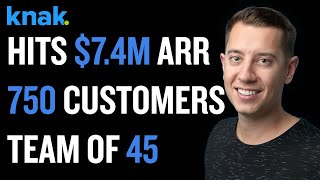
| 2021 | Knak Hit $7.4m revenue in November 2021 | |
| 2020 | Knak Hit $3.9m revenue in December 2020 | |
| 2018 | Knak Hit $2.1m revenue in September 2018 | |
| 2016 | Knak Hit $850k revenue in June 2016 | |
| 2015 | Knak Hit $400k revenue in June 2015 | |
| 2015 | Launched with $0 revenue |
The company operated a freemium model for approximately one to one and a half years before concluding it produced high churn and was not a path to scale. After pivoting to an enterprise sales model anchored at $10,000 per year, growth accelerated. Knak now offers its original template product for free as a top-of-funnel tool, converting users into its paid solo and enterprise tiers. Ujjainwalla confirmed net dollar retention above 100 percent, driven by expansion within accounts as individual teams roll out the product to broader global organizations.
Applying the stated trailing growth rate of 100 percent as a ceiling and a deceleration-adjusted rate as a floor, GetLatka estimates Knak's 2022 revenue will be in the range of roughly 1.5 to 2 times its 2021 revenue. This is a GetLatka estimate based solely on the 100 percent year-over-year growth rate Ujjainwalla stated; Knak has not disclosed an absolute revenue base, so the estimate carries significant uncertainty.
Founder / CEO
Pierce Ujjainwalla
CEO
Pierce Ujjainwalla, 36 at the time of the December 2021 interview, is the CEO and founder of Knak. He founded the company in 2015 after a career that included roles at IBM, SAP, and Marketo. Knak has two additional co-founders who joined later: the first in 2017 and the second in 2018. Because Ujjainwalla founded the company before his co-founders joined, he holds a larger equity stake than an even three-way split would imply. The names and current titles of the two co-founders were not disclosed in the interview.
Ujjainwalla also founded RevenuePulse, a marketing operations consultancy, which he describes as his first business. He hired Joe Peters as CEO of RevenuePulse to run it day to day, allowing Ujjainwalla to focus on Knak. RevenuePulse continues to grow and serves as a channel for identifying opportunities in the marketing operations community that Knak sells into.
Ujjainwalla said he has more than 10 percent of his net worth allocated to crypto, specifically citing Bitcoin and Ethereum. A net worth figure was not discussed, and GetLatka does not have sufficient data to estimate one. He said he follows Michael Saylor and recently read a book about James Dyson.
Q&A
| Question | Answer |
|---|---|
| What's your age? | 39 |
| Favorite online tool? | - |
| Favorite book? | - |
| Favorite CEO? | - |
| Advice for 20 year old self | - |
Customers
Knak had approximately 600 customers as of December 2020. As of December 2021, Ujjainwalla declined to give a specific customer count, saying only that the company has hundreds of customers and thousands of users worldwide. He confirmed the company is replacing the status quo 95 percent of the time when it competes for a deal.
Knak's pricing is seat-based on an annual subscription. The starter plan for a single individual is $5, the solo plan is $10,000 per year, and the enterprise plan covers 5 to 1,000 users. The company's sweet spot is billion-dollar-plus enterprises with hundreds or thousands of marketers spread globally. Ujjainwalla noted that a typical enterprise sale might begin with one team of roughly 10 people in one location and then expand to hundreds or thousands of users across the global organization. The free Knak Templates product serves as a top-of-funnel acquisition tool, with users migrating to paid tiers after experiencing the limitations of template-based email creation.
Knak serves 750 customers.
Knak Business Model
Knak generates revenue through seat-based annual subscriptions. The core paid product starts at $10,000 per year for a single user and scales to enterprise contracts covering 5 to 1,000 users. The company also offers a free tier, Knak Templates, which replaced the original $99-per-month plan and is used as a top-of-funnel conversion mechanism rather than a revenue source.
Net dollar retention is confirmed above 100 percent, driven by account expansion as enterprise customers roll the product out from one regional team to global organizations. Ujjainwalla said one quota-carrying sales representative handles all new sales, down from two the prior year after one departed over the summer of 2021. A team of five customer success managers handles upsells and account expansion. Profitability was not discussed in the interview beyond Ujjainwalla's statement that Knak proved it could build a good profitable business before raising, which he offered as context for the secondary component of the Series A.
Ujjainwalla described the addressable market as more than one billion dollars and said Knak holds less than 1 percent market share as of 2021. Gross margin, burn rate, runway, CAC, LTV, and churn rates were not disclosed in the interview.
Point-in-time figures shared on the GetLatka podcast, each linked to the exact moment it was said on camera.
Net dollar retention (2021)
100%
“Nathan Latka: Is all this code word for your guys' net dollar retention as well above 100%? Pierce Ujjainwalla: I can confirm it's over 100%.”
WatchKnak Employees & Team Size
Knak had 45 employees as of December 2021. The company planned to hire 50 additional people following the close of its $25 million Series A, which would roughly double the team. Ujjainwalla cited preserving Knak's culture as his primary concern during this rapid hiring phase, noting the company won a best places to work award in Ottawa and recorded an employee net promoter score of 85.
Knak employs approximately 72 people as of 2026, including 15 sales reps that carry a quota. It serves 750 customers that rely on its solutions.
| Year | Milestone | Source |
|---|---|---|
| 2024 | Reached 72 employees (October 2024) | |
| 2023 | Reached 72 employees (November 2023) | |
| 2023 | Reached 72 employees (October 2023) | |
| 2023 | Reached 94 employees (September 2023) | |
| 2023 | Reached 96 employees (January 2023) | |
| 2022 | Reached 80 employees (November 2022) | |
| 2022 | Reached 80 employees (January 2022) | |
| 2021 | Reached 45 employees (December 2021) | |
| 2020 | Reached 28 employees (December 2020) | |
| 2020 | Reached 28 employees (November 2020) | |
| 2019 | Reached 14 employees (June 2019) | |
| 2018 | Reached 9 employees (September 2018) |
Frequently Asked Questions about Knak
What is Knak's revenue?
Knak generates an estimated $18.3M in annual revenue.
Who founded Knak?
Knak was founded by Pierce Ujjainwalla.
Who is the CEO of Knak?
The CEO of Knak is Pierce Ujjainwalla.
How much funding does Knak have?
Knak raised $25M across 1 round.
How many employees does Knak have?
Knak has 72 employees.
Where is Knak headquarters?
Knak is headquartered in Ottawa, Ontario, Canada.
Compare Knak to the industry
Knak operates across multiple industries. Browse revenue, funding, and growth data for Knak in each sector below.
Full Interview Transcripts
Bootstrapper Does $25m Round with Secondary Building Future of Email Marketing for Enterprise TeamsDec 2, 2021
[00:00] Hey, folks. My guest today is Pierce Ujjainwalla. He's a career marketer who's lived in the marketing trenches of companies like IBM, SAP, and Marketo. He launched knak, that's k n a k, in 2015 as a platform designed to help marketers simplify email creation. He's also the founder of RevenuePulse, a marketing operations consultancy. Pierce, you ready to take us to the top? [00:19] >> Let's do it. [00:20] Alright. So you came on back in December last year, so about a year ago, and told me that knak had passed about 600 customers. Tell me more about growth today. Are you adding more customers, or are you expanding the historical ones? [00:33] >> Yeah. We have continued to grow our our business at, you know, over a 100% year over year. We were just named one of Canada's top growing companies where we posted over 500% revenue growth over the last three years. And so, yeah, we're we're growing within new accounts, within our existing accounts. We see a lot where we'll get into an account with, you know, one team there, and it grows globally across an enterprise. So lots of exciting [01:09] >> stuff happening. [01:10] And for the those folks that don't know knak or missed a worse interview together, what are these customers paying you for? Describe your product a bit. [01:17] >> Yeah. So knak is a codeless enterprise campaign creation platform. And so for everyone out there, you know, you all receive these beautiful marketing emails with the banners and buttons. Well, somebody is coding those most of the time. And an average marketing email is like 800 lines of code. And so marketers, well, they're not developers. They're marketers. And so what that means is that historically, they've had to work with developers or really expensive and slow agencies to [01:58] >> get this done. And with knak, well, we're giving them the power back to be able to do all of this themselves and really unlock the creativity that they got into marketing to do in the first place. [02:11] Mhmm. And it sounds like, again, folks are using it. You said a 100% year over year growth. Is that true of the customer base as well? So 600 customers a year ago means about, what, 1,200 now? [02:20] >> Yeah. So we don't disclose how many customers we have, but we do have hundreds of customers, thousands of users all over the world. And, yeah, I mean, we are replacing the status quo 95% of the time. And so, yeah, when customers [02:38] Pierce, what changed, man? I get before you raise, you're bootstrapped, you come on, you share your customer account. Now what your board says, Pierce, gotta be you gotta be more conservative. Be less fun on interviews. No more no more customer numbers. [02:50] >> No. I think you had speculated our customer number. I did a long time ago, but we've had a lot of changes with our business model. You know? Initially, like any founder, we went out with let let's do get as many customers as easily as possible. So it's $99 a month credit card, no sales calls. Now we've we've really shifted. And when we're working with these large enterprise customers, they want us to they wanna talk to a [03:23] >> salesperson. They wanna get comfortable. We have to go through procurement, security, all that fun stuff that you get to do with enterprise companies. [03:32] Well, last question on customer stuff. So, I mean, when you say hundreds and then thousands of users, so, I mean, do you think you can break a thousand actual paid customers next year, over the next twelve months? [03:43] >> So we're we are continuing to grow, you know, triple digit every year. We're really focused on helping all the marketers out there. That's why I'm so excited about our raise. You know? [03:57] So so, Pierce, if you grow a 100% over the next twelve months, you're basically saying if you keep on that growth trajectory, you'll break a thousand paying customers next year. [04:05] >> So we're all about getting every marketer to be able to unlock that creativity that they have within them. And that's why we're raising to be able to get to as many customers in this space. [04:19] You're raising again or you're talking about the raise you just completed? [04:22] >> No, no, the one that we just did. [04:24] Yep. So so you and and so let's jump into that then. Right? So you raised how much capital and is this your first tranche or have you raised prior? [04:31] >> Yeah. So we are proudly bootstrapped right up until our series a. We didn't raise any money before then. And we just announced the $25,000,000 series a with Insight Partners. [04:45] Why'd you do it, Pierce? I mean, you give up a lot. I mean, you just give up a lot. Right? And going from bootstrap to raid. And this wasn't a little raids. This was like, you're definitely on the VC track now. You have to make it work. [04:56] >> Yeah. You know, like I said, we're proudly bootstrapped up into the race. And we had our year end in the summertime this year. And we looked at, hey, what do we wanna do to continue growing the business and grow it as fast as we can? I'm a very conservative person by nature. And, you know, I think that's how we got here boot strapping. We didn't have to raise, but we we identified about 50 people that we [05:26] >> wanted to hire on our team to accelerate growth. And if we continue to bootstrap and do it that way, it would have taken a lot longer. And we all know with technology, time is of the essence than we felt like, hey, you know, the capital markets are great right now. It's very founder friendly, and we're able to find a great partner like Insight who can give us a lot more than just the capital. They have a [05:55] >> huge network, great centers of excellence around scaling out software teams that are our size. And it felt like a great opportunity that we can say no to. [06:06] What's team size today, Pierce? [06:09] >> We are currently 45 people. [06:13] 45. Great. Well, it sounds like some aggressive hiring plans. Now, most founders, especially going out doing like a first raise like this at this size, like this pattern, if you're picking insight, many founders will pick insight because insight many times will let founders take secondaries, especially if the founders are early employees or early investors, angels, etcetera, have been slicking away at it for a long time. You guys were launched, I believe in 2015, right? So you've [06:34] been at it for six, seven years. Was all that 25,000,000 going directly on the balance sheet or were you able to create some liquidity for early employees, you know, founders, etcetera? [06:44] >> Yeah. We definitely took out some secondary. Think to your point, you know, we we proved that we could build a good profitable business, and it felt like a good opportunity to take some of the chips off the table. Not just me, but I also felt like it was important and fair to let everybody in the company who had vested options the opportunity to sell as much as they wanted to. I have to say it was a [07:12] >> pretty emotional moment for me when, like, the majority of our team didn't sell anything because they believe so much in our mission and what we can do in our future here at knak. [07:26] Did you recommend they take some off the table to do things like buy a home, buy a car, start a family, pay off student debt, like life stuff? [07:34] >> I I definitely encourage them to do that. I I told them that I'm gonna personally be doing that and that, you know, it's fully their decision. And I think, yeah, that was something that that really did get me emotional was just that, you know, they had the opportunity to to really take chips off the table and make a good amount of money, but, you know, they're in it for the long haul, and I think they see [08:02] >> the potential that we have ahead of us. [08:05] How much of the 25,000,000 would you and Insight you would have been comfortable letting go to secondary? Obviously, it did not do that because people chose not to sell, but what was the maximum that you guys were comfortable with? [08:16] >> That I I that's something that I I can't disclose, but I will say that in talking to a lot of investors, and I think this is where where, you know, other founders who are out there thinking about this, the market has changed. Right? It's no longer that secondary is kind of, like, looked down upon. For us, it was something we always wanted to go into this deal with. It wasn't an option. We put that on the [08:43] >> table to every investor, and none of them had any issues with what we're looking at. [08:49] What did you say when you were kicking off the process? Did you phrase that as something like, we wanna take at least 5,000,000 off the table, or we want at least 10% of the round to be secondary? Did you phrase it as a flat number or a percentage? Like, how did you set the early expectations for this? [09:03] >> Yeah. We had a percentage and a number. [09:07] Okay. So what if only one of those things hit? So what if what if you said 10%, but then the round was only 10,000,000, so you only had a million for secondary versus, you know, five, you know, you wanna take 5,000,000 [09:16] >> off Well, that were they were together. Like, yeah, it was it was a number that was the percentage that we were looking for. [09:23] Okay. Got it. So so by default, when you put those two things together, you can back into what the round size would need to be in order to hit both the percentage and the flat number. [09:32] >> Yep. [09:32] Was insight the highest valuation or did you not optimize for valuation? [09:38] >> Listen, I think there's a lot of companies out there right now, a lot of firms that will give you the highest valuation. But what we found is that those firms are really just about the capital. Right? They don't come with all of the resources that an insight does. So, of course, valuation is important and an insight was close to the top. But we looked at the full package. Right? Like I said before, we're looking to me, [10:10] >> like half of the value is working with a firm that's done this hundreds of times and has the resources to help you grow. Mhmm. [10:20] And and help me understand sort of where this came in. Right? So most people when they're doing a series a, I would say industry standards, you're selling somewhere between sort of 10 to 20% of the business. Did you fall into that same average or were you on an extreme for some reason? [10:33] >> Yeah. Again, I can't disclose the valuation, but I will say that, like I said before, the market right now is very founder friendly, and we were very happy with the dilution that we're able to achieve on this round and our valuation. [10:51] Pierce, it's really important for my listeners to try and understand things that they should negotiate for when they go into their rounds. And so you providing any kind of range is helpful. I didn't ask you name the valuation because I know you can't disclose that, but can you can provide some sort of range for my audience? I mean, 10 to 20%, again, is pretty standard here. [11:07] >> Yeah. Yeah. To me, if you're giving up more than 20% equity in a series a, like everyone's different. But personally, I would never do that. [11:17] Yep. Yep. Okay. Cool. That makes sense. Yeah. You were seeing, you know, Chili Piper just sold 7,000,000 secondary at a 625,000,000 valuation with 15,000,000 in revenue. But that's very different than what Lemlist just did, which was sell 30,000,000 for 20% of the business at 150,000,000 valuation with 10,000,000 revenue. Very different multiple profiles there, but obviously both included secondary. So cool, that makes sense to you. And were you able to make this decision yourself, or did you [11:39] have a bunch of co founders you had to get get everyone on the same page and agree with? [11:43] >> So I do have two other co founders that were were really aligned as a leadership team, and we all felt like this is the right thing to do for the business. Mhmm. [11:53] And did you guys when you launched back in 2015, you had a consultancy, how you think you brought in. I don't know, like, if someone put up more money for the MVP or stuff, or did you guys just split it evenly right at the beginning in 2015 or no? [12:06] >> So so I yeah. So I actually founded the company in 2015, and then my co founders came on later, like, seventeen, twenty eighteen. [12:16] I see. Got it. Got it. Got it. So you obviously own more than it wasn't even split. [12:22] >> Right. [12:23] Tell me more about how the agency plays into this. You still put that in your bio, which means it's still important to you. At least your PR people put it in your bio for this interview. So help me understand how the agency plays in here. [12:33] >> Yeah. Revenue Pulse is the first business that I started. I think all entrepreneurs know that there's kind of a special attachment to that. I realized a couple of years ago that really my focus was on knak, and that's what got me out of bed every day and got me super energized. So I hired an amazing CEO, Joe Peters, to run the RevenuePulse business for me. RevenuePulse continues to grow every year, and it's a great way that [13:04] >> consultancy is where we keep our pulse on what is happening in the marketing operations community, which is who we sell into at knak every day. So there's a lot of synergy between the two companies, both revenue pulse identifying new opportunities for knak and knak opportune identifying opportunities the other way for services. [13:30] Mhmm. Tell me more about like the typical kind of customer. You mentioned early on price plans are $99 a month, no touch, right? Sign up with a credit I imagine price points like your average ARPU has increased since then. I think last episode you said you were much closer to like a thousand bucks a month was sort of your sweet spot. [13:48] >> Yeah. So prices continue to to go up. I think we're really focused on the enterprise. So the typical customer that works with us, I think our sweet spot, you know, that these are billion dollar plus a year companies. They have marketers spread across the globe, hundreds or thousands of marketers. And they really need the collaboration capabilities that knak provides, the brand control, the ease of use, and the ability to empower all of their marketers to be [14:24] >> creative and and integrate seamlessly into their marketing automation platform. So we continue to work with a lot of Marketo customers, Eloqua, Responsys, Marketing Cloud, Pardot. All of those marketers need our help. [14:42] You have knak templates, which are free. That's sort of your top of funnel, helps maybe make CAC more efficient. You then have to work hard both in product and your sales team to move them into knak solo, which is a $10,000 a year commitment. Free to 10,000 a year is obviously a big move. What sorts of things do you do in between those two plans to make sure people move up? [15:02] >> Yeah. Again, our goal is really to help marketers. And a lot of marketers are still in the mindset that they need a template. Templates are kind of the old way of how marketers used to accomplish creating an email or a landing page. So that was our initial product, Nathan. That that was the one that we used to sell for $99 a month. We are giving that away now because, again, we want to position knak as the [15:32] >> company that is there to help marketers no matter where they are on their journey. I think what we see is once those marketers use the templates and realize really the the pitfalls of using templates, how they're slow and rigid and hard to change, that's when they open their mind to like, hey, actually do need a better way of of creating a campaign. And they naturally look to knak, solo or enterprise to get that done. [16:06] Mhmm. And and were you able to ride that $99 a month plan? I'm I'm trying to figure out what took you to your first million dollar in revenue and what year that was. I mean, was that like 2016, 2017? [16:16] >> Yeah. So the $99 a month plan was so important for us. Like, that is really how we learned how to onboard customers. Right? When you're in that freemium model, you need to know everything about how your product works, where people can get stuck, how you upsell them, how you get their feedback. And that is really what has helped us grow this whole time. And by listening to our customers, that's how we identified the opportunity to build [16:49] >> this new product, this product that, you know, has way bigger potential. We think we're in a more than a billion dollar market here, and we have less than 1% market share. Right? [17:03] Pierce, So you're killing me, man. So so so were you able to use $99 a month to break that million dollar run rate in, like, 2016, 2017? I'm just trying to get a sense of what you looked like when you broke a million. [17:13] >> We didn't we didn't get to a million on the $99 a month plan. We only got there after we pivoted to sales procurement, that whole process. [17:25] And that was in 2018? [17:28] >> Don't know the date off off the top of my head. [17:31] Which year did you break a million dollar run rate? [17:35] >> Again, I we don't disclose that. [17:38] Pierce, this was years ago. Come on, man. You're making this very, very difficult on me. I people people like to understand the playbook zero to a million and then a million plus, and then now you're not bootstrapped and moving into VC. You gotta be able to give me some number here. Yeah. [17:50] >> No. I I think the way you get to a million is you have to continue to listen to your customers and figure out you know, look at your trends. Right? If you're [18:02] Pierce, what year was that for you for knak? We want we wanna use numbers and then tie that to the tactics that you're communicating now. I mean, was that 2016, 2017 somewhere in there? [18:10] >> Yeah. Yeah. You know, you were I I do wanna help your listeners get to a million, and I'm trying to give some some examples of how to do that and how we got there. I think what we realized was that that freemium model wasn't gonna do it for us. It was really high churn. You have to realize your churn numbers. Right? How are you gonna get people to stay in your platform and how are you gonna [18:38] >> build a scalable business for us? [18:40] So how many years did learn that, How long did it take you to learn that? There's people listening right now maybe doing the same thing going, do I need to test this for a year, two years, three years? [18:48] >> I think we realized the freemium model wasn't gonna get us to where we needed to probably within a year, year and a half. [18:57] Okay. So by '20 mid twenty sixteen, you were thinking, what did a sales motion look like, and how do I think about a higher price plan? [19:03] >> Yeah. Well, and I think what we what we learned again was that templates were not sticky. Right? And they were flawed still. That was the biggest learning that we had was we realized we're solving one part of our customer's issue, the marketer's issue, with the coding of the templates. But there were so many issues around that that we needed to really build a new product that would address all of those. So brand control, collaboration, integration with [19:39] >> the marketing automation platforms, all of flexibility and the creativity component were huge. And that's what fueled a much, you know, stronger growth trajectory. [19:53] Pierce, this makes a lot of sense. What are you most nervous about right now? You just brought in money. You have you have, we will call it a VC sugar daddy now. Right? Board meetings coming up. What are you nervous about? [20:04] >> Yeah. I think as we grow, and I mentioned we wanna hire 50 people, one of our secret weapons that I think we have here at knak is our culture. It's amazing. You know, everybody loves coming to work. We just won best places to work in Ottawa. Our employee, ENPS, is, like, off the charts. I think it was 85 last time we did it. And so we're we're growing quickly. We're hiring 50 people. We're doubling the team. [20:34] >> I wanna make sure that we're able to, you know, grow this culture into something really positive as we continue to grow the company. And I'd say that's something that's top of mind for me. [20:47] Alright. Love that. And then real quick, round out the sales motion. You mentioned that this is critical to the ultimate success moving away from templates. How many, like, quota carrying sales reps do you have today? [20:57] >> Yeah. I mean, this is another beautiful part of this business is right now we only have one quota carrying rep. [21:05] That's down from a year ago. You had told me you had three. [21:10] >> Well, we had two. We lost one over the summer. We're rehiring. But we've continued to double you know, triple digit growth of our revenue every year, and I think that just speaks to the need for a solution like knak in the market. [21:28] Does that one sales rep talk to every single person that upgrades to the $10,000 per year plan, or do you have people that never touch your support or sales reps that go from 0 to $10,000 a year? [21:38] >> We have a big CSM team and account management team that is is working on the upsells and account expansion. But our RA currently touches all of our new sales. [21:52] Wow. Okay. How many are on the CSS team CSM team? [21:57] >> So I think we have five CSMs now. [22:00] Should I ask more questions there? Are you doing something unique there? Is it pretty standard playbook? [22:05] >> I think, again, it just speaks to when we get knak when we get our customers using knak, they realize how this can transform their marketing department and how this can help them go way faster and way cheaper than ever before. And so there's a lot of organic growth that that is happening there. [22:29] You're talking about expansion revenue. They go from 10,000 a year to 20,000 a year in their first 24 [22:35] >> Oh, yeah. A lot of our customers like, keep in mind, we're selling to the enterprise. Right? So we might get one group at a company, maybe it's 10 people who try it in one location. And then their global team says, what are you guys doing over there? That's pretty cool. Let's now roll it out to the whole company. Now we have a 100 or 500 users. And so that's that's really how it's growing. [23:02] Yeah. And is that I mean, that is the thing you put at the top of your pricing page. Individuals, one user is knak knak starter is five, and enterprise is five to a thousand users. Is that your most powerful upsell mechanism? It's the number of seats? [23:14] >> Yeah. So our pricing model is yeah. It's very simple. Right? It's just how many how many people are gonna be creating assets within knak. [23:25] That's more powerful though than your feature based upselling, like built in workflows on your enterprise plan or customizing user access roles and permissions? [23:34] >> It really depends on the company. So the smaller companies, we find they just don't even need those necessarily need all of the features in the enterprise plan. Mhmm. Whereas big companies, they need all of that stuff. So it's usually kind of a combination of both features. [23:55] Is all this sort of is all this code word for your guys'net dollar retention as well above a 100%? [24:02] >> I can confirm it's over a 100%. [24:05] Boom. But hey, we got a number. Give this guy a little little thumbs up on iTunes or YouTube. [24:10] >> Give me something, Nathan. [24:12] Hey, gotta give me something to work. I look. I kinda got the million dollar run rate in like 2016, twenty seventeen ish. I got a 100% or a dollar retention. I mean, this is nice growth. Couple 100 customers, but not a thousand but your free plan is driving a lot of new users because it's free obviously, but not a good product because it's not sticky, but again, helps your CSM team expand folks. So makes a lot [24:29] of sense here. I know we're over time here. So let's wrap up with the famous five. Number one, favorite business book. [24:35] >> What's one that I just read? [24:41] >> Yeah. [24:44] >> One that I just read well, actually, I just read the bucket with Dyson. So the guy who started Dyson vacuums, which is interesting. [24:54] Number two, is there a CEO you're following or studying? [24:58] >> I'm loving Michael Saylor right now. I'm a big Bitcoin person, and I think he just sees the future in ways that other people can't. [25:08] What percent of your total net worth right now do you have at today's prices exposed to, Bitcoin and ETH or some form of crypto? [25:15] >> Over, [25:18] >> let let's say a sizable amount, but more than 10%. [25:22] Okay. I was I was waiting for you to go, like, 70%. I was gonna go, what? Alright. More than 10. [25:28] >> Number three, what's your favorite online tool for building a knak? [25:33] >> Can I say knak? [25:35] No. [25:35] >> You can't [25:35] >> Can't say knak. [25:37] Says the says the marker of cover. [25:39] >> Yeah. Let's say, hey. You know, we can run our business without Slack, and they're great customer verse. [25:47] Number four. How many hours of sleep do you get every night? [25:52] >> Seven to eight. [25:54] Okay. And situation, married, single kiddos? [25:57] >> Married with a with a four and a six year old. [26:02] Oh my god. Busy guy. Alright. How old are you, Pierce? [26:05] >> 36. [26:06] 36. [26:08] >> Gave you another number. [26:09] I know. I'm getting all of these. I I just gotta ask the family question numbers. That's how I do this. Alright. Last question. Take us home. Something you wish you knew when you were 20. [26:17] >> Yeah. I think the older I get, the more I look at going for the long game. And that's something that I feel when I was younger, it was kind of much shorter term thinking. It's you have to be confident, stay focused, and keep your eye on the long game and good things happen. [26:39] Guys, we're having a knak launch in 2015 off the back of a marketing agency. They now help enterprise brands do email much faster, much better. Marketing teams don't have to rely on their development teams to get things out the door. They're upselling like crazy over 100% net dollar retention, mainly focused on enterprises with more than 50 seats. Launched in 2015, just did a 25,000,000 round. Pierce feels selling to 10% to 20% of business is really what [27:00] you should target in this sort of range. Anything above that feels a little uncomfortable. 45 on the team, hiring fast up there in Ottawa. Pierce, thanks for taking us to the top. [27:08] >> Thank you, Nathan. That was fun. [27:12] One more thing before you go. We have a brand new show every Thursday at 1PM Central. It's called Shark Tank for SaaS. We call it deal or bust. One founder comes on, three hungry buyers, they try and do a deal live and the founder shares back end dashboards, their expenses, their revenue, ARPU CAC, LTV, you name it, they share it and the buyers try and make a deal live. It is fun to watch every Thursday 1PM [27:37] Central. Additionally, remember these recorded founder interviews go live. We release them here on YouTube every day at 2PM Central. Make sure you don't miss any of that, make sure you click the subscribe button below here on YouTube, the big red button and then click the little bell notification to make sure you get notifications when we do go live. I wouldn't want you to miss breaking news in the SaaS world, whether it's an acquisition, a big fundraise, [28:00] a big sale, a big profitability statement or something else. I don't want you to miss it. Additionally, if you want to take this conversation deeper and further, we have by far the largest private Slack community for B2B SaaS founders. You want to get in there. We've probably talked about your tool if you're running a company or your firm if you're investing. You can go in there and quickly search and see what people are saying. Sign up [28:21] for that at nathanlatka.com slack. In the meantime, I'm hanging out with you here on YouTube. I'll be in the comments for the next thirty minutes. Feel free to let me know what you thought about this episode. If you enjoyed it, click the thumbs up. We get a lot of haters that are mad at how aggressive I am on these shows, but I do it so that we can all learn. We have to counter those people. We [28:41] got to push them away. Click the thumbs up below to counter them and know that I appreciate your guys'support. Alright, I'll be in the comments. [28:47] See you.
Knak CEO Pierce Ujjainwalla: How $2m+ Enterprise Email SaaS Tool Plans To Survive COVIDDec 6, 2020
you're gonna love this interview just got done editing it i'm glad i got it live for you i'll be in the comments for the next 30 minutes hanging out answering any questions you have in fact leave a comment below about data points or what you think is going to happen to the company and i will respond to every comment additionally if you're just loving the content click the thumbs up and i will go and check out your profile as well and give your videos some love as well in the meantime enjoy the interview hello everyone my guest today is pierce eugene walla he is the ceo and founder of a company called nac an enterprise email creation software for teams knack's the first platform to help enterprise folks do this empowering marketers writers and designers to collaborate and create beautiful responsive on-brand emails quickly with no coding required pierce you're ready to take us to the top let's do it all right so people are going to hear enterprise email and go no there are plenty of companies that help brands send out you know enterprises send out mass email how are you different yeah i mean my background is really on the marketo side of things you know one of the biggest marketing automation platforms serving a lot of enterprise companies and i had a consultancy that did a lot of professional services in this space and every customer we worked with had the same issue around this problem um so when we started knack it was really about helping marketo customers with it but the more we got into it we realized this is a way more widespread issue than just mercado when did you launch the company uh five years ago we actually just had our fifth anniversary oh congratulations yeah and you came on you came on actually back in september of 2018 and shared that you guys were you know flirting with 600 customers 500 rpo about a 3 million ish run rate right yeah that was that was your best estimation and uh yeah yeah wait so where um are you exclusively growing based off the market integration like are you have you dedicated yourself and kind of gone all in on one channel uh so in the past since we last spoke really we've been looking at diversifying our revenue and really looking to be make mac that platform agnostic platform so a lot of our growth is actually coming from other marketing automation platforms other tools that our enterprise customers use to communicate with their prospects and customers can you name it can you name a couple of those so what else for sure so uh we're seeing growth uh salesforce marketing cloud par dot uh oracle responses and then we're also just discovering all these new platforms a lot of in-house platforms that our enterprise customers work with very good and are you uh are you still serving out 600 customers has that grown significantly so when we last spoke we kind of were in the middle of transitioning to become more of an enterprise focused platform when we last spoke we still had like a 99 per month a credit card product as well so i'd actually say we've we have have less customers than we did before but our asp has gone way through the roof right so um we have grown a hundred percent year over year since we last spoke but really taking more of that enterprise focus and expanding our business that way okay so how how many smaller customers have you let turn off like are you down to like 100 customers now today yeah so i mean that was the other thing was that those 99 a month customers what we learned took a lot of support uh churned very quickly whereas our enterprise customers we've got net revenue churn of under two percent now so so yeah so we you know we were happy to kind of not lose customers but really focus on that enterprise space where i think we can add the most value yeah well pierce just because the reason i'm pushing on these numbers is this is something that i think actually more people should do they test a more freemium approach like 99 bucks free to 99 bucks a month they get a thousand customers and they don't have the courage to say this isn't economically viable we need to turn some of these folks off and move enterprise quadruple price points and churn their customers it's back down so what is that updated number like is it about 100 customers now today or less i mean what's that number today yeah i mean first and it's a great point right when it when it's very attractive to have a 99 a month credit card product where people can just put in a credit card they don't have to talk to sales it's a very quick sale and not a lot of effort right but the issue with those types of customers is that just as easily as they came onto your platform they're gonna get off it as well so what we realized especially as a bootstrap company was that we need to focus on our customers who we can add the most value to who are going to pay us for that value that we're able to give them so i can tell you we definitely lost a lot of customers right well there's what's a lot though i'm agreeing with your strategy i'm trying to get to like an actual number so we still are in the hundreds of customers okay so that's what i can tell you okay it's not 600 anymore yeah it's significantly less than that but but north of 100 yeah yeah absolutely and your asp has grown so let me ask you a question one of the big challenges with sas seos when they do this transition is they don't know how to communicate the price changes to their older grandfathered cheaper accounts so how did you approach that did you make people either decide to leave or upgrade to your new pricing or did you grandfather them at 99 bucks a month yeah i think the only reason we got to where we are today is because of those initial customers who trusted us with our business from the beginning what was really important to us was those customers who allowed us to get here that we took care of them and that we gave them a way to either join us on our kind of new mission in which case we did grandfather a lot of our initial customers on or some people simply said yeah you know what you know we're we're gonna opt out to that which we totally respect and we still thank them for their business to help but that's okay then that's not good though right so if you told them they could have stayed on your platform without paying the new pricing and hundreds of them turned off that's not a good sign if you didn't force them into the higher price point and they said even if you give us the 99 bucks a month still we don't want to continue that's not a good sign sorry let me clarify that any of our customers who wanted to stay with us with what they were paying us are still doing that right the ones who churned off um were more of our one time we used to have like one time payment customers or 99 a month customers uh in order to get on to our new product there was in some cases uh a price increase or you know they felt like hey we have all the templates we need now we're good so we recognize we're gonna lose some customers and we're hot you know we recognize this is the future of knack and what we wanted to do okay so so it's fair then if you update now today you take your grandfather customers post your new customers your new price points etc you're saying your asp is significantly north of 99 per month at this point yeah well last time we spoke we said our asp was 6 000 a year okay so 500 a month and yes i can confirm that our our asp is significantly higher than that which is what's allowing us to grow it 100 year-over-year significantly i mean is it fair to say it's more than double that yeah you know i wish i could share exactly what that is with you but uh you know i'll let you come up with your own estimations well i don't wanna i mean if if i wasn't going with my own estimations i would just do the podcast without you being on it uh that would be a lot of fun me talking to myself but the point the point being here like you've made a strategic decision not to put pricing on your pricing page which drives some people crazy but for you and from the sas ceo watching it's also great leverage because you funnel those leads to your sales team and they can work up a custom plan and if someone's willing to pay more money for the value you provide then you get more money paid to you right so so how do you handle that how many how many sales reps do you have right now uh yes so up until two months ago we've been a hundred percent inbound so everyone that we've sold to has come to us through our website uh in an inbound manner so up until a couple months ago we hired our first outbound rep so we have three sales reps right now and they all carry a quota yep okay and and what percent of the total team is at how many total people on the team uh so we have 25 people on the team okay okay so three three quarter carrying books and how many engineers uh our dev team is uh about eight people okay and so so let's shift now to like current day you can't do an interview like this today and not talk about the recession right the virus is impacting everybody right uh you're based i believe up in canada how is this impacting are you seeing a churn spike uh no so we haven't i think we're very fortunate in the sense that you know if you look at what companies typically dedicate their marketing budget do a huge amount of that is going to be in-person physical events or traditions now with with kovid you know digital channels i think are becoming more important than ever before we actually looked at our platforms data last month and saw that we had double the amount of emails that have ever been built before month over month so i think it's early for us still uh it's it's have you seen anyone churn i mean has anyone emailed you and said hey we need to can you pause our account no not yet that's fine i mean yeah we're we're definitely trying to work with our customers on that so we're here to help them i think uh one thing that we're we've communicated to our customers is you know if they have any issues with their subscription moving forward or they need to kind of pause their subscription renewal uh discussion we're happy to discuss that but at this point no one has tuned because of this and now you're you're in a unique spot as well because you're bootstrapped you can should be bootstrapped today which means you've been operating a company at either breakeven or profitable already over the past five years correct yeah so it's not like you raised a bunch burns too high and now you have to cut a bunch to get back to profitability to survive something you're good in terms of surviving yeah we have it we have a lot of runway ahead of us um and i think what this has also showed us is how resilient a sas business can be as opposed to that kind of one-time payment business where you need those customers coming in all the time this has been an incredible advantage for us and those 25 team members are they all based up there in ontario with you uh so we have um most of them in ontario and then there's other remote employees across canada so all of us are in canada um but not everyone here in ottawa okay i see got it um and where so where do you think the next again considering a recession virus i mean where do you think how do you get your next million dollars in arr where's it come from yeah it's a great question i think one thing that that we really see as a company is that when we started this we thought hey this is a platform for marketers who are going to help build their communications but what we have realized over time is that this is actually a platform for everybody in a company that needs to send out on-brand communications and so i think there is a ton of potential in expanding that beyond that marketing department to you know in-house communications development communications partner communications sales communications like that there's so much more to go there and then we also do see you know a lot of growth potential in the platform expansion strategy which is something that we're doubling down on right now what does that mean platform expansion strategy well like we were just connecting to marketo last time we talked now right we want to be an agnostic platform that can support you no matter where you're sending your communications out from i'd see i see and is this i mean is this something you go out and do potentially raise capital for to drive extra growth or are you happy being bootstrapped uh we are still happy being bootstrapped i think canada has actually some amazing programs to help fund startup companies um irap is one of them so we're able to access capital that way with how do you spell that company uh i r ap okay is that the same as the shred financing similar so shred is more about getting money back from your r d spend whereas irap you can nominate specific projects that you're working on and they'll cover the development of this interesting so basically it sounds like irap is almost like pre-approved shred they'll confirm it's an r d events and pre-approve you for it yeah it's similar to that it's a it's a much more streamlined process um that's more of like a business focus with a specific business outcome that's come from it if you look at the past five years of the business in terms of how the canadian government has potentially helped fuel the development growth of knack i mean can you quantify how much money you've gotten back from the government you think it's more than a million uh so we we actually just started taking advantage of these programs last year so i think we've just scratched you know the tip of the iceberg on what they can help us with but it's an incredible program and i'd encourage other bootstrap companies in canada to train to you know leverage it to help them grow very good last question here what's the next big revenue goal you think even in a recession you guys can get up to five six million bucks in ar this year is that more of a stretch yeah i think you know i i've spoken with our team about what if we want to move the target that we had said for ourselves at the end of the year and you know fully putting it to them like hey i understand if we need to adjust this based on everything that's happening but what we're seeing in our pipeline and how we're seeing our deals close we're keeping that same number again and that's going to put us at again 100 year-over-year growth that's right what is that target i mean can you get i mean can you drive additional growth to get up to five six in a r this year or is that more of like a 2021 goal yeah like one of the things that happened to us during this coveid was that you know the adobe summit is our biggest uh marketing event of the year we put it's you know that's our super bowl for us and uh you know this year we don't get that we don't get to interact with our customers we don't get to see us see them and have that face time so to me that's really the biggest thing is you know is are we going to be able to replicate that virtually are we going to be able to change our marketing spend to enable us to continue to create that pipeline and based on what we're seeing so first flipping it to digital is that we're still having a lot of success driving new leads and pipeline guys those of you watching live this is one of the first times we're doing the one of the podcast live if you do have questions for peers she's the ceo of knack an enterprise email marketing solution but expanding quickly to be more of a platform play between 100 and 600 customers you have questions for them you can post them here on facebook i'll fire them at them as we're wrapping up here right when we uh when we wrap up here with the famous five pierce you ready to wrap up yeah sure man all right number one favorite business book well we did this last time i feel like i gotta switch it up now well yeah hopefully you're not reading the same book you were reading three years ago you're slow we got a slow reader on the show today guys i uh you know one thing for me is about building our team right now so i recently read who which is about a book about how to hire your players and that was incredible number two is there a ceo you're studying or looking at right now yeah i think um recently i've really been following the base camp guys so um jason and dhh yep number three what's your favorite online tool for building mac um i'm gonna go with salesforce number four how many hours you're sleeping every night try and get my full eight hours that's good and situation married single kids married two kids the two and a five-year-old and i'm shocked that we haven't heard them yet as i'd say all my podcast over the past like three or four days with everyone at home i've i've always had a kid running into like dad's arms on the show and covering his mouth that's kind of how it works all right so two and five and how old are you i just turned 35 35 last question what do you wish your 20 year old self knew um i wish my 20 year old self knew that it's not all about making money and it's actually about doing what you're passionate about with people that you enjoy doing that with guys there you have it pierce building knack.com founded back in 2015. they're now serving between 100 and 600 customers mainly more enterprise now than they were three or four years ago he's built this company completely bootstrapped with these uh customers paying anywhere between call at six thousand dollar acvs all the way up to way way north of that as they've moved more towards enterprise the virus is impacting them the adobe summit is really where they get a lot of their new customers connecting new customers that's obviously cancelled but they're still looking to scale their team of 25 people eight engineers three quota carrying reps again serving the enterprise space in the email marketing world hoping to expand more to a platform play pierce thanks for taking us to the top thank you nathan always a pleasure all right stay safe see you cheers you guys know i fight like heck to get these data points for you from these ceos that rarely do these kinds of shows if you want more shows like this make sure you subscribe right now we're trying to get 10 000 youtube subscribers by the end of september here 2019 and it would mean the world to me if you clicked now to subscribe additionally i've got two more great interviews for you if you want more data points from the world's leading sas ceos click and watch
Bootstrapped Enterprise Email Marketing Firm Breaks $3.6m ARR, 70% YoY GrowthSep 13, 2018
Nathan's introduction to today's show hello everyone my guest today is pierce eugene walla he started his career two company called cognos which went on to be acquired by IBM he didn't join two startups that both wanted to have successful exits where I let him implemented Marketo he then founded a revenue pulse a Marketo consultancy and nack a SAS application for enterprise email creation all right Pierce are you ready to take us to the top let's do it all right so tell me about the consultancy so are you still running the Marketo consultancy today yeah okay and so what does that look like how many Why they work with 40 to 50 active clients today in their agency clients what do you charge on average yes so we have at any given time around 40 to 50 active clients we work with some of mercado's largest clients and so you know these are companies where they're not really so concerned about the price more that they want to work with you know the best consultants in the business yep and how many people do you have on just the consulting team we're at 26 people now okay 20 is a pretty healthy and what was last 12 months revenue about we raised year-over-year revenue by 90 percent last year okay that's great and so again over the past twelve months about how much total revenue did you do yeah I mean we're private companies that we don't really release those numbers but fully bootstrap company and we're at 26 people okay obviously running it profitably since you're bootstrapped correct absolutely fair to say north of a million okay so why let me you know Ryan at HootSuite has it has a similar story it started off as a consultancy and one of the key decision points for him was wouldn't actually go fully into SAS you're kind of balancing both right now so why did you start you know coding you're the first application at all how'd you get the idea and when How he came up with the idea to transition to SaaS potentially do transition to full SAS yeah so you know with the revenue there is one particular project they were doing over and over for our clients and so we decided over time like hey let's just productize this and make it a better experience for the customer and that's really what led us so started knack and so what was that process yeah so we incorporated a new company we found new developers so brought on a new team essentially who could build out the application at first we started with a very basic platform you know MVP classic story where we built out what we thought our customers would need and started from there so it was initially a $99 per month credit card signup form you could do everything through our website and yeah we we had incredible attraction we kind of sponsored one main tradeshow and that's how we got the word of both businesses have really been a lot of word-of-mouth referral based pay period I mean before you get too far down this this track is we don't know what nack actually does what does not do okay sir so nack is an enterprise email creation Why they've developed knak. as an enterprise email optimizer platform so essentially we connect with Marketo and eloquent and we help their largest customers streamline the email creation for us those so can we think kind of email you know enterprise MailChimp built specifically for Marketo yeah I mean historically the big marketing automation platforms haven't really spent a lot of time on that asset creation part of it and so what we're trying to do is really build out a platform where when you have hundreds of users around the world trying to build out these emails and landing pages to give them the workflow the collaboration the approval and review processes that allows you to scale to creating you know thousands of marketing emails a month got it and now you know from the from your website in them what my research team told me when you've got kind of templates built in you know the builders are you just doing like the email templates and the email merge tags and How they've built out their entire process over time those things you know specific to regions are you also doing like landing pages and things like that [Music] yes so we we started off doing sort of templates that you would sink to your marketing automation platform and now we're doing the entire process you build that entire email with an AK and then you're using your marketing automation tool just to deploy it right now we do have email and landing page templates and we've got to have the enterprise version of that for emails only but our long-term goal is to be the platform that combines both emails and landing pages in one place and you mentioned you start off at a $99 a month price point it sounds like you maybe have run some experiments here what what's the average Chester paying you today per month Why the average customer is paying them around $6k annually significantly more than that so I would say sort of our self sign up business is about 20% of our revenue right now then we've got kind of a mid tier plan that's about six thousand a year that accounts for probably another thirty to forty percent and the restless' enterprise revenue so definitely we've seen and sort of through our experiments realized that hey if we really want to grow the business going to that enterprise market is what's going to allow us to do that okay I mean so is it fair to say if we look at your current customer base without going on every cohort a fare average might be that middle plan the average is call it six grand per year yes or about 500 a month probably about it okay and are you pulling that cash flow Ford or most these folks paying on a monthly basis so again yeah as we transition to sort of those higher ASP s we're pushing more for annual pricing right so pay for the entire year at once or do even multi year deals where it's an annual payment frequency what percent would you say of your new customers when you sign them up or say you know paying for the annual plan upfront versus paying monthly probably nine eighty ninety five so majority annual contracts yeah okay and they put all this on a timeline for us so when did you you know you know leave leave corporate and start doing your own thing what year was the consultancy launched yes so I started Revenue Paul six and a half years ago and then I started knack about three years after How they launched knak. in 2015 that's that's about three and a half years old okay so called 2015 yeah okay and and and what have you scaled to in terms of total customers on I just on knack let's ignore the consultancy moving forward so we've got over six Why more than 600 customers are using their software right now hundred customers on there okay and that's really healthy so how many of those have have come from the consultancy are most of them coming from they do consultancy first in software yeah there's definitely some overlap there most of our customers the knack find us organically you know through Google or through one of the marketing automation communities there is certainly overlap from both sides like some some clients will come in through neck and then it will work with them on the consulting side and vice versa yep and then look at $6,000 ASP on average divided by 12 to get monthly comes up to about 500 bucks a month and if I multiply that times obviously you're 600 customers that would put you at about 300 grand a month or about 3.6 million How they are close to $3.6M in ARR right now in terms of a r-run right is that fairly accurate today yeah I can we're private company so we don't what is that why this just to be clear Pierce I'm only multiplying numbers you gave me so I you just told me six on our customers and you just told me $6,000 ASP is average so are any of those two numbers you already gave me wrong yeah you know that would be roughly where we're at okay got it so so talk to me even about growth rate so if you're at call it you know three point six ish today where were you a year ago Why they are growing 70% year over year so yes growing at 70 percent you're okay so that's healthy so call maybe you know two million in terms of a our run rate twelve months ago now almost double that up to three point six ish something like that whereas most that growth come from same customers expanding or adding new customers so our biggest area for growth you know it's definitely our two new products so the the Builder and enterprise products that's where we're seeing higher aSG's much more upside and the ability to get you know more users so we have a user based pricing model on the filter and enterprise products so there's a lot more outside potential when we get into different customers thing and you've bootstrap an AK as well or know you've raised now this feed strip appears I like you even more this is great I love I love bootstrappers okay wonderful so bootstrap did is I also love I mean this is a pattern I see so many times of smart people leaving corporate starting an agency finding the same problem across many customers you know in their agency and saying we should just develop this they hire some developers they scale it up and before you know what they're doing 3.6 million bucks in ARR so what's the team right now in AK just only knack not the marketing consultants How they've grown knak. to 9 full-time employees isn't it yeah so nack we we basically are very heavy on the dev side so my personal belief is if you have a really good product you don't have to spend as much on sales and marketing and you don't need this big of team stuff over there so we are heavily focused on developing our products so we've got you know a head of development a couple of friend developers because we're in the email space that's obviously super important to us and we've got an email developer as well well so it's total team size yeah we're at nine people in Iowa and our most people are remote or they're all up there in Ottawa both companies they're fully remote fully remote I love that where did you first off is your background technical or business business okay so a lot of business founders they struggle making that first you know development hire where did you find your head of development or your first development hire so that was that's a tricky when I Why he's gone through a few technical leads initially and we've gone through a few okay so I think we're on our third you know how to development at this point and so initially was actually a friend of mine we kind of started things off things didn't work out what do they look like that was that like a consulting agreement or did you give him equity or what did that relationship look like I didn't know what I'm doing back then and I learned all through the process so feel like I got a business law degree as we run through that but yeah you know over time I've yes a business person learned so much of it what type of developer what's the relation should look like how do you set up a good employment contract oh yeah sorry Pearson this is like a very valuable lesson I would say 50% of my audience is gonna learn from this if you can give me a good answer here so like that first relationship you had was it like against like how did you structure that first engagement and what was wrong with it what was wrong with it was there wasn't enough structure because we're friends you know we we didn't do the paperwork the way that we should have when there was there no paperwork correct okay so it's kind of like a hey work this weekend on this scope I built on it in balsamic or Google's sketch and I'll pay you like 300 bucks for this weekend and they know it let's do it again next weekend and then before you know it you have revenue and you're like crap this is a real company now what so if they you know for the people that are listening I think it's absolutely critical no matter how good of a friend you are with somebody to get the proper legal advice as you start something even if you think it's not gonna go anywhere because when it does then you run into problems yeah yeah and this is never an issue if your idea sucks and tanks it's always an issue once the developer sees oh my gosh Pierce is making real revenue on this I've done all the code I should ask him for 20% of my company right and a real and a real thing so yeah when you took all the risk in the beginning cuz you were paying okay very good so and what have you transitioned to now I assume it's probably a standard employee agreement of the vesting schedule an all that jazz yeah absolutely yeah we we actually just put an employee stock option plan in place so you know it's something that we've always wanted to work towards and we want all over him of skin in the game with the companies so yeah so we're the develop the head of development Iran now where did you find How Pierce found his current head of development him or her yes so people that I had met around Ottawa before through through actually revenue palace clans we met some great development talent and our initial developer who developed a lot of the application not the friend relationship but we had another full-stack developer who developed on he introduced us to a lot of his network and that's how we found our current head of development okay take me back to the guy or gal you hired after your friend where did you find him somebody that I had known about in the Mercado community I didn't personally know him but I just reached out and LinkedIn and because we had very similar interests you know he came on board that was that was good Salesforce ended up poaching him from us so you know hard to compete with them yeah but yeah I current head of development is awesome and he's really aligned with the company goals and yeah I think it's it's the best fit you know you kind of learn over the years what you really need them I think we we've got our long term head of dub now good Why their churn varies based on the product talk to me about churn what's your turn today yes so as I mentioned we have three different products right templates builder and enterprise our template product I would say you know our churn is higher than I would like it to be but I think it's just the nature of that product it's a more transactional type where you can start it get your value and then you don't you know there isn't as much ongoing value that makes you hapy really instead of breaking down sorry and so everything on every because I'm sure you have a lot of different cohorts let's instead talk about a logo turn let's talk about revenue pterence when you'll get the whole the company as a whole like some products turned some but some expands so net net I mean our How they've gotten to net revenue retention north of 100 net or percent annually net were tension yeah yeah now in terms of revenue dad so just to be clear of everyone that signed up twelve months ago in January across all your products you take out all the ones that churned like today you take out other ones that churned then you add back all the expansion revenue and the expansion is more than making up for the lost revenue correct ignoring any new customers added yeah that's great that's really great and and where is most that expansion coming from like what pricing axes are you upselling on yeah the expansions coming from our builder and Enterprise Products that's you know in our opinion that's the future of email creation and so that's where people are naturally going now and and fully weighted what do you what are Why almost of their leads are coming through organic channels you paying to acquire one of these six thousand dollar per year customers we still do like no marketing we do a couple of trade shows that's all organic so our cost of customer acquisition that's pretty love that unless that first trade show you said you went to that you kind of used to launch what was that trade show how that was the market assignment okay I just could have guessed that and and would you pay to sponsor that ten twenty grand yeah that's like ten thousand yeah and you got that back in spades yeah that one that one was really good or way yeah there's rumor others obviously Marketo was taken private in 2016 by Vista partners there was rumors started actually yesterday that potentially Adobe is gonna be acquiring Do you think Adobe will acquire Marketo? Marketo do you think it happens I do you think one of the Giants will acquire Marketo at some point I'm not sure if it'll be Adobe but I think we will see some kind of consolidation happen yeah all right piers good stuff let's wrap up here with the famous five number one what's your favorite business book The Famous Five I'm Marcus God's dragon and number two is there a CEO you're following or studying right now I've got a save you on must number three is your what is your favorite online tool for building your business [Music] America Doe number four how many hours of sleep to get every night get seven or eight okay that's good and what's your situation married single kids married two kids kiddos and how old are you three and one year old and how are you I'm 33 33 last question what he was your 20 year old self now yeah I mean III think 20 years old I wish I knew that corporate America may not be everything it's cracked up to be corporate America ain't that great all the time folks coming from Pierce again did the whole corporate thing and then stopped in 2010 launched a consultancy has grown that to 20-plus people over million bucks and revenue and said he know what we're doing the same thing for multiple customers let's hire some developers he worked with a friend first and launched knack which is now scaling it has about nine people think you're like enterprise email marketing and landing page kind of automation they've bootstrapped the company serving 600 clients that pay on average six grand per year so about 3.6 million bucks run rank today going about 70 percent year-over-year so call it 2 million bucks and air are about a year ago in August 2017 economics look healthy most of the inbound most the customer position is organic or inbound you know spending almost basically zero bucks starting with a 10 thousand dollar sponsorship of Marketo conference many years ago over 100 percent net revenue or attention Pierce thank you for taking us to the top thank you thanks for having me
Data and Sources
All figures on this page are taken directly from interviews or are estimates from public sources and proprietary models. Not financial advice. Read full disclaimer.
Claim this profilePeople Also Viewed
Y42
Y42 is a Berlin-based all-in-one data platform founded in early 2020 by Hung Dang, a solo founder...
PlaceFirst
Placefirst is an innovative services and development business specializing in providing...
HIVE Diversity
HIVE Diversity provides a virtual recruiting platform that creates engagement between companies and...
Marketwake
Digital marketing agency providing data-driven services including marketing strategy, paid media...
Kaisa
We’re on a mission to personalize the buying experience. For everyone. High-consideration...
Nonprofit Megaphone
Company that helps over 600 nonprofit organizations to maximize the value of their Google and...