
Founder Interview
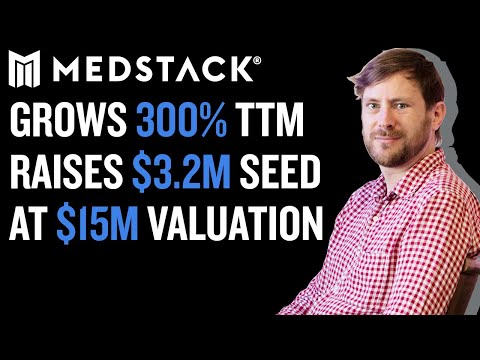
How MedStack Reached 90 Customers and Just Under $2M ARR After Closing a $3.1M Round (Interview with Co-Founder and CTO Simon Woodside)
- Interview Date
- November 9, 2021
- Interviewee
- Simon WoodsideCo-Founder and CTO
Company Metrics at Interview Time
Customers (2021)
90
ARR (2021)
Just under $2M
ARPU (2021)
$1,500-$2,000 per month
Latest Funding Round (2021)
$3.1M
Net Revenue Retention (2021)
110%
Team Size (2021)
15
Historical Snapshot
These numbers were reported by Simon Woodside during his interview with Nathan Latka in November 2021 and are a historical snapshot, not current figures. See MedStack’s current numbers.
Key Takeaways
- 01MedStack had approximately 90 customers as of November 2021
- 02Simon said MedStack was "just shy of 2,000,000 ARR" in November 2021, with a flat $2M ARR the year-end target rather than a number already hit
- 03Average revenue per customer was $1,500 to $2,000 per month (US dollars)
- 04The company completed a $3.1M funding round led by Blue Ventures and TELUS in 2021
- 05Net revenue retention was above 100% — Simon estimated 1.1 to 1.2 when pushed on a 140% benchmark
- 06The engineering team stood at 9 people, including co-founder Simon Woodside
- 07Total team size was 15 full-time employees
- 08MedStack was founded in 2015 by Simon Woodside and Balaji Gopalan, who is CEO while Simon is CTO
- 09The company previously raised a $2.4M seed round in 2019
- 10Named customers include Keriton (neonatal ICU) and Inkblot (digital therapy)
- 11Capital from the new round was being invested entirely into headcount, primarily engineering
Company Metrics at Time of Interview
| Metric | Value | Source |
|---|---|---|
| Customers (2021) | 90 | Founder interview, Nov 2021 |
| ARR (2021) | Just under $2M | Founder interview, Nov 2021 |
| ARPU (2021) | $1,500-$2,000 per month | Founder interview, Nov 2021 |
| Net Revenue Retention (2021) | 110% | Founder interview, Nov 2021 |
| Team Size (2021) | 15 | Founder interview, Nov 2021 |
| Engineers (2021) | 9 | Founder interview, Nov 2021 |
| Funding Round (2021) | $3.1M | Founder interview, Nov 2021 |
| Funding Round (2019) | $2.4M Seed | Founder interview, Nov 2021 |
| Year Founded | 2015 | Founder interview, Nov 2021 |
Growth Breakdown
Revenue
Simon Woodside confirmed MedStack was just shy of $2M ARR in November 2021, with the company expecting to hit $2M ARR by year end. Average revenue per customer ran $1,500 to $2,000 per month (US dollars) across approximately 90 customers.
Customers
MedStack served around 90 customers at the time of the interview. Named customers include Keriton, which operates in neonatal intensive care units, and Inkblot, a digital therapy platform that was acquired by insurance company Green Shield.
Team
The team had grown to 15 full-time employees, with 9 on the engineering team including Simon Woodside. The company was actively hiring additional engineers and planned to add a few more before year end.
Funding
MedStack completed a $3.1M funding round in 2021, led by Blue Ventures and TELUS, a major Canadian telecommunications and digital health operator. This followed a $2.4M seed round in 2019. Simon noted the company could have approached revenue neutrality without the raise but chose to invest in growth.
Growth Strategy
Serving Digital Health App Makers
Rather than selling directly to hospitals or insurance companies, MedStack targets digital health application developers who in turn sell to those larger institutions. This positions MedStack one step upstream and lets it scale across many end markets through a single customer type.
Trust as a Core Differentiator
Simon emphasized that MedStack's entire company functions as a security team. Firewalls are on by default and cannot be disabled, all communications are encrypted by default, and all customer data is backed up automatically. This approach helps MedStack customers pass lengthy compliance questionnaires from hospitals and insurers.
Strategic Investor Partnerships
MedStack chose investors for their strategic value, not just capital. TELUS brings deep connections in Canadian digital health and EMR markets, while the cybersecurity-focused co-lead investor adds credibility in a trust-sensitive industry. Simon noted these backers open doors and lend credibility.
Pricing Model Evolution
MedStack shifted to a SaaS tiered pricing model with a much smaller variable component, moving away from a more usage-heavy structure. This change, combined with existing customers growing on the platform, drove ARPU higher over time.
Multi-Cloud Expansion
A major engineering priority at the time of the interview was adding AWS support alongside the existing Azure focus. Simon described running 750 virtual machines and database instances on Azure and noted that expanding cloud support was one of the biggest near-term product pushes.
Best Quotes
“We definitely are dealing with hospitals and insurance companies, but they are at one removed from us. So our direct customers are digital health app makers, and then they, in turn, are selling to hospitals and insurance companies.”
“So the average is, there's definitely quite the range from small to large, but kind of like typically between, our average is gonna fall like 1,500 to 2,000 US dollars a month.”
“We've raised more. Yes. So we actually just completed a raise of 3,100,000. And so that was led by Blue Ventures and Telus, one of our previous investors as well. But, yeah, I mean, we're making good money as well. So, I mean, theoretically, we might have been able to go revenue positive, but, you know, we wanna grow.”
“It's all going into people.”
“So we're at nine on our engineering team today, including me, and we're still gonna add a couple more by the end of the year.”
“NRR is over 100. It's very good.”
“The business we're in is not currently like a sexy VC area. You know? It's like platforms were kind of super sexy, like maybe ten, five, ten years ago. Right now, it's not as much.”
“For MedStack, firewalls are on by default, and our customers can't turn them off. We encrypt all incoming communications. By default, you can't turn it off. We back up everything that our customers have and you can't turn it off.”
What Happened Next
This interview captured MedStack in November 2021, shortly after closing a $3.1M funding round and serving approximately 90 digital health customers. The figures Simon Woodside shared, including ARPU, team size, and net revenue retention, reflect the company at that specific point in time. MedStack has continued to operate in the digital health compliance and security platform space since then. Visit the MedStack company profile on GetLatka for current metrics and updated funding information.
View MedStack’s current profile and metricsFull Transcript
Chapters
- 0:00Introduction and MedStack Overview
- 0:22Who MedStack Serves: Digital Health App Makers
- 0:33Named Customers: Keriton and Inkblot
- 1:25Average Revenue Per Customer
- 1:42ARPU Growth and Pricing Model Changes
- 2:31Total Customer Count: Around 90
- 3:41Funding: $3.1M Round Led by Blue Ventures and TELUS
- 6:14Team Size and Hiring Plans
- 6:44Engineering Team: 9 People and Growing
- 7:39Net Revenue Retention Above 100%
- 8:25Choosing Strategic Investors Over Valuation
- 9:59Next Engineering Priorities: Multi-Cloud and Scalability
- 11:31Security Defaults That Differentiate MedStack
- 11:56Famous Five Rapid Fire Questions
Introduction and MedStack Overview
Nathan Latka
00:00Hey, folks. My guest today is Simon Woodside. He's the cofounder of medstack, which is helping secure platform for digital health. He's got a CS degree at the University of Waterloo and as part of the Apple core operating system group, engineering program manager. Before that, Simon, you ready to take you to the top?
Simon Woodside
00:14I am. Thank you, Nathan. All right.
Nathan Latka
00:16Tell us what medstack is. Are these hospitals that are paying you for HIPAA compliant solutions or where are you playing?
Who MedStack Serves: Digital Health App Makers
Simon Woodside
00:22We definitely are dealing with hospitals and insurance companies, but they are at one removed from us. So our direct customers are digital health app makers, and then they, in turn, are selling to hospitals and insurance companies.
Named Customers: Keriton and Inkblot
Nathan Latka
00:33So give me an example of a customer. Can you name one or two?
Simon Woodside
00:36Sure. I'll give you a couple. So one is a really cool company called Keriton, and they're in neonatal intensive care units, and they are operating a system that manages bottles of mother's milk, which is critical of these. Have to always go to the right person at the right time without too much delay. So that's a pretty mission critical system with a lot of availability requirements. And another really awesome customer is called Inkblot. They are doing digital
01:06health or sorry, They're doing digital health
01:11therapy. So it's like remote telemedicine, one on one with real people, psychological therapy, psychotherapy, and they're pretty big. They were just bought by an insurance company, Green Shield. So yeah.
Average Revenue Per Customer
Nathan Latka
01:25And Simon, what are these companies paying on average per month to use the technology?
Simon Woodside
01:30Yeah. So the average is, there's definitely quite the range from small to large, but kind of like typically between, our average is gonna fall like 1,500 to 2,000 US dollars a month.
ARPU Growth and Pricing Model Changes
Nathan Latka
01:42Okay. So that's up significantly since our last interview in April 2020, almost double the ARPU you told me back then. Are you moving upstream on purpose?
Simon Woodside
01:52Yeah. I mean, it's we're not no. So so we're not trying to exclude small companies. I would say we've had a lot of companies grow on the platform. We've had new companies join that are bigger. We have changed our pricing model. So we've moved to more of a SaaS pricing model where we have a base set of tiers, and then the variable component is much, much, much smaller. It's basically like, because we're hosting like we're a
02:19hosting platform, we just pass through the price of a virtual machine or a database instance. So, yeah, we've just adjusted our pricing, we've had a bunch of customers grow a lot too.
Total Customer Count: Around 90
Nathan Latka
02:31Understood. So how many total customers are you working with today?
Simon Woodside
02:34I think it's around 90.
Nathan Latka
02:3690. Okay. Yeah.
Simon Woodside
02:37You told me 70 about a year and a half ago.
Nathan Latka
02:38So you've added about, call it, ten, twenty more, which is great. And then can I mean, can I multiply those together? 90 times $2,000 a month. You guys are what? $180,000
Simon Woodside
02:46a month right now in revenue? That's about right. Yeah. We're just we're just shy of 2,000,000 ARR, so it's, like, probably a little bit less than that. But we'll we'll be hitting 2,000,000 ARR by the end of the year.
Nathan Latka
02:57I love stories like this. I don't know if you remember. You know, our first interview was back in the middle of twenty eighteen. Do you remember that?
Simon Woodside
03:02Well, so yeah. So you interviewed my my CEO, business partner, cofounder Balaji Yes. I think twice now. Right?
Nathan Latka
03:09Yes. Oh, okay. That was him, not Got it.
Simon Woodside
03:11It was him. Yeah. So I'm the CTO.
Nathan Latka
03:14Very cool.
Simon Woodside
03:14So, you know, I did I did get some of the numbers and make sure I had them right. But I'm more I'm more expert in other parts of the business.
Nathan Latka
03:21Well, just love I should have begged you to write a check back in 2018 because, Balaji, you shared back then you guys were doing about $30,000 a month in revenue. You're now five times as big here four years later. So this is a this is an exciting story. Now, Simon, have you been able to do this funded by customer growth after your 2,400,000 seed round in 2019, or did you raise more?
Funding: $3.1M Round Led by Blue Ventures and TELUS
Simon Woodside
03:41We've raised more. Yes. So we actually just completed a raise of 3,100,000. And
03:49so that was led by Blue Ventures and Telus, one of our previous investors as well. But, yeah, I mean, we're making good money as well. So, I mean, theoretically, we might have been able to go revenue positive, but, you know, we wanna grow. Like, we see a huge, huge, huge opportunity, like, you know, you say a billion dollar opportunity. Like, it's bigger than that. You know? And so we wanna continue to grow quickly, and that that
04:13meant you know? And we have some great and and, you know, some of investors are great partners as well, so they open doors for us.
Nathan Latka
04:18And you and you and Balaji are the two cofounders. Right? You just split fifty fifty at the start?
Simon Woodside
04:22So so I mean, obviously Yeah. Me and Balaji co founded the company, yeah, back in 2015.
Nathan Latka
04:262015. Okay. Yeah. So so, yeah, so so obviously just managing equity, right? I mean, you don't wanna take money unless you really have a good use for it to drive that growth because you two are both managing dilution. I mean, most people in their seed round are selling about 20% of the business. Is that sort of where you guys came at?
Simon Woodside
04:39I don't have the exact numbers. We've done well, though. Like, know, we're we're pretty much on target in terms of what you'd expect.
Nathan Latka
04:45Okay. So got it. You were right in that 20%. 20% range. Yeah.
Simon Woodside
04:48Yeah. Yeah. We're in that ballpark.
Nathan Latka
04:50Yeah. Yeah. Yeah. So,
Simon Woodside
04:54pre money. Yeah.
Nathan Latka
04:55So again, why I mean, that's a lot of dilution. Right? If you believe it's gonna be big, that's a lot of dilution. You absolutely needed that 3,100,000 or how'd you go through that rationale?
Simon Woodside
05:03Well, like I said, we didn't absolutely need it. We could have gone revenue neutral, but we wouldn't we wouldn't be growing anywhere near the way we can with the capital. So that's definitely a factor. But the other factor is just that, you know, like, one of our new investors is is a a cybersecurity investor. Mhmm. The the other lead investor for this round is TELUS, which is known as as a as a big Canadian well, the
05:30biggest, I think, Canadian telecommunications operator, but they are also a huge health division. So they have a huge digital health or EMR EHR operation. So both of those really help us out. We have good board members who are really helping us out, connecting us with partners, that kind of thing. Gives us a lot of credibility as well. We're in a trust business. What we're doing is enabling our customers to be trusted by their customers. All those
05:57hospitals, clinics, insurance companies need to be able to trust them to curate or to handle their protected health information with due diligence, with security, with privacy. And so for us, trust is paramount. And so having these kinds of backers is a big value for us.
Team Size and Hiring Plans
Nathan Latka
06:14Understood. What's the team look like today? How many folks full time?
Simon Woodside
06:18Oh, we're 15 now.
Nathan Latka
06:1915.
Simon Woodside
06:20We've grown rapidly since we raised.
Nathan Latka
06:22And are you so so where do you intend to invest most of that money? Or is it just a signal you want to send to the market and say, look, you can trust us. We've raised all this money. We're not gonna shut down tomorrow.
Simon Woodside
06:31It's all going into people.
Nathan Latka
06:32But what kind of people?
Simon Woodside
06:33It's staff. So we've just doubled or more than doubled. We're just doubling our engineering team.
Nathan Latka
06:41How many are total engineers today?
Engineering Team: 9 People and Growing
Simon Woodside
06:44So we're at nine on our engineering team today, including me, and we're still gonna add a couple more by the end of the year. Mhmm. And so, like, we're we're scaling up that operations and engineering teams, high reliability engineering, application support engineering, core engineering, all that stuff. We want to scale. We need the platform to be scalable. It already was a highly scalable platform, but our goal is always to, again, trust, right? So we want to
07:11stay ahead of the market. So the way we approach security is most people are like, Do you have a security team? Our whole company is a security team. People say, What's your scalability? We have built the whole product. It's like over engineered effectively. And we need to continue to do that to always be ahead of the game so we don't have problems. I kind of harp on a broken record or something here, but it's super important
07:38for
Net Revenue Retention Above 100%
Nathan Latka
07:3915 folks, nine engineers hiring. When you guys look at retention of these kinds of customers you're working with, what does net dollar retention look like year over year? Is it above 100?
Simon Woodside
07:48Yeah. Yeah. It is. NRR is over 100. It's very good.
Nathan Latka
07:52So would consider very good compared to others, like, in the 140% range. Are you that high?
Simon Woodside
07:57Oh, yeah? No. I don't think we're quite there. Think it's I don't I don't I think it's it's like 1.1 or 1.2, something like that.
Nathan Latka
08:05Okay. So, like, a 120%. That that's I would say that's that's that's, like above average. But some of, I mean, it's crazy. When you look at a lot of valuations happening today, some of the valuations where you're seeing forty and fifty X multiples are ones where net dollar retention is like 150%. Even if revenue growth overall is slower, but your NDR is really high, that's by far where the premium valuations are happening today. I'm actually surprised
Choosing Strategic Investors Over Valuation
Nathan Latka
08:25that you guys did you guys run a competition the seed round? I'm actually surprised that you did this at 15,000,000. I've seen with your same comps raising at like 30 and 40 pre. It sounds like you optimized for strategics here though.
Simon Woodside
08:37Strategics. And the other things I wanna say, Nathan, is that it's like the the business we're in is not currently like a sexy VC area. You know? It's like platforms were kind of super sexy, like maybe ten, five, ten years ago. Right now, it's not as much.
Nathan Latka
08:56Mean, what sexy went from is $50,000 a month in revenue to $150,000 in revenue in the last 18 Who cares? I mean, the more niche you are, the better. The more vertical you are, the better, the bigger moat you can build. I don't I don't agree with the statement that you're in a not sexy space.
Simon Woodside
09:10We are. I mean, I think we are. I love it. I wouldn't be anywhere else. And then the other thing is we're a Canadian company, so we don't get the Silicon Valley. If we were a Silicon Valley company, yeah, we would have it would be a different story. But you know what? We like
Nathan Latka
09:23Well, mean, no no one's in Silicon Valley right now. Everyone's behind their Zoom screens. Anyway, did you I mean, I guess what I'm asking, did you run a process, or was this the one term sheet you looked at that you you went with?
Simon Woodside
09:35Yeah. No. I think we had multiple I I'm not sure, to be honest. I I I know that we had we had some
Nathan Latka
09:41You have Balaji handle all that?
Simon Woodside
09:43He's the CEO. Right? I'm the CTO. Don't I don't do I'm not the frontline fundraiser.
Nathan Latka
09:48Yeah. Fair enough. Yeah.
Simon Woodside
09:50I think we got we feel we got a good deal.
Nathan Latka
09:52Talk to me more about the engineering stuff. So so what's next what's next on the engineering side of things? What's the next product look like? Product release?
Next Engineering Priorities: Multi-Cloud and Scalability
Simon Woodside
09:59A big push for us is multi cloud support. So we want to have the ability to support AWS and Azure. We're pretty focused on Azure right now. AWS is a big deal for our customers, and so that's the big push, probably one of our biggest ones, but always it's scalability. So right now, for example, with Azure, we're hitting quota limits because we're running a lot of resources. It's seven fifty different VMs and databases, which may not
10:39seem that much for some people running enterprise stuff, but we were certainly hitting quota limits, so we had to rearchitect around some technical stuff around subscriptions they have. The
10:50other aspect of it that's really important is what do our customers really value? In the end, like I mentioned, trust. So how does that come through? What it comes through is our customers go to sell to an insurance company or hospital, and they go into an assessment process. So the hospital says, Okay, here's a questionnaire. Our security team, our compliance team provides questionnaire to the customer. So let's say to Inkblot or to Keriton or any of
11:21our other customers. And it could be 150 questions. Just actually am working on one right now. It's three thirty questions. So it's not small.
Security Defaults That Differentiate MedStack
Simon Woodside
11:31We provide a lot of guidance to our customers on those questionnaires. So we can pretty much tell them how so we provide guarantees. And this is what really differentiates us from an Amazon or an Azure is for medstack, firewalls are on by default, and our customers can't turn them off. We encrypt all incoming communications. By default, you can't turn it off. We back up everything that our customers have and you can't turn it off.
Famous Five Rapid Fire Questions
Nathan Latka
11:56There you guys have it. I feel like if you're looking at using medstack, you wanna hear from Simon talking about all this tech stuff that I do not understand. So, Simon, this makes a lot of sense. I'm glad to get the second half of of the story here with you coming on, but we're out of time for now. Let's wrap up with the famous five. Number one, what's your favorite business book?
Simon Woodside
12:14High Output Management by Andy Grove. Everybody should read that. It's classic.
Nathan Latka
12:17Number two, is there a CEO you're following or studying?
Simon Woodside
12:21Tobi Lutke with Shopify. He's amazing.
Nathan Latka
12:25Number three, what's your favorite online tool for building the business?
Simon Woodside
12:29I mean, I'm just checking out Almanac right now. It's we're just trying it out, but it's pretty cool.
12:38Almanac.
Nathan Latka
12:39Number four, how many hours of sleep do get every night?
Simon Woodside
12:41Around nine hours of sleep.
Nathan Latka
12:43Okay. And what's your situation, Simon? Married, single, kids?
Simon Woodside
12:46I'm single.
Nathan Latka
12:47Okay. No kiddos. How old are you?
Simon Woodside
12:5044.
Nathan Latka
12:5144. Last question.
Simon Woodside
12:52Something you wish you knew when you were 20.
12:55I wish I knew when I was 20. I don't know. I'm not sure if I'd go back in time and change anything.
Nathan Latka
13:01And another thing you would change, just something you wish you knew?
Simon Woodside
13:07I wish I knew how to get good coffee back then. You couldn't get it around here.
Nathan Latka
13:11This is really for someone else who's listening today who might be 20 years old. What's something they could learn from you? Right? Something you wish you knew.
Simon Woodside
13:16Sure. Okay. That's that's that's that's a reasonable question. I think I hadn't kind of opened my mind at that point. I was very tech oriented. I hadn't opened my mind to the possibility, the interest of designing and developing businesses.
13:31As a really interesting mental exercise, something you can really get into and work on using your brain. It's not just like smooshing. It's a lot of really hard work and interesting design development activities.
Nathan Latka
13:43Guys, digital health applications use medstack.co for privacy and security compliance. Growth rate's impressive here. Eighteen months ago, doing $50,000 a month in revenue. Now doing over a $150,000 a month in revenue. Almost about to break $2,000,000 run rate as they look to scale $3,100,000 seed round. Recently sold 15 to 20% of the business as Simon scales up here. They've got a nine nine folks on the engineering team hiring fast. Total team fifteen has developed other products
14:07for these digital health applications. Simon, thank you for taking us to the top.
Simon Woodside
14:11You're welcome. Thank you, Nathan.
Nathan Latka
14:15One more thing before you go. We have a brand new show every Thursday at 1PM Central. It's called Shark Tank for SaaS. We call it deal or bust. One founder comes on, three hungry buyers, they try and do a deal live and the founder shares back end dashboards, their expenses, their revenue, ARPU CAC, LTV, you name it, they share it and the buyers try and make a deal live. It is fun to watch every Thursday 1PM
14:40Central. Additionally, remember these recorded Founder interviews go live. We release them here on YouTube every day at 2PM Central. To make sure you don't miss any of that, make sure you click the subscribe button below here on YouTube, the big red button, and then click the little bell notification to make sure you get notifications when we do go live. I wouldn't want you to miss breaking news in the SaaS world, whether it's an acquisition, a big
15:02fundraise, a big sale, a big profitability statement or something else. I don't want you to miss it. Additionally, if you want to take this conversation deeper and further, we have by far the largest private Slack community for B2B SaaS founders. You want to get in there. We've probably talked about your tool if you're running a company or your firm if you're investing. You can go in there and quickly search and see what people are saying. Sign
15:24up for that at nathanlatka.com/slack. In the meantime, I'm hanging out with you here on YouTube. I'll be in the comments for the next thirty minutes. Feel free to let me know what you thought about this episode and if you enjoyed it, click the thumbs up. We get a lot of haters that are mad at how aggressive I am on these shows, but I do it so that we can all learn. We have to counter those people.
15:43We got to push them away. Click the thumbs up below to counter them and know that I appreciate your guys'support. Alright, I'll be in the comments. See you.