
Conference Talk
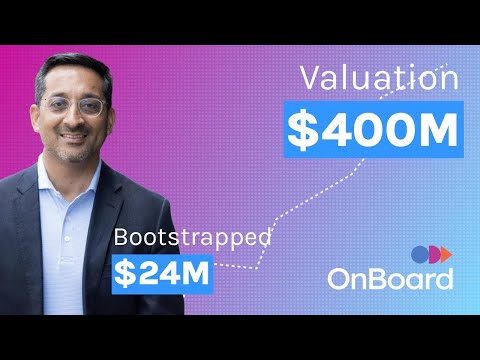
How OnBoard Bootstrapped to $15M ARR and 600 Bank Customers Before Raising $100M (Talk by Co-Founder & CEO Paroon Chadha)
- Talk Date
- September 1, 2022
- Speaker
- Paroon ChadhaCo-Founder & CEO
Company Metrics at Interview Time
ARR (2022)
$15M
Customers (2022)
600
Revenue Growth (2022)
50%
Total PE Raised
$105M
Year Founded
2003
Historical Snapshot
These numbers were reported by Paroon Chadha during his talk recorded in September 2022 and are a historical snapshot, not current figures. See OnBoard Meetings’s current numbers.
Key Takeaways
- 01OnBoard Meetings reached $15M ARR before taking its first private equity round
- 02The company has 600 bank and financial institution customers as of 2022
- 03OnBoard is growing at 50% annually at interview time
- 04The first PE round was $5M, followed by a $100M round in 2021
- 05The legacy product OnSemble generated $2M to $3M per year that was reinvested into OnBoard
- 06OnBoard acquired a 60-person team out of Toronto as its first inorganic transaction
- 07The company has hundreds of customers overseas across the UK, Australia, and Canada
- 08The $100M fundraising process took only one and a half weeks to close
- 09Paroon Chadha has run the same company since founding it in 2003
- 10Partner co-marketing with vertical industry associations was a core growth tactic
Company Metrics at Time of Interview
| Metric | Value | Source |
|---|---|---|
| ARR (2022) | $15M | Founder talk, Sep 2022 |
| Customers (2022) | 600 | Founder talk, Sep 2022 |
| Revenue Growth (2022) | 50% | Founder talk, Sep 2022 |
| First PE Round (2018) | $5M | Founder talk, Sep 2022 |
| Second PE Round (2021) | $100M | Founder talk, Sep 2022 |
| Total PE Raised | $105M | Founder talk, Sep 2022 |
| Legacy Product Annual Cash Contribution | $2M to $3M | Founder talk, Sep 2022 |
| Year Founded | 2003 | Founder talk, Sep 2022 |
| Acquired Team Size (2022) | 60 people | Founder talk, Sep 2022 |
| Fundraising Process Duration (2021) | 1.5 weeks | Founder talk, Sep 2022 |
Growth Breakdown
Revenue
OnBoard Meetings reached $15M ARR by September 2022, growing at 50% annually. The legacy employee collaboration product OnSemble contributed $2M to $3M per year in cash that was reinvested into the OnBoard business throughout the bootstrap phase.
Customers
The company has 600 customers, with a strong concentration in financial institutions including banks and credit unions. OnBoard has also expanded into healthcare, nonprofits, universities, and publicly listed companies, and has hundreds of customers overseas in the UK, Australia, and Canada.
Team and Acquisitions
After raising $100M in 2021, OnBoard completed its first acquisition, integrating a 60-person team out of Toronto. The company added an M and A committee that meets every two weeks to pursue further inorganic growth.
Funding
OnBoard bootstrapped from 2003 until taking a $5M private equity round, then raised $100M in a second private equity transaction in 2021, bringing total PE raised to $105M. The first round also included a secondary component that allowed early employees and the founder to take some liquidity.
Growth Strategy
Vertical Niche Focus
Paroon Chadha credited staying tightly focused on financial institutions as the foundation of OnBoard's growth. Having 600 banks as customers gave the company deep compliance expertise and credibility that opened doors in adjacent regulated verticals like healthcare and nonprofits.
Partner Co-Marketing
OnBoard signed partnerships in the credit union, banking, and university sectors by leveraging early customer advocates. These partnerships provided market credibility and a channel for reaching new customers within each vertical.
Acquisitions
After raising $100M, OnBoard pursued inorganic growth through acquisitions. The first acquisition brought in a 60-person team and was structured to be immediately accretive. An M and A committee now meets every two weeks to evaluate further targets.
Product-Led First Time User Experience
OnBoard invested heavily in what Paroon calls FTUX, or first time user experience, ensuring new directors can be onboarded the same day and run their first board meeting seamlessly. This focus on product quality drove word of mouth and customer advocacy.
International Expansion
Using institutional capital, OnBoard opened offices in the UK, Australia, and Canada, each seeded with a single salesperson to test the market. All three markets grew and now contribute hundreds of customers to the total base.
Best Quotes
“We are in the board meeting business. So board meeting management business. Over the next twenty minutes, I'm gonna actually walk you through, you know, how we got started, you know, first product, really good success with that. And then, you know, went on to really kinda just monetize that through, you know, first, actually really took on debt to continue to bootstrap till we got to $15,000,000 in ARR.”
“Have 600 banks as customers today. And that actually kind of just gives you a lot of credibility.”
“The team had stayed with me for a very long time. I wanted to take some real money off as well. When you really find lots of folks around you in your team have made their first 6 figure, 7 figure checks and they work with you, it will completely change the culture.”
“Fundamental thing before you raise money is to make sure that you nail the unit economics. It's just not going to scale if the unit economics are bad, whether they are your CAC or your payback period, you know, retention rate, all of those. So for me, the fundraising cycle was a very short one. It was just a week and a half.”
“Terms are just as important as the valuation, in fact, if not more. So everybody had to give me their valuation based on our terms, and that was a key part of shortening this cycle.”
“When you do an acquisition, which is more than 20% of your ARR, it's gonna test you. You almost need to hire execs ahead of that transaction.”
“Stick with a niche. Niches will bring riches. Certainly, you know, I can attest to that. If you have 200 customers in the same vertical, you're gonna be more, investable than have actually being spread over lots of different verticals.”
What Happened Next
This talk captures OnBoard Meetings at a specific moment in September 2022, when the company had reached $15M ARR, 600 customers, and was deploying its $100M private equity raise into acquisitions and international expansion. The figures here reflect what Paroon Chadha reported on stage and may differ significantly from the company's current position. Visit the OnBoard Meetings company profile for the latest available metrics.
View OnBoard Meetings’s current profile and metricsFull Transcript
Chapters
- 0:00Introduction and Company Overview
- 0:38Bootstrapping to $15M ARR
- 2:01First Product and the 2009 Financial Crisis
- 4:14Growing 50% and Staying Focused on Product
- 4:54Ideal Customer Profile and Vertical Discipline
- 6:47600 Bank Customers and Partnership Strategy
- 10:25Why Paroon Decided to Take Institutional Capital
- 12:35First $5M PE Round and Secondary Liquidity
- 14:22Raising $100M and What Changed
- 15:51Unit Economics and the 1.5-Week Fundraising Process
- 20:01Term Sheet Strategy and Valuation
- 20:21Post-Raise Priorities: Team, Product, and M&A
- 21:16First Acquisition: 60-Person Toronto Team
- 22:58Key Lessons: Niche, Unit Economics, and Playing Long Ball
Introduction and Company Overview
Paroon Chadha
00:00Please help in welcoming Parum Shahada from onboard to the stage. Hello,
00:07everybody. Yeah. I'm gonna actually walk you through, you know, what I would say probably the most unusual story here. We are all about bootstrapping, and I saw how many hands went up. I'm gonna walk you through going from bootstrapping to really getting to, you know, exits along the way, multiple bites of the apple, if you will, and still actually sort of maintaining, you know, the chance to make the dent that you're after. So Parun Chhata, Parun
Bootstrapping to $15M ARR
Paroon Chadha
00:38right, rhymes with maroon. You'll remember my name now. We are in the board meeting business. So board meeting management business. Over the next twenty minutes, I'm gonna actually walk you through, you know, how we got started, you know, first product, really good success with that. And then, you know, went on to really kinda just monetize that through, you know, first, actually really took on debt to continue to bootstrap till we got to $15,000,000 in ARR. Along
01:07the way, I had to clean up the cap table. There were some non performing co founders, if you will, that had to be managed. And that took a while. But at that point, I was able to take on some private equity money to accelerate the growth. And that drove the growth model. And then last year, we took a bigger check from a second private equity transaction. Since then, we've actually gone on to do inorganic transactions and
01:39acquisitions. It's a big focus as well. So I'm gonna walk you through this. And trust me, you know, I am a bootstrapper at heart. I do wanna actually kinda just salute each one of you guys who's doing this. It's extremely hard to show the discipline. But one of the things that I realized that you could be a bootstrapper for a fair amount of time and then still get to be venture backed so you can actually see
First Product and the 2009 Financial Crisis
Paroon Chadha
02:01the acceleration that your product or your space truly deserves. So this is a brief background of the company, the trajectory. I'll walk you through this. First off, I should say, you know, we started back in 2003. I've run, you know, the same company throughout. If you run into a problem that you can solve for the rest of your career, my advice would be to actually play the long ball and stay in it. Investors and founders will
02:26come and go. You could still actually run this. You could still actually take some chips off along the way. That's one way to think about it. So our first product was an employee collaboration product, OnSemble. Off to a fast start. It was bootstrapped, got onto the Inc. 500 list, And we were making money. We were actually, you know, be able to, you know, take some distributions at the end the year. This was, you know, me and
02:51my co founder. But there was one problem with it. In 2009, when the financial crisis happened, eight, nine time frame, every single one of my customers was either a bank or a credit union, which meant we came to a screeching halt when it, you know, came down to the sales cycles. So we had to think about what are we gonna do. At that point, we went from an employee collaboration product to a board meeting management solution,
03:18which is now the only product I offer. Meanwhile, we continued down the path of taking the original product OnSemble and making it into a cash cow, which funded the business $2,000,000 to $3,000,000 every year. That money was plowed back into growing the onboard business. Along the way, my founders lost interest. Stuff happens. And we we had to find a way to really kinda just, you know, come to terms with how will I actually bring that cap table
03:47to be unlocked. So I used debt, and I used some of the, you know, crude capital to come up with a schedule to pay him off, pay the second investor off, and then actually went on to, you know, really kind of grow the product through the two rounds that I've done since. So I'm gonna walk you through that here. So first, you know, first part of the presentation is about bootstrapping. The
Growing 50% and Staying Focused on Product
Paroon Chadha
04:14number one thing you have to think about is actually the product itself. Everything else won't matter. Financial engineering comes later. Optimization comes later. You can think about everything else later and you can hire all of those pieces out until you actually nail the product. You won't really get too far with it. So if you're an early stage, you know, that's sort of, you know, what you focus on. The slide here is showing that we took a
04:39while to get to the revenue numbers. At this time, we are growing 50% and we are actually fast growing. I would attribute most of that to the early stages when we were truly focused on the product.
Ideal Customer Profile and Vertical Discipline
Paroon Chadha
04:54I think not just the product itself and making sure that product is adding value, you also have to make sure that you're getting customers of the same kind. Because if you get seven customers, all each one of them is using it differently, you don't really have a business yet. Right? So to stay close to your ideal customer profile or to continuously evolve and fire the customers that don't belong there, this is the discipline that you have
05:19to be sure about in early stages. Definitely feel like the only thing that I did very well was to stay. Every single one of those customers was a financial institution I just told you when crisis hit us, right? Well, we should have diversified, but frankly, it helped us build a product that was really good in a compliance heavy industry and eventually came handy to diversify elsewhere. I'll also talk about, you know, you know, I I often
05:51talk about being able to explore and exploit at the same time. As a founder, CEO, you have to be ambidextrous. But once you find your niche, you gotta exploit it. And don't get distracted at that time to explore new things. Right? You still have to do some exploration because you have to think about what's next. But that's a pretty key part to bootstrapping well. I'd also talk a little bit about, you know, when we entered the
06:17financial services industry, there were other verticals, other sectors that came open, healthcare, nonprofits. These are compliance driven industries. So we eventually went there and certainly used some of the equity that we had built in the financial services industry, know, publics publicly listed companies. All of these are customers at this point, but that going back to how we started in the financial services industry. Have 600 banks as customers today. And that actually kind of just gives you
600 Bank Customers and Partnership Strategy
Paroon Chadha
06:47a lot of credibility. I'll talk a little bit about that. And finally, you know, the product. The best growth hack will always be an amazing product. A product that actually wows every single user. And that's still the goal for a big part of the organization. This is sort of our board product. If you run a board and you want to be excellent in your boardroom delivery, it's an inexpensive product. It'll force you to think about your
07:18board meetings and what you get out of your board intentionally. Most organizations today actually really are dealing with what you see here on this slide. Know bunch of different digital duct tape helping you get your board decks out and if you want to get intentional get really good in the boardroom which by the way has huge returns. Right? Your investors gain in confidence. You are deal ready all the time. Then you'll actually look at a product
07:46like this. That was the goal. There are two things that drive us at onboard. And this is sort of, you you have to be that clear with your team. The first one is we wanna make sure that we build everything within the platform, everything that a board needs to do, not just the board book delivery, the board assessment, the D&O questionnaire, you know, CEO review, you know, all approvals, everything should be right there. Minutes routing should
08:12be within the platform. So that's the first big heuristic that we are clear about. The second heuristic is we want to make sure that the first we call this FTUX. First time user experience is an absolute amazing one, which means when a new director gets your product, they should be wowed. We can implement our product within the same day. So if you had a board meeting this evening and you called us in the morning, we'll be
08:37able to implement that and your director should be able to run with it and your first meeting itself will go off seamlessly. That focus is extremely important when you're building, you know, the product in the early stages. Once you do that, and that comes only that comes about only if you built amazing relationship with customers. Other speakers have talked about this. In my case, my first customer was also somebody who gave us infrastructure. We used their
09:06office. They also advised a lot on operations side, how do you get compliance certifications and such. And eventually, they became my debt partner. When I talked about buying back my co founder, my first customer since this was a financial institution, they helped me figure out a loan which allowed me to buy back my partner. So you can get a lot out of your early customers. They are emotionally invested just like early employees. The question really comes
09:33down to what are you going to solve for with them? They're your early board, if you will. In our case, lots of things came out came out of this. So for example, all our early customers became advocates for us to go sign up these partnerships. So what you're seeing here is partnerships we signed up in different sectors. There's one in credit union industry. There's one in the banking industry. There's one in the university space and so
09:57on. So we've used a lot of customer credibility to sign up partnerships, which actually then give you more credibility in the market. And that's how you go about doing this cycle. So nail the product, gets the partnerships. At least in our case, it's a very vertical sales cycle that we have. So we are focused on lining up the partners for it. So I'm going to switch gears here and talk a little bit about where you need
Why Paroon Decided to Take Institutional Capital
Paroon Chadha
10:25institutional capital. So once you build good partnerships, you have a good product, you start to get into and in my case, there was debt to be paid off. Right? You know, there was debt because I'd bought back my co founder in the business and the other partner as well. Taking on debt, if you're married and there's whole family and the greater family, everybody's gonna be like, you are crazy. You should do something about this. Right? There's
10:48all kinds of other pressure that comes at you. So I wanted to clean slate this if I could. That was the first reason why I thought I should take institutional capital. Secondly, I think, you know, taking on some capital allows you to really truly think about how high you could fly. Like in my case, opening up an office in UK, in Australia, in Canada. By just test marketing in a single salesperson to see if those markets
11:13grow, which they have all grown by the way. We have hundreds of customers overseas now. Without institutional capital, it would have taken me that longer. Getting to really invest in the team, the talent density goes up astronomically after you've raised money, you know, with some big valuation numbers or big checks because people wanna come and work at your firm. And you are inviting your friends as well. So I think, you know, you really get a chance
11:42to think about the organization that'll truly scale. I talk about building a championship team, and that's what it comes down to. You know, it's a it is actually important for you to have a top class revenue team, a real solid data team and all the other teams that you are thinking about. Being able to build that capital helps. Certainly, I think you realize when you bootstrap, you're growing. Your goal is to break even at a higher
12:10and higher number every year. That's essentially what you're doing. By taking institutional capital, when you look at that business, which is fundamentally very solid and you pour in some fuel on it, you'll just see the acceleration happen. And I wanted to see that happen. So the first check was actually only $5,000,000 on the balance sheet. I did take some secondary off just to really kind of just ease the pain. And I'll talk about that a little
First $5M PE Round and Secondary Liquidity
Paroon Chadha
12:35bit because it's been a long journey. And there were a lot of employees and myself, we were actually doing this for a fair amount of time. It allowed us to invest in the product innovation cycle. So ideas that were actually truly risky and out there, they often don't get funded in a bootstrap mode. Being able to take some of those bets who have the which actually naturally have the best returns, that was a key part of
13:00it. So for me, actually, doing all of that, the first round of the
13:09to
13:16we're of customers, different clusters of customers in different verticals really allows you to be thinking about world class delivery, being the best platform. And once you've proven this model by taking on some capital, it gives you a chance to really kind of just do other things. For example, analytics on all these sectors, benchmarking, applying AI to all of this. These things are just not possible in bootstrap mode. The goal of being bootstrapped should be to actually
13:50make sure that you have a model really well, but you should also keep an eye on when you've outlived that cycle because that happened. We wanted to do not just board meeting, but also other board related workflows, the annual cycle, assessments and such, skills matrix, ESG matrix, things like that. That required us to raise money. So when we did actually get to raise money, we raised $100,000,000 last year.
Raising $100M and What Changed
Paroon Chadha
14:22That's a significant check. I heard somebody say here. That's exactly right. Everybody around you will suddenly actually call you. Like, what the hell just happened? Right? But that is actually fundamentally, a moment of truth in your life because you realize you can pretty much do most things you've wanted to do now. Right? So I want to talk a little bit about, you know, how you prep for that cycle. And then, you know, why secondary was important?
14:54So taking some money off was extremely important. I was just having this conversation with you back there. The team had stayed with me for a very long time. I wanted to take some real money off as well. When you really find lots of folks around you in your team have made their first 6 figure, 7 figure checks and they work with you, it will completely change the culture. You don't have to worry that there's a proven
15:20culture of financial rewards, extraordinary rewards, outsized rewards that can happen just by being in that company. So people don't have to go work elsewhere. I think for me, it was actually also about getting to, you know, swing with a heavier bat. Right? You can really swing for the fences. So when you take some money off, personally, you'll feel I will actually change the way board meetings are run. What's the board meeting of 2030? Let me go
Unit Economics and the 1.5-Week Fundraising Process
Paroon Chadha
15:51after that construct. So those are some of the things to think about as you think about taking on some money. I will say, fundamental thing before you raise money is to make sure that you nail the unit economics. It's just not going to scale if the unit economics are bad, whether they are your CAC or your payback period, you know, retention rate, all of those. So for me, the fundraising cycle was a very short one. It
16:22was just a week and a half.
16:25But all the work went in prior to that where, you know, the business was fundamentally solid. We knew that there was lots of market opportunity with Proven. The TAM was well developed. In fact, I spent, you know, no less than two, three weeks just working on the TAM analysis. The TAM analysis should be done extremely well
16:45simply because big investments only come in big markets. So unless you have a huge potential, nobody's going to write a big big check. So think about that and spend a disproportionate amount of time just figuring out your TAM. I also prepped really hard as to what would be my growth thesis and the one that my then current board shared with me. So when I went out, I turned the question around to every one of the firms
17:10I was talking to. This was a self run process. What would you do with this firm if you were actually partnering with me on the same side of the table in the boardroom? And I sat and I listened to what they had. And I got the chance to think about, you know, five, six, six really awesome takes. And then I could actually figure out which ones would be the best group to work with, where the culture
17:32fit would be. So to build your growth thesis and to test it out, that is a golden opportunity to do that. These are the slides that are available in the key fob. They've this was literally just that's the deck. I intentionally kept it very, you know, to the point. You know, the overall business, the TAM and the market sizing exercise, how we get our customers, what's the go to market motion, proof points on why it's going
18:00to be hugely accretive, And then certainly, you know, details about competition. How are we gonna actually outsmart and outflank everybody? Slide on the team. And then a slide that talks about what change we are after in this world. Right? And how would we actually change the way, boards operate? And finally, our unique, you know, selling proposition. Why us and not anybody else has the best shot in going after this? So once you do that, you,
18:35in at least in my case, I should say, we got several term sheets. In fact, I should go two slides back real quick here.
18:45You know, we ran a process ourselves. You know, the process piece is on the far right there. Number one, we were transparently talking about, you know, internally, hey. We're gonna raise money. We're gonna do this. Internally, everybody knew about this. Even the board, you know, helped in in in a working to that moment. Once we decided we're gonna go to the market, the deck was actually really nothing. The story kinda sold itself. You know, the use
19:12of funds was the easiest thing ever. Actually, it's not there on the slide because I wanted to ask them how would you spend the money. That was a big part of it. We did have real, you know, slides slides. I only courted firms that showed a lot of interest. They were all using our product in their portfolio, so it made it a little easier for me. But in the meanwhile, investors that show true interest in you,
19:37I remember CVC, they're they're a big PE firm. They helped me with the TAM analysis. I asked them, hey. I can't actually figure out how many boards are there in every part of the world. They literally actually gave me their analysts to work with them, you know, for next two, three do this. Firms will do that if they're interested in you. So that's a good way to test things out. But eventually, you know, I focused on
Term Sheet Strategy and Valuation
Paroon Chadha
20:01the fit and partnership, but I also actually had, you know, we are gonna close this round by next week. These are the terms on which you should actually, you know, give me the term sheet. So I only wanted down the fairway kind of terms. Terms are just as important as the valuation, in fact, if not more. So everybody had to give me their valuation based on our terms, and that was a key part of shortening this cycle
Post-Raise Priorities: Team, Product, and M&A
Paroon Chadha
20:21because we don't have the time to really kind of run a three month process to raise money. Right? The shorter the cycle, the easier it is for you to actually live up to the promises you're making. So when you do all of this, you actually get to do a lot of fun stuff downstream. Since we've raised money, these are some of the things that we have done, added a lot of talent, thought of what the product should
20:42look like in the next four, five, six years. Certainly, we've done a lot more on building and supporting the exec team, running a board meeting solidly as you imagine. We've added an audit committee, a compensation committee, and certainly, recently we just added an M and A committee. We've started to do these acquisition conversations much more rigorously internally. Every two weeks we are meeting. This is the first acquisition we did. Essentially paid a multiple, which was certainly
First Acquisition: 60-Person Toronto Team
Paroon Chadha
21:16at what multiple you raise your money. It's going to play into where you can acquire others. We wanna make sure that you are instantly actually accretive in these transactions. So think about that. If there are other companies that you wanna acquire downstream, what multiple would they trade at? That would give you the multiple that you should shoot for and what you could be comfortable with. I do believe, you know, working through, the COVID cycle was an
21:43interesting one just because you couldn't meet them. That was a tough part of doing an acquisition last year. You really had to do this remotely most of the times. And then while we're deploying capital into onboard business, we also had to think about now integrating a team, 60 people team out of Toronto. That really tested us as well. So think about some of those pieces. The key lessons here, when you do an acquisition, which is more
22:07than 20% of your ARR, it's gonna test you. You almost need to hire execs ahead of that transaction. When you go from a founder led organization and you try to digest that company, you'll have to change the incentive structure very quickly. The founders will likely make, you know, good money. Their way of thinking will adjust. They need a little time to adjust to the new context. But think about this. Every single employee in that company, all
22:33their customers, all their partners, they all need to be really thought about ahead of the transaction. All of that has to happen in a very short thirty, forty five day time period. So we've realized that for the next acquisition, we've started to run this M and A committee really well. It's one of the most rigorous parts of my business now because we do want to grow inorganically. That was the whole point of taking on this capital.
Key Lessons: Niche, Unit Economics, and Playing Long Ball
Paroon Chadha
22:58So yeah, over in the last twenty minutes, I've twenty, twenty five minutes, I've spent sharing my story. These are the three important things to take away. First of all, stick with a niche. Niches will bring riches. Certainly, you know, I can attest to that. If you have 200 customers in the same vertical, you're gonna be more, investable than have actually being spread over lots of different verticals. Number two, when you want to actually explore, you know,
23:29you want to actually first make sure your unit economics are right. Once you nail it, it's easy to scale it. And lastly, you know, if you stay in the game long enough, and I certainly feel like I I am doing my part on that end, you will find that the best in your field will wanna go become part of your journey. You'll be able to acquire a lot of these companies. A lot of these founders have
23:50looked at you for a while. So the goal here is to play long ball. And if you do that and add that, you know, and add being excellent in the boardroom, which we can be good partners for. We'd love to actually help you get there. I think this could be a lot of fun. Thank you. That's, how we did it at onboard.