
Founder Interview
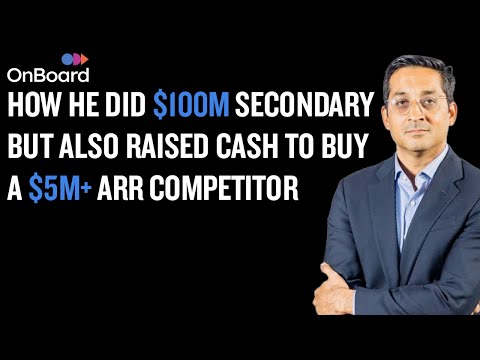
How OnBoard Meetings Grew Past 3,000 Customers and 275 Team Members After a $100M Raise (Interview with Co-Founder and CEO Paroon Chadha)
- Interview Date
- July 27, 2022
- Interviewee
- Paroon ChadhaCo-Founder & CEO
Company Metrics at Interview Time
Customers (2022)
3,000+
Team Size (2022)
275
Total Funding Raised
$105,000,000
Sales and Marketing Headcount (2022)
60 to 70
Historical Snapshot
These numbers were reported by Paroon Chadha during the interview recorded in July 2022 and are a historical snapshot, not current figures. See OnBoard Meetings’s current numbers.
Key Takeaways
- 01OnBoard Meetings passed 3,000 customers as of July 2022, up from 2,500 the prior year
- 02The company was adding approximately 70 to 100 new customers per month at interview time
- 03OnBoard raised a $100M private equity round in 2021, combining primary and secondary capital
- 04The $100M round was used partly for the eScribe acquisition, partly as secondary, and partly for the balance sheet
- 05eScribe had approximately 400 customers and an average contract value of $20,000 to $25,000 at acquisition
- 06OnBoard divested its OnSemble intranet product in an 8-figure transaction toward the end of 2021
- 07Total team size reached 275 people in 2022, with sales and marketing growing from 20 to 30 people to 60 to 70
- 08The company was founded in January 2003 and reached $1M in revenue in 2004 or 2005
- 09OnBoard bootstrapped and ran profitably for approximately 15 years before taking outside capital
- 10Five Elms Capital made the first institutional investment of $5M in 2018
Company Metrics at Time of Interview
| Metric | Value | Source |
|---|---|---|
| Customers (2022) | 3,000+ | Founder interview, July 2022 |
| New Customers Added per Month (2022) | 70 to 100 | Founder interview, July 2022 |
| Team Size (2022) | 275 | Founder interview, July 2022 |
| Sales and Marketing Headcount (2022) | 60 to 70 | Founder interview, July 2022 |
| Sales Reps (prior year) (2021) | 20 | Founder interview, July 2022 |
| Total Funding Raised | $105,000,000 | Founder interview, July 2022 |
| Five Elms Capital Investment (2018) | $5,000,000 | Founder interview, July 2022 |
| Private Equity Round (2021) | $100,000,000 | Founder interview, July 2022 |
| eScribe Customers at Acquisition | 400 | Founder interview, July 2022 |
| eScribe Average Contract Value | $20,000 to $25,000 | Founder interview, July 2022 |
| eScribe Revenue at Acquisition | $5,000,000 to $10,000,000 | Founder interview, July 2022 |
| OnSemble Divestiture Price (2021) | 8 figures | Founder interview, July 2022 |
| OnSemble Share of Company Revenue | 25% | Founder interview, July 2022 |
| Year Founded | 2003 | Founder interview, July 2022 |
| Year Reached $1M Revenue | 2004 or 2005 | Founder interview, July 2022 |
Growth Breakdown
Customers
OnBoard Meetings passed 3,000 customers by July 2022, up from 2,500 the prior year. The company was adding approximately 70 to 100 new customers per month, a pace that accelerated after the eScribe acquisition brought in roughly 400 additional government and public-sector boards.
Team
Total headcount reached 275 people in July 2022, with plans to cross 300 before year end. Sales and marketing alone grew from roughly 20 to 30 people to 60 to 70 people over the prior year, expanding across the US, Canada, UK, and Australia.
Funding and Capital Allocation
OnBoard closed a $100M private equity round in August 2021, combining primary capital, secondary liquidity, and acquisition financing. The first institutional round was a $5M investment from Five Elms Capital in 2018, used to clear debt accumulated during the founder's buyout of early partners. Total funding on record stands at $105M.
Profitability and Bootstrapping
Paroon Chadha bootstrapped OnBoard for approximately 15 years, running the business profitably and paying dividends to partners before taking outside capital. The company divested its OnSemble intranet product in an 8-figure transaction in late 2021, redeploying focus entirely toward board and committee meeting software.
Growth Strategy
Acquisition of eScribe
OnBoard acquired eScribe, a Toronto-based board meeting platform focused on local government, in August 2021 using capital from the $100M round. eScribe brought approximately 400 customers with average contract values of $20,000 to $25,000, significantly higher than OnBoard's existing base, and added talent and a foothold in the Canadian market.
Divestiture to Sharpen Focus
OnBoard sold its OnSemble intranet product, which represented about 25% of company revenue, to Ncontracts in late 2021. Paroon described the move as trading a player who no longer fit for one who could help build a championship team, allowing the entire organization to focus on board and committee meetings.
Geographic Expansion of Sales and Marketing
Following the eScribe deal, OnBoard built out sales and marketing teams across four geographies: the US, Canada, the UK, and Australia. The company hired a chief revenue officer, doubled the number of account executives and SDRs, and expanded demand generation and partnership management functions.
Partner Co-Marketing
Partner co-marketing was cited as a key growth tactic, helping OnBoard reach new customer segments alongside complementary products and services in the board governance space.
Evergreen Market Positioning
Paroon emphasized that board meetings are an evergreen problem that will need solving for decades, and he built the company with a long-term ownership mindset. This philosophy guided capital allocation decisions, including how much secondary liquidity to allow acquired team members to take versus retaining equity in the combined business.
Best Quotes
“We've grown past 3,000 at this point. And we are adding about, I'd say about 80 to 100 customers a month. That's the clip that we are operating at and we you know since we spoke last time we actually really got a chance to acquire a company called eScribe out of Toronto”
“Their average contract pre transaction was right around $20,000 to $25,000.”
“OnSemble was about, I would say 25% of our revenue. And when we swapped out OnSemble for eScribe, we are actually further ahead. So the revenue run rate basis that was sort of neutral to actually favorable.”
“It was not a 100,000,000 secondary. It was actually primary and secondary combined. It was actually a $100,000,000 round.”
“Total team size is actually we are pushing, you know, 275 maybe at this point. And with some reps open, we'll definitely cross 300 before the end of the year.”
“Completely bootstrapped, ran a profit for, believe it or not, fifteen years. And some of this math doesn't even make sense, but that's how it worked out.”
“investors will come and go if you find yourself in an evergreen space. Keep building like you're gonna own this forever because you just might.”
What Happened Next
This interview captured OnBoard Meetings at a pivotal moment in July 2022, roughly one year after the company closed a $100M private equity round and completed the acquisition of eScribe. The figures here, including customer count, team size, and growth targets, reflect what Paroon Chadha reported at that point in time and are not current. Visit the OnBoard Meetings company profile on GetLatka for the latest available data.
View OnBoard Meetings’s current profile and metricsFull Transcript
Chapters
- 0:00Introduction and the Challenge of Board Meetings
- 1:41Customer Growth Past 3,000 and eScribe Acquisition
- 3:17eScribe ACV and Customer Profile
- 7:03eScribe Customer Count and Revenue at Acquisition
- 7:31OnSemble Divestiture and Revenue Mix
- 10:28The $100M Round: Primary, Secondary, and Acquisition Capital
- 15:13Sales and Marketing Team Expansion Across Four Geos
- 16:16Total Team Size and Hiring Plans
- 20:09Bootstrapping for 15 Years and Early Partner Buyouts
- 21:34Five Elms Investment and Path to Institutional Capital
- 22:25Milestone: $1M Revenue in 2004 or 2005, Founded 2003
- 24:06Famous Five: Books, CEOs, Tools, and Personal Life
Introduction and the Challenge of Board Meetings
Nathan Latka
00:00Hey, folks. My guest today is Paroon Chadha. He is the founder of onboardmeetings.com. He's doing this to inspire and enable the best board meeting experience possible and finding technology solutions to empower that. Alright. Paroon, you ready to
00:12take us to the top?
Paroon Chadha
00:13Absolutely. Let's have at it.
Nathan Latka
00:15All right. Now, a lot of people, maybe they haven't raised VC. They don't even know what it's like to manage a board. Why is managing a board meeting hard?
Paroon Chadha
00:22Great question. Know, I like to say that there is often a board meeting that you have in mind based on your agenda and the pre board meeting discussions. Then there's an actual board meeting that you end up having. And then two days after the board meeting, you realize there's a whole different board meeting that you should have had. And this emotion is true for all CEOs every time I've checked. Board meetings are hard because they're structured
00:50meeting. There's a lot of prep that goes into it. And right before the board meeting, you are clearest about your business. This is what's going well and what's not, and there's new topics to be introduced and they often show up. And the preciousness of that time to make all the calls, to make sure you're thinking through everything makes it a very tough interaction. It's difficult to nail them and our objective is to help CEOs and boards
01:20really get the most out of the investment by making the meeting that you had in mind, the meeting that you actually have, the meeting that you should have had all be the same thing.
Nathan Latka
01:29Now, when we chatted back in July or August of last year, you'd said you had over 2,500 founders and boards really using the platform and also a lot of government agencies and things of that nature too. Are you still about 2,500 or have you grown customer base?
Customer Growth Past 3,000 and eScribe Acquisition
Paroon Chadha
01:41We've grown past 3,000 at this point.
Nathan Latka
01:44Wow.
Paroon Chadha
01:45And we are adding about, I'd say about 80 to 100 customers a month. That's the clip that we are operating at and we you know since we spoke last time we actually really got a chance to acquire a company called eScribe out of Toronto and
02:04they are squarely focused on the local government, you know, so these are towns and cities, you know, and also special districts and schools. So government funded boards.
Nathan Latka
02:21Which that matches nicely the base you were selling into. So when you say you're adding 80 to 100 per month right now, new customers, are they the same kind of customers you've been serving? Their school agencies, boards, government folks?
Paroon Chadha
02:32They're all board meetings, and they're all boards that we are adding, boards and committees. And yeah, we were actually right around sixty, seventy prior with eScribe coming in, are actually seeing most months clock around seventy, eighty to 100, depending on it's a quarterly, a quarter ending month or not.
Nathan Latka
02:52Now your ARPU back then, you said that these customers are paying on average $5,000 a year to manage two or three board meetings annually. Was eScribe's ARPU significantly below yours or were they more enterprise than you or were they exact match, same size customers?
Paroon Chadha
03:07They are actually higher. So if you think of a city council, there's often a much bigger number of people involved, some more subscribers.
eScribe ACV and Customer Profile
Paroon Chadha
03:17Their average contract pre transaction was right around $20,000 to $25,000.
Nathan Latka
03:24Oh, wow. Okay. Had they learned about Was that because there were more seats using their platform or were they upselling more features that you hadn't built yet?
Paroon Chadha
03:34Seats. And there were some technology that we really liked that has application in all board pursuits that we have. I like this
03:44transaction mainly similar culture, gives access to talent. They're based in Toronto primarily. And then there were a team that was trying to get into The US market. We are of course well entrenched, couple 100 people working in different cities here in US. So we can bring eScribe product to The US market and we've had tremendous success with that. I'm sitting here in Laguna Beach in California and we just signed up Laguna Beach as a customer
04:13two weeks ago. So lots of synergies in market expansion, some access to talent and then certainly rounding out our portfolio in terms of covering all meetings. Public meetings, these are the public sector meetings, should say. And then through OnBoard, we are also of course doing private boards and then publicly listed companies and then also nonprofits.
Nathan Latka
04:39Oh, what's going on there, YouTube? Good to see you guys. Now imagine this, you love watching these interviews with SaaS founders. But imagine if we took all of the valuation data out from over 2,807 interviews I've done manually Saves you a lot of time. Well, we've done this. We've built it into the beautiful interface inside of Founderpath. Check this out. I'll show you how you can access this in a second, but you log in, you connect
05:03your Stripe account, you see your valuation real time. You can see what it changed over the past eighty eight days and even set goals for valuation this year. Now the secret evaluation is there's many different ways to value a SaaS business. So the reason you're gonna see three or four different valuations inside of your Founderpath dashboard, this is all free by the way, is because depending on who's doing the buying of your SaaS company, you're gonna
05:27get a different valuation. A VC is gonna pay a different valuation, private equity firm is different. If you're gonna do a minority sale, that's different. And if you sell the whole business, that's a different valuation. You can see all those when I hover over here. Right? So the teal is what a VC would pay. Yellow is what private equity and red is if you sold the whole thing outright. Now what's cool about this is this is
05:49not built off random data. Again, you guys hear these interviews on YouTube. All these datas are built from real time valuation data points founders share with us on the show. So traction, 1,200,000 seed round, 3.7 raise. They sold 22% of their business. Go in here and filter by the event. Maybe you only wanna see companies that have sold the whole business. Well, here are a bunch that have been acquired the valuation and the multiple. Maybe you're
06:15going out right now and you're raising your seed round. We'll go in here and look at all this recent seed deals that went down, what they raised, what valuation they raised at and what percent that they sold. There's never been a larger dataset of SaaS valuations than what you can get now inside of Founderpath. And we're thrilled to bring it to you. Alright. We're gonna go back to the YouTube video here in a second, but if
06:37you wanna check this tool out, if you wanna jump in and sign up, you can check it out for free to get your valuation at this link. This link, founderpath.com/products/valuations. Or if you go to founderpath.com and hover over products, click on get your valuation here, and go ahead and sign up to give it a whirl. Again, all that valuation data live right inside the platform. I hope to see you there. Alright. Let's jump back into the
eScribe Customer Count and Revenue at Acquisition
Nathan Latka
07:03interview. And when you made the purchase of eScribe, how many customers did they have at the time?
Paroon Chadha
07:08They had about 400 customers and change.
Nathan Latka
07:11Oh, 400. I mean, so 400 times the $20,000 ACV. I mean, they were like 5, 6, 8,000,000 in revenue, something like that.
Paroon Chadha
07:17Yeah. I know. I would say, you know, just short of that, but, yeah, that was sort of the revenue range. You know, they were in the 5 to 10,000,000 range for that. I don't know the exact specific number this this time, but, yeah.
Nathan Latka
07:29When did you close the transaction?
OnSemble Divestiture and Revenue Mix
Paroon Chadha
07:31So since we last spoke, we raised money and then we actually really did this transaction around August, September. So we are closing in on one year anniversary of that. And then we also actually divested, there was a divestiture that happened. There was an Intranet business that I started long ago called OnSemble. So we sold that off towards the end of the year just because it becomes slightly off center compared to, you know, where we were headed.
Nathan Latka
07:59What was that called?
Paroon Chadha
08:00It was called OnSemble.
Nathan Latka
08:02Onsemble, like O-N-S-E-M-B-L-E?
Paroon Chadha
08:06Spelled O N, but yes, it sounds exactly like ensemble. So it was an employee collaboration product. And to to quickly summarize we started with an employee collaboration tool pivoted towards board collaboration because the intranets are toughest market. The extranets really became very important especially when it comes to boards and all the other folks that you work with. So we pivoted towards that market and then found a lot of success and then now we've added eScribe. With
08:40all of this the focus had become meetings whether it's boards or committees or you know commissions and such and the Intranet product really kind of looked a little off center so we actually got it to the right spot. There's a company called Ncontracts that actually you know, was doing a roll up on various employee collaboration tools and that's where that team and that customer base is now gone.
Nathan Latka
09:03Was that a small sort of meaningless transaction or did it make, know, more than a couple million bucks for the business when you when you divested?
Paroon Chadha
09:09No. I I think we sold in November. It was a good time, actually. It was actually it was certainly, you know, you know, it was 8 figures. It was actually a good transaction.
Nathan Latka
09:18Oh, wow. Okay. How how much revenue did did the OnSemble product have when you when you divested it?
Paroon Chadha
09:23OnSemble had you know, I I don't know if I'm you know, if I should disclose the revenue, but it was actually, the range was less than 10,000,000.
Nathan Latka
09:32Less than 10. Okay.
Paroon Chadha
09:33Yeah. I'm still actually bound by that contract. I can't disclose the exact revenue figure,
Nathan Latka
09:37but Well, let me the reason the reason I'm asking is I'm I'm curious how much of like your core you sort of gave up. So I guess maybe a better question to ask that doesn't get you in NDA trouble is what percent of revenue across the entire company did OnSemble represent? Was it 50%?
Paroon Chadha
09:52No, no, no. OnSemble was much less. OnSemble was about, I would say 25% of our revenue. And when we swapped out OnSemble for eScribe, we are actually further ahead. So the revenue run rate basis that was sort of neutral to actually favorable. What we now have is it's like trading a player who'd done really well was not fitting well for a superstar that we can actually all get behind and build a championship team. That's how I
10:26started, you know, marketing to my point.
The $100M Round: Primary, Secondary, and Acquisition Capital
Nathan Latka
10:28That's a great analogy. Now I am curious because when you last came on and talked about the round in August of last year, I believe that was a $100,000,000 secondary at a 400,000,000 valuation, right?
Paroon Chadha
10:38It was not a 100,000,000 secondary. It was actually primary and secondary combined. It was actually a $100,000,000 round.
Nathan Latka
10:44Oh, I see. Okay. Got it. So so both
Paroon Chadha
10:47Some of that capital was used for this acquisition. Some of that capital was secondary. Some of that capital actually went on the balance sheet.
Nathan Latka
10:54Some was secondary, some for transactions, some for operations. Mhmm. I see. I see. Okay. I mean, can you without getting into trouble here, I mean, less than 50% of the 100,000,000 was secondary?
Paroon Chadha
11:06Less than 50. Yes. And this is a pretty significant transaction. We had looked at this transaction while we were raising money, we kind of knew that we were in due diligence with this team. So this was sort of one of the drivers, if you will. So this gives us a chance to expand into a big market in terms of talent Toronto. Then it also actually allows us to be full spectrum all kinds of board meetings like
11:29I summarized. And then it also gives us a chance to actually expand quickly. Remember, last year we were still in COVID sort of times, which means if had you to add thirty, forty, 50 people, it's extremely hard to recruit people while you're on remote. So this was a good chance to find a team that can actually help us bulk up quickly since we were seeing tremendous growth overall.
Nathan Latka
11:57What month did you close the eScribe deal?
Paroon Chadha
11:59eScribe deal was August, so it's coming up actually.
Nathan Latka
12:03That was still the hot, hot, hot time. The market hadn't crashed yet. What revenue multiple did you pay for the business?
Paroon Chadha
12:09I don't know if I can accurately share the revenue multiple, but I'll say actually there was some,
12:19I would say, similar multiples. That market was actually really 10 to 15x sort of multiples. It was a good market. And then we got OnSemble sort of packaged and off to Ncontracts also in the same timeframe. And now we are seeing actually really sort of first year anniversary of raising money and doing these transactions all of that come through. We're seeing our growth rates sort of justify all of that while the valuations were you know
12:51crazy in the valley. Remember I was in the Midwest you know still raising money from there And we I was conscious of finding the right partner, not the one who's giving us the highest multiple, but the one who had the best chance of getting us to sort of, know, where I think would be the right spot for this business.
Nathan Latka
13:10Yep. Yep. Now, a lot of times when you're doing a deal like this, the team has 58 people. Were they boot was eScribe bootstrapped or was there VCs to negotiate with?
Paroon Chadha
13:17Oh, it was actually really some angels, but it was bootstrapped. Yeah. Largely bootstrapped.
Nathan Latka
13:22So very capital efficient. That's great. Was the majority of the deal all cash or do they now have a bunch of stock in OnBoard?
Paroon Chadha
13:28No, I think the employees actually, they all rolled. They were the cohort group and actually really sort of in a deeper L1, L2s were vested and they got a chance to roll here and some of them cashed out because they've been invested for a long time. I really like these transactions especially when I think about being somebody who started a bootstrap business too. You can only hold on to all of that for five, ten, fifteen years
13:56while everybody else around you is actually either working for big tech where they're making big dollars every year or they're seeing these short run startup cycles. This is a great chance to stay in the same business, stay on the same mission while you get to take some chips off. So we saw a little bit of that in this transaction as well.
Nathan Latka
14:17But you don't want them to take too many chips off because you want them to be incentivized to stick around and build the now combined business together. So can you share a little bit in terms of what there's a total deal price of X, which you probably can't share, but of X, what percent did you allow to be cash take off the table versus stock in the parent company?
Paroon Chadha
14:34There was not a very simple rule, unfortunately, and I'm trying to form my own framework around this, but a good rule of thumb is, you take half off and then in the new combined entity, you are back on the schedule to get some more options. So you are accurately back in the vesting schedule. Now what people quickly see especially a year into this they clearly see is that the next this is a step function up from
15:04where they were earlier in terms of the rigors of planning, the rigors of recruitment, the rigors of just
Sales and Marketing Team Expansion Across Four Geos
Paroon Chadha
15:13investments that go into sales and marketing. And that's been the story. If you ask me last one year, we've gone from twenty, thirty people combined in sales and marketing to maybe sixty, seventy people. That's been above Just in sales and marketing? Just in sales and marketing. Sales and marketing has actually become,
15:32it's US, it's Canada, it's UK, it's Australia, first of all, there are four geos. And then you know chief revenue officer who joined us you know around middle of the year last year, double the number of AEs, double the number of SDRs, lots of you know folks in various aspects of demand gen and partnership management, all of that went through a sea change. That's the big change and every employee whether they have been a long time
16:03member or the ones that came in last year or two, they clearly see that when they see the numbers that really look very different.
Nathan Latka
16:11Right? Yeah. So what what is the just for context, what's what's the total team size today? Everybody?
Total Team Size and Hiring Plans
Paroon Chadha
16:16Total team size is actually we are pushing, you know, 275 maybe at this point. And with some reps open, we'll definitely cross 300 before the end of the year. Still high.
Nathan Latka
16:25That make that makes sense. And then real quick, just to go back to the eScribe deal. Right? So you mentioned, you know, them doing between 5 and $10,000,000 in revenue when you acquire them and you pay somewhere between sort of a 10 and 15x multiple you closed last November on that. So let's just say that deal price is right in the middle there, like a 70,000,000 all in. What you're saying is you're totally cool having 50%
16:43of that or 35,000,000 be cash off the table, but you really wanna have the other 35,000,000 of the total deal price be the equivalent stock and OnBoard to build the thing long term together.
Paroon Chadha
16:53I think that's the model that I would like to pursue going forward. These can get actually expensive at times and the investors don't actually like the fifty-fifty model. I was sharing with you there that as an operator who stayed in this for a fair amount of time, if you're not a five year run kind of a business and by the way we are an evergreen business and this is a key difference some pursuits are just going
17:19be evergreen twenty years from now somebody's going to be solving for board meetings I guarantee you. Twenty years from now somebody is going to be solving for employee collaboration. It's such pursuits in the past we didn't really have a chance for people to cash in on some of what they've built. Now with subsequent rounds and some of these transactions I think it's an amazing opportunity that is afforded to early employees and founders. It didn't really shake
17:45out 50%. I was open to up till 50% for some of those discussions. Of course, the founders have a lot bigger shares. Know they're building for long term and that's where these are top heavy plans often. Most of those folks took some chips off but didn't really take as much for the reasons that you cited, they know it's going to compound into a much bigger number here as they look at into the future prospects. Now we
18:14need to know. Employees who are sort of lower in the organization and they've been there for five, seven years and, you know, it's okay for them to accurately kind of just, you know, get that relief and then re up for the next stage.
Nathan Latka
18:26And so Paroon, when you look at including the revenue you added from the eScribe acquisition, when you look at your revenue growth rate over the past twelve months, what percentage you hit?
Paroon Chadha
18:35So past twelve would be tough, it's across two financial years. I can tell you our goal for this year is to be actually accelerating in our growth rates. So we'll actually really end close to 50% growth rate for the year if the rest of the plan year checks out. Yep. Is tremendous, you know, that's actually really sort of, you know, one of the key objectives that I had from, this round to accelerate our growth.
Nathan Latka
19:04Yep, well, I mean, when you came on last and you talked about last year and again, August, 2,500 customers paying $5,000 ACV, you were at a $24,000,000 run rate then. And if you added eScribe revenue on top of that, you've got to be probably either flirting with or past 30,000,000 at this point, is that accurate?
Paroon Chadha
19:21That is accurate. And ending the year, of course with a few big months end of the year accurately, could get to numbers that are higher than, know, closer towards 35, 37 and you know, we'll go from there. We are also building the foundation for long term success here. This some of the go to market that we've, you know, redone is keeping scale in mind. And our goal is to actually sustain this for three, four, five years
19:52as we actually really sort of continue to leverage all the opportunity that we see here. Some of the things that we find is available to us, some of the talent that's actually becoming available with every step here.
Bootstrapping for 15 Years and Early Partner Buyouts
Nathan Latka
20:09Yeah, and look, I appreciate how you've built the business. You're one of the rare examples where, I mean, didn't, you weren't super diluted early. I think you did a $5,000,000 private equity round on 30,000,000 valuation back in 2018. But prior to that bootstrapped, right?
Paroon Chadha
20:20Completely bootstrapped, ran a profit for, believe it or not, fifteen years. And some of this math doesn't even make sense, but that's how it worked out. I had two partners early on and both of them actually worked very well for seven, eight years. We were taking dividends and profits. And then we realized that one of the partners wanted to actually move on. And the only way to free up the cap table is to buy him out,
20:45which meant we had to start saving up and I had to take some debt. And eventually, he was bought out. And then the second partner wanted to do the same.
Nathan Latka
20:53How much did he own equity?
20:55How much equity did he own?
Paroon Chadha
20:56That was actually good, more than a third of the company. That was 40 percent.
Nathan Latka
21:01Well, bought
Paroon Chadha
21:02back 40% of the business.
Nathan Latka
21:03When? What year was that?
Paroon Chadha
21:05This was 2010 to 2014, I think I was paying down that. My other partner was a credit union, that was my early investor and they own about 15% of the cap table. They lend me money to buy the equity from the other partner here. And then eventually they said, could we be on the same plan? Could you convert my equity into debt? And I said, yeah, I can do it if we get to reasonable numbers here
Five Elms Investment and Path to Institutional Capital
Paroon Chadha
21:34as I'm still running a bootstrap company. And And eventually there came a time when there was no cap table, there was just a single cell, I owned all of it and there was some debt and I the first time we took capital from Five Elms it was to clear out that debt and start thinking about growth again and that was a it's a skip hop jump method but you really do have a wonderful sort of journey now
22:00that you look back at it where early investors made money and then you bootstrapped your way to pay all that off and then eventually took capital to start thinking bigger, scale and higher growth rates. And then you actually go from there. Now it's M and A
22:21building for the next
22:24phase of the business.
Milestone: $1M Revenue in 2004 or 2005, Founded 2003
Nathan Latka
22:25Well, Paroon, people can hear more of your story at Founder500 September first in Austin, Texas. We're gonna dig deeper into all this charts, graphs, more questions. It's gonna be fantastic. Real quick though, what your two final questions here before we wrap up with the famous five. What year did you guys pass a million dollars in revenue? Do you remember?
Paroon Chadha
22:41Million dollars in revenue in 2004, actually, 2005, 2004 or '5, one of the other. Yeah.
Nathan Latka
22:47And so when did the company launch?
Paroon Chadha
22:49January 2003.
Nathan Latka
22:51Wow. Okay. I love this. Long term, focus, consistent. It's great.
Paroon Chadha
22:56It's my twentieth year of doing this. The success here, the secret here, I should say, that that I've always known that I'll be doing this and I'm still building it like I'm going to be doing this twenty more years. If I can say this not
23:13sounding
23:17like I know how the future is gonna go, investors will come and go if you find yourself in an evergreen space. Keep building like you're gonna own this forever because you just might.
Nathan Latka
23:27Yep. I love that analogy. And Paroon, you're managing your capital appropriately. You have taken some dilution, 5,000,000 from Five Elms to take out the debt, $100,000,000 secondary to get the eScribe deal done, plus the divestiture, plus operating capital. But it still sounds like, I mean, you still own what, 40% to 60% of the business personally?
Paroon Chadha
23:43I think I still own substantial portion of the business and I still act really, it's still
Nathan Latka
23:50You dodged the question.
Paroon Chadha
23:50Too much to be dodged.
Nathan Latka
23:52You dodged the question. All right.
Paroon Chadha
23:53I did dodge the question just because it's actually really, I don't know what I should share. The the path on this is actually far, you know, I'm ahead of what I'd ever thought of. That's what
Famous Five: Books, CEOs, Tools, and Personal Life
Nathan Latka
24:06I'm I that, Paroon. Let's wrap up your famous five. Quick answers. Number one, favorite book.
Paroon Chadha
24:13Favorite book, I'd say that's a good one actually. What's a good book that I'm actually really hooked to right now?
24:23Actually, you know, favorite book would still be Eating the Big Fish. I think I gave you the same answer last time.
Nathan Latka
24:29No. You said Good to Great.
Paroon Chadha
24:32Eating the Big Fish. This is if you're a challenger, number two, number three, go get them.
Nathan Latka
24:36That's Number number two, is there a CEO you're following or studying?
Paroon Chadha
24:42I am actually, certainly like quite a few of the ones that everybody follows, Tim Cook, Jamie Dimon. But this time I actually went to Warren Buffett's annual conference and spent a couple of days and really liked the long term value and moat-based worldview that he presents. And I find it extremely compelling.
Nathan Latka
25:06Number three, what's your favorite online tool for building OnBoard besides your own?
Paroon Chadha
25:10Favorite online tool?
25:14I'm using
25:17favorite online tool, actually, you know, I'd still say Slack. I Slack just with myself. I should qualify. We use Teams for the company. I Slack in multiple channels. I'm having a great time just using it just on my phone for my thoughts.
Nathan Latka
25:32Love that. Number four, how many hours of sleep do get every night?
Paroon Chadha
25:37Five to seven.
Nathan Latka
25:38And situation, married, single, kids?
Paroon Chadha
25:41Married with a five year old.
Nathan Latka
25:44One kid. And did you celebrate a birthday? Are you are you 47 now?
Paroon Chadha
25:48I did celebrate a birthday. I'm 47 now. My wife and I have been together twenty years and the business has been going twentieth year now. And, yeah, it's a lot to actually continue to be thankful for.
Nathan Latka
26:02Guys, there we have it. Launched the business in 2003, broke a million revenue back in 2005, on track to break, call it 35, 36,000,000 this year. They just did a big acquisition, a $100,000,000 secondary plus operating capital, plus money for that acquisition last year at a $400,000,000 valuation. He's being smart with capital allocation in the business. They look so continue doing this for the next twenty years. Again, onboardmeetings.com, help you run effective board meetings, both follow-up
26:26and pre event to make sure it runs smoothly. Paroon, thanks for taking us to top.
Paroon Chadha
26:31You got it. Thank you so much for listening.
Nathan Latka
26:35One more thing before you go. We have a brand new show every Thursday at 1PM Central. It's called Shark Tank for SaaS. We call it deal or bust. One founder comes on, three hungry buyers, they try and do a deal live and the founder shares back end dashboards, their expenses, their revenue, ARPU, CAC, LTV, you name it, they share it and the buyers try and make a deal live. It is fun to watch every Thursday one
26:59p. M. Central. Additionally, remember these recorded founder interviews go live. We release them here on YouTube every day at two p. M. Central. To make sure you don't miss any of that, make sure you click the subscribe button below here on YouTube, the big red button and then click the little bell notification to make sure you get notifications when we do go live. I wouldn't want you to miss breaking news in the SaaS world, whether it's
27:21an acquisition, a big fundraise, a big sale, a big profitability statement or something else. I don't want you to miss it. Additionally, if you wanna take this conversation deeper and further, we have by far the largest private Slack community for B2B SaaS founders. You wanna get in there. We've probably talked about your tool if you're running a company or your firm if you're investing. You can go in there and quickly search and see what people are
27:43saying. Sign up for that at nathanlatka.com slack. In the meantime, I'm hanging out with you here on YouTube. I'll be in the comments for the next thirty minutes. Feel free to let me know what you thought about this episode and if you enjoyed it, click the thumbs up. We get a lot of haters that are mad at how aggressive I am on these shows, but I do it so that we can all learn. We have to
28:02counter those people. We got to push them away. Click the thumbs up below to counter them and know that I appreciate your guys' support. Alright, I'll be in the comments. See you.