
Founder Interview
How Run Of Show Raised $200K Pre-Seed at a $650K Valuation to Build Task Management for Event Planners (Interview with CEO Gil Gibli)
- Interview Date
- January 4, 2023
- Interviewee
- Gil GibliCEO
Company Metrics at Interview Time
Pre-Seed Raise (2021 to 2022)
$200,000
Pre-Seed Valuation (2021)
$650,000
Equity Sold (2021)
30%
Free Users (January 2023)
5
Year Founded
2021
Historical Snapshot
These numbers were reported by Gil Gibli during his interview with Nathan Latka recorded in January 2023 and are a historical snapshot, not current figures. See Run Of Show’s current numbers.
Key Takeaways
- 01Run Of Show raised $200,000 at a $650,000 valuation in a pre-seed round from friends and family.
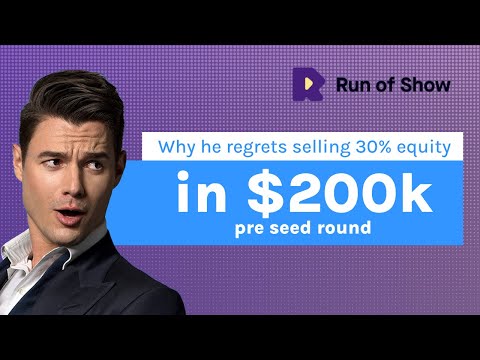
- 02Gil Gibli sold approximately 30% of the company in the pre-seed round and says he regrets giving away that much equity.
- 03The company was pre-revenue as of January 2023, with paid pricing set to launch January 15, 2023.
- 04Run Of Show had 5 free users on the platform at the time of the interview, including PopShop.
- 05Gil spent approximately $100,000 on an early engineering team that did not deliver the product he needed.
- 06The current team consists of 4 full-time engineers and 2 part-time contractor designers.
- 07Gil founded the company in 2021 after leaving WeWork in May 2020, where he managed 50 to 100 events per week across the US.
- 08The platform targets event planners and hospitality businesses, with restaurants identified as an additional target segment.
Company Metrics at Time of Interview
| Metric | Value | Source |
|---|---|---|
| Pre-Seed Raise (2021 to 2022) | $200,000 | Founder interview, Jan 2023 |
| Pre-Seed Valuation Cap (2021) | $650,000 | Founder interview, Jan 2023 |
| Equity Sold (Pre-Seed) (2021) | 30% | Founder interview, Jan 2023 |
| Free Users (January 2023) | 5 | Founder interview, Jan 2023 |
| Full-Time Engineers (January 2023) | 4 | Founder interview, Jan 2023 |
| Part-Time Designer Contractors (January 2023) | 2 | Founder interview, Jan 2023 |
| Wasted Engineering Spend (2021 to 2022) | $100,000 | Founder interview, Jan 2023 |
| Year Founded | 2021 | Founder interview, Jan 2023 |
Growth Breakdown
Revenue
Run Of Show was pre-revenue as of January 2023. The pricing page was live on the website but was not connected to a payment gateway, meaning customers could not yet pay even if they wanted to. Gil planned to officially launch paid pricing on January 15, 2023.
Customers
The company had approximately 5 free users at the time of the interview, including PopShop. Gil described these early users as providing valuable reassurance and product feedback through weekly calls.
Team
The team consisted of 4 full-time engineers and 2 part-time contractor designers as of January 2023. Gil spent roughly $100,000 on an earlier offshore engineering team that did not deliver, before transitioning to the current team.
Funding
Run Of Show raised $200,000 in a pre-seed round from friends and family at a $650,000 valuation, selling approximately 30% of the company. Gil stated he regrets giving away that much equity and would have given away less in hindsight.
Growth Strategy
Network-Led Sales Launch
Gil planned to kick off paid customer acquisition on January 15, 2023 by reaching out directly to his personal network of event planners and restaurant operators. The initial approach was designed to be a hands-on, high-touch experience rather than a broad marketing push.
Free Trial and Discount Codes
To convert early contacts into paying users, Gil intended to offer free trials and 100% discount codes to get people onto the platform and build usage habits before charging.
Expanding into Restaurants
Gil identified restaurants as an additional target segment beyond event planners, noting this realization came in the months before the interview. This expanded the addressable market and gave the team a second outreach channel for the January launch.
Weekly Feedback Loops with Free Users
The team ran weekly calls with free users to gather product feedback and validate the direction of the platform. Gil described this as providing both reassurance and actionable feature input.
Event-Specific Product Differentiation
Run Of Show was built with features not available in general tools like ClickUp or Monday, including a key moment timeline, a production timeline, and a dynamic staff scheduling tool. Gil positioned these as the core reason event planners would choose Run Of Show over existing project management software.
Best Quotes
“Runofshow is a smart task management, project management tool that is specifically designed for event planners and hospitality industries.”
“Over the last five, six years, WeWork and even before, I've struggled often with mobilizing teams, getting everybody on the same page, running multiple platforms. So runofshow's intention is to essentially consolidate all of these platforms into one collaborative place that your team of planners, your team of staff can efficiently and collaboratively work on executing tasks and driving your event to the finish line.”
“As a business owner that hires a software engineer, first and foremost, you have to have full control of the code. You have to have full access and ownership of every single line of code that the engineers are writing.”
“I didn't promote the website. The website is live and available for people to see, but nobody knows about it. I did not start marketing this business. The goal is to begin marketing the website on January 15.”
“I've realized in the last couple of months that restaurants are also target users that may find runofshow useful and valuable.”
“We have a weekly course to discuss feedback features that potentially they would be interesting to see in the application. We get, first of all, I think it's giving us a great reassurance that we're doing the right thing when they're using it and using it successfully.”
“I left in May 2020 when public gathering wasn't possible anymore.”
What Happened Next
This interview captures Run Of Show at a very early stage in January 2023, when the company was pre-revenue with 5 free users and preparing to launch paid pricing. The figures and plans described here reflect what Gil Gibli reported at that specific point in time and are not current. Visit the Run Of Show company profile on GetLatka for the latest available data.
View Run Of Show’s current profile and metricsFull Transcript
Chapters
- 0:00Introduction and Company Overview
- 0:36What Run Of Show Does
- 1:25Why Not Just Use ClickUp or Basecamp
- 2:13Event-Specific Features Explained
- 3:55Gil's Background at WeWork
- 9:04Leaving WeWork and the Founding Idea
- 9:41Pre-Revenue Status and Funding the Company
- 11:54Early Engineering Mistakes and $100K Lesson
- 13:54Pricing Launch Plans for January 15
- 15:35Targeting Restaurants as a New Segment
- 16:41Famous Five: Books, CEOs, and Life Advice
Introduction and Company Overview
Nathan Latka
00:00Guys, sold about 30% of his company as pre seed round, $200,000 at a $650,000 valuation after he left his job at WeWork where he was running 50 to 100 events per week. And he said, oh my gosh. I need to build a tool for event organizers to help them build their run of show. That's how he created runofshowapp.com. He's got five free users on it right now. Getting ready to launch paid pricing. I encourage you to check
00:21it out. We'll see what he does next. Hey, folks. My guest today is Gil Gibli. He's a strategic events in operation leader, founder and entrepreneur, and former senior director of private events at WeWork. He's now building runofshowinc. Alright. Gil, you ready to take us to the top?
What Run Of Show Does
Gil Gibli
00:36>> Sure. Runofshow is a smart task management, project management tool that is specifically designed for event planners and
00:52>> hospitality industries. Over the last five, six years, WeWork and even before, I've struggled often with mobilizing teams, getting everybody on the same page, running multiple platforms. So runofshow's intention is to essentially consolidate all of these platforms into one collaborative place that your team of planners, your team of staff can efficiently and collaboratively work on executing tasks and driving your event to the finish line.
Why Not Just Use ClickUp or Basecamp
Nathan Latka
01:25Gil, one of the questions I always have about tools like this is it's effectively a product management tool. Right? I mean, sorry, a process sort of management tool. Right? You have ClickUp, you have Basecamp, you have Jira. Now your argument would be, yeah, but we are doing a bunch of specific things that are specific for event producers and, you know, etcetera. So give us a sense. Why why does someone need runofshow when things like ClickUp already exist?
Gil Gibli
01:47>> By the way, I watched your ClickUp interview with the CEO of ClickUp. I loved it. It was an awesome interview.
Nathan Latka
01:54Oh, good. Thanks.
Gil Gibli
01:55>> That's one. The second thing is runofshow is designed with events planning in mind. We have features that are very specific to the event industry that don't exist on Monday, they don't exist on ClickUp and
Event-Specific Features Explained
Nathan Latka
02:13Name a couple of those features.
Gil Gibli
02:15>> For example, a specific key moment runofshow, meaning when you create an event, you want to make sure you have a moment by minute by minute runofshow of what guests may see. Or you also want to have a production timeline. You want to know what your entire team of collaborators are working on behind the scene. This is something that is oftentimes done without anybody noticing in terms of guests. So this is done behind the scene. So we have
02:49>> production timeline, key moment timeline, you have a schedule. I don't believe ClickUp has it, I might be wrong, but employee and staff schedule, dynamic schedule that allows you to plug your staff into specific positions of the events. We do have the shared document features, which I believe ClickUp is offering as well and other task management tools do the same. Master calendar for all of your events with different labels on whether the event is confirmed, pending, upcoming
Nathan Latka
03:24Yeah.
03:25Mean, this is a very fragmented space. We put on two events per year, SaaS Open dot com and Founderpath five hundred. And we use a combination of sort of Airtable for runofshow, ClickUp for task management, Google Drive for storing slide decks. I mean, it's sort of all over the place. You know, Bizzabo for selling tickets, Bizzabo for the mobile app, you're effectively taking all these and trying to put them into one thing.
Gil Gibli
03:47>> Correct. You're exactly exactly describing the issue that I had to deal with when I ran and planned events.
Gil's Background at WeWork
Nathan Latka
03:55Make us feel that. What did you actually do at WeWork? And most people are gonna go say, wait. Isn't Gil's, like, super rich? WeWork was worth a lot of money. Did you own equity there?
Gil Gibli
04:04>> So no. I'm not rich, but I had the best five, six years, you know, amazing time working for I joined in 2015 and I left when COVID hit in May 2020, unfortunately. What I did for WeWork at the beginning was I programmed and streamlined a lot of the experiences that took place inside our facilities, inside the WeWork buildings. And about two or three years afterwards, after I began working for WeWork, they identified an awesome opportunity to
04:46>> rent WeWork locations for private events, not just for offices. So take in the unoccupied, unmonetized space and rent it for people that are interested to host daily workshops, conferences, multi day events, and so on and so forth.
Nathan Latka
05:05Oh, what's going on there, YouTube? Good to see you guys. Now imagine this. You love watching these interviews with SaaS founders, but imagine if we took all of the valuation data out from over 2,807 interviews I've done manually. Saves you a lot of time. Well, we've done this. We've built it into the beautiful interface inside of Founderpath. Check this out. I'll show you how you can access this in a second, but you log in, you connect
05:28your Stripe account, you see your valuation real time. You can see what it changed over the past eighty eight days and even set goals for valuation this year. Now the secret evaluation is there's many different ways to value a SaaS business. So the reason you're gonna see three or four different valuations inside of your Founderpath dashboard, this is all free by the way, is because depending on who's doing the buying of your SaaS company, you're gonna
05:53get a different valuation. A VC is gonna pay a different valuation. Private equity firm is different. If you're gonna do a minority sale, that's different. And if you sell the whole business, that's a different valuation. You can see all those when I hover over here. Right? So the teal is what a VC would pay. Yellow is what private equity and red is if you sold the whole thing outright. Now what's cool about this is this is
06:14not built off random data. Again, you guys hear these interviews on YouTube. All these datas are built from real time valuation data points founders share with us on the show. So traction 1,200,000 seed round three point seven raise. They sold 22% of their business. Go in here and filter by the event. Maybe you only wanna see companies that have sold the whole business. Well, here are a bunch that have been acquired the valuation and the multiple.
06:40Maybe you're going out right now and you're raising your seed round. We'll go in here and look at all this recent seed deals that went down, what they raised, what valuation they raised at and what percent that they sold. There's never been a larger dataset of SaaS valuations than what you can get now inside of Founderpath. And we're thrilled to bring it to you. Alright. We're gonna go back to the YouTube video here in a second,
07:02but if you wanna check this tool out, if you wanna jump in and sign up, you can check it out for free to get your valuation at this link. This link, founderpath.com/products/valuations. Or if you go to founderpath.com and hover over products, click on get your valuation here, and go ahead and sign up to give it a whirl. Again, all that valuation data live right inside the platform. I hope to see you there. Alright. Let's jump back
07:28into the interview. Gil, were you managing engineers here? Were you building software to solve this problem, or was it all just project management and spreadsheets?
Gil Gibli
07:37>> It was pretty to build this, no. I did not run an engineering team. It was pretty much all working using companies like Triple Seat, using the Google Drive, using multiple tools that enabled me to mobilize the 30 people that were under my team.
Nathan Latka
08:00And so 30 people on your team, how many events would you say you put on while you were at WeWork across how many locations?
Gil Gibli
08:05>> So there are different types of events. There were external events of companies that are paying money for WeWork to use the spaces. I would say that every week, we probably had close to
08:18>> 50 to 100 events across the country of folks that rented out WeWork space.
Nathan Latka
08:24Across The United States is the country you're in or somewhere else? US?
Gil Gibli
08:27>> Yeah.
08:27>> New York.
08:28>> I have an accent. I'm originally from Israel, but I live in the state for twenty something years, but I still didn't lose the accent. So
Nathan Latka
08:35That's awesome.
08:36Yeah. Okay. So so 50 to 100 events per week from WeWork members. What about external events?
Gil Gibli
08:42>> That was not necessarily just WeWork members. You have
Nathan Latka
08:44Oh.
Gil Gibli
08:45>> This specific service that I managed for WeWork was open to members and nonmembers.
Nathan Latka
08:54Okay. So 1,500 events per week in WeWork locations by members and nonmembers?
Gil Gibli
08:58>> Correct.
Nathan Latka
08:59Okay. And then and then, I guess, when did you what year did you leave?
Leaving WeWork and the Founding Idea
Gil Gibli
09:04>> I left in May 2020 when public gathering wasn't possible anymore. So that's
Nathan Latka
09:11And did you launch runofshow right afterwards? Or when did you write the first line of code for runofshow?
Gil Gibli
09:14>> No. That's when I that's when the idea sparked me when I left WeWork. I realized that there is an opportunity, there was a gap in the event planning business. And that's when I began doing the research to understand what's out there, what's missing. That's when I hired the developers to start taking- taking.
Nathan Latka
09:33When was that? Was that 2020, twenty twenty one, twenty twenty two?
Gil Gibli
09:36>> 2021. Beginning of
Nathan Latka
09:37So you launched the company in 2021?
Gil Gibli
09:40>> Correct. Yes.
Pre-Revenue Status and Funding the Company
Nathan Latka
09:41Okay. So my next question is you've gone now 2021, all of 2022. You told me pre show your pre revenue. How are you funding this thing? How are you paying people with no revenue?
Gil Gibli
09:51>> We raised a small amount of a 150 to $200,000 from friends and family that believe in me, believe in the idea, were interested to join this.
Nathan Latka
10:06And that was last year?
Gil Gibli
10:07>> That was in the last two years. That was between 2021 and 2022.
Nathan Latka
10:12Okay.
Gil Gibli
10:13>> Keep in mind, I did deal with a lot of startups managing and switching and changing development teams. I'm not sure how much you've seen that over the, you know, in your experience, but finding a winning team of engineers wasn't easy for me. And that's probably one of the reasons why it took me a little while to get to where I'm at today.
Nathan Latka
10:36Well, let's come back to that in a second. But first, the 200,000 you raised in 2020 on the pre seed round, I mean, most people sell 20 ish percent of their company in the pre seed round. I mean, was that at what? Like a million dollar cap or a 5,000,000 cap or something?
Gil Gibli
10:48>> That's what that was about 650,000. Okay.
Nathan Latka
10:53650,000 cap. Okay. So you sold about 30% of the business, something like that?
Gil Gibli
10:58>> Yes.
Nathan Latka
10:59Okay. Do would you do it again? Was that the right move?
Gil Gibli
11:03>> No.
Nathan Latka
11:04Why do you say that? What would you do different?
Gil Gibli
11:07>> I say
11:09>> Well, I am a I wanna say that I'm an entrepreneur. I've launched
11:15>> different businesses in the past, but I did not launch a startup business that is similar to runofshow. The thing that I kind of didn't pay enough attention was the cap table and how shares are distributed, how much I should raise and how much shares and equity I should give in exchange. So I do think that I've been a tiny bit generous at my friends and family round. I think I should have given away less equity from
11:45>> the company when I did it. Yeah. So that's kind of, you know, one of the things that I that I would have done differently.
Early Engineering Mistakes and $100K Lesson
Nathan Latka
11:54So talk to me a little bit about your first developer hire. There's a lot of engineer business people listening right now trying to find engineers to help them build their first idea. So how much money did you spend or sort of like waste on engineers that didn't end up building the MVP you needed?
Gil Gibli
12:08>> Probably a $100,000.
Nathan Latka
12:10Okay. And what did you learn to that process?
Gil Gibli
12:14>> That as a business owner that hires a software engineer, first and foremost, you have to have full control of the code. You have to have full access and ownership of every single line of code that the engineers are writing. Never, you know, trust an engineer to eventually pass on the access to a code and product and software that you're paying for in the development. So that's
Nathan Latka
12:44Were you paying an engineer who then didn't give you software when it was over?
Gil Gibli
12:49>> I got the access to the code, but I think that I paid, well, I couldn't get a CTO to join for equity and not for compensation. So I hired this sort of a staffing team that connected me to developers offshore in Egypt. And I trusted them and eventually it turns out that unfortunately, I was sort of misled by that team. And I don't wanna get into details, but the good news is that I was able to
13:26>> transform the entire product development into a different team of engineers that are now doing an extraordinary job.
Nathan Latka
13:34I see. Okay. So how many folks are on the team today, both full time and contractors?
Gil Gibli
13:39>> Four.
Nathan Latka
13:40Okay. How many full time?
Gil Gibli
13:42>> Four.
Nathan Latka
13:42Oh, four. How many contractors?
Gil Gibli
13:45>> Oh, I have two designers that are part time contractor and four full time engineers.
Pricing Launch Plans for January 15
Nathan Latka
13:54Okay. Very cool. Now let's talk about revenue and sales. Right? I mean, you have a beautiful website. You have pricing up. Why hasn't anyone purchased yet?
Gil Gibli
14:03>> I didn't promote the website. The website is live and available for people to see, but nobody knows about it. I did not start marketing this business. The goal is to begin marketing the website on January 15. Just when you see pricing, but it's not even connected to a payment gateway. So even if you wanted to pay for it, you couldn't.
Nathan Latka
14:26Yep. Yep. Interesting. Okay. So when I see like PopShop, the makeup show, Igo, Metropolitan Pavilion, are they using your free version?
Gil Gibli
14:37>> Yes. I mean, PubShop, yes. The
14:42>> short answer is yes.
Nathan Latka
14:43Okay. And what feedback are you getting from some of these early free users?
Gil Gibli
14:48>> I love it, by the way. We have a weekly course to discuss feedback features that potentially they would be interesting to see in the application. We get, first of all, I think it's giving us a great reassurance that we're doing the right thing when they're using it and using it successfully. So two things, one is reassurance and two is awesome valuable feedback. Those are the two main things that we get from those free users.
Nathan Latka
15:18How many free users do you have today?
Gil Gibli
15:20>> Not a lot, about four or five.
Nathan Latka
15:23Four or five. Okay. Well, at least you can stay focused. That's great. All right. So you got five folks. You've got the site up. You're launching pricing officially January 15, which is great. How do you plan to get your first 10 paying customers?
Targeting Restaurants as a New Segment
Gil Gibli
15:35>> Interestingly enough, I've realized in the last couple of months that restaurants are also target users that may find runofshow useful and valuable. So what we're going to do on January 15 is we're to go after our immediate network of planners and restaurants, and we're going to begin selling the platform. Again, this is not going be a massive promotion effort. This is going to be more of a, you know, handholding experience with the first users, the first
16:10>> clients. Potentially, we're going to extend a free trial, you know, 100% discount code to get everybody to use the platform. But the intention is to immediately get in contact with our people that, you know, network of planners and restaurants and stuff.
Nathan Latka
16:29Gil, you're hedging a lot here with your pricing launch. Are you scared to ask people to pay you?
Gil Gibli
16:35>> Not when I'm happy with the product, I'm not gonna be afraid.
Famous Five: Books, CEOs, and Life Advice
Nathan Latka
16:41I can tell you there's products that look way worse than your website doing millions of dollars of revenue. I don't know what you're waiting for, but I'm certainly rooting for you. We're out of time today. Let's wrap up with the famous five. Number one, what's your favorite business book?
Gil Gibli
16:58>> I would say
Nathan Latka
17:05Or the last one you read?
Gil Gibli
17:07>> I would say that it's
Nathan Latka
17:12We'll skip it. Number two, is there a CEO you're following or studying?
Gil Gibli
17:16>> Is there a CEO I'm following or studying? I particularly love it's funny because you're mentioning it. You interviewed the
17:28>> CEO of ClickUp, which I see as an amazing company that is growing exponentially and I love them and I love them and what he does.
Nathan Latka
17:36Great. Number three, what's your favorite online tool for building runofshow?
Gil Gibli
17:42>> Wake up.
Nathan Latka
17:43Number four. How many hours of sleep do you get every night?
Gil Gibli
17:46>> Six.
Nathan Latka
17:47And what's your situation? Married, single, kids?
Gil Gibli
17:49>> Married with one, two with a two years old baby.
Nathan Latka
17:53Oh, can can okay. So one kid, two years old, how old are you?
Gil Gibli
17:57>> I'm 48.
Nathan Latka
17:5848.
17:59Last question. Something you wish you knew when you were 20.
Gil Gibli
18:12>> Buy real estate.
Nathan Latka
18:15Guys, he sold about 30% of his company as pre seed round, $200,000 at a $650,000 valuation after he left his job at WeWork where he was running 50 to 100 events per week. And he said, oh my gosh. I need to build a tool for event organizers to help them build their run of show. That's how he created runofshowapp.com. He's got five free users on it right now. Getting ready to launch paid pricing. I encourage you
18:36to check it out. We'll see what he does next. Gil, thanks for taking us to the top.
Gil Gibli
18:39>> Thank you.
Nathan Latka
18:40Thanks, Gil. One more thing before you go. We have a brand new show every Thursday at 1PM Central. It's called Shark Tank for SaaS. We call it deal or bust. One founder comes on, three hungry buyers, they try and do a deal live and the founder shares back end dashboards, their expenses, their revenue, ARPU, CAC, LTV, you name it, they share it and the buyers try and make a deal live. It is fun to watch every
19:05Thursday, 1PM Central. Additionally, remember these recorded Founder interviews go live. We release them here on YouTube every day at 2PM Central. To make sure you don't miss any of that, make sure you click the subscribe button below here on YouTube, the big red button, and then click the little bell notification to make sure you get notifications when we do go live. I wouldn't want you to miss breaking news in the SaaS world, whether it's an acquisition,
19:28a big fundraise, a big sale, a big profitability statement or something else. I don't want you to miss it. Additionally, if you wanna take this conversation deeper and further, we have by far the largest private Slack community for B2B SaaS founders. You want to get in there. We've probably talked about your tool if you're running a company or your firm if you're investing. You can go in there and quickly search and see what people are saying.
19:50Sign up for that at nathanlatka.com/slack. In the meantime, I'm hanging out with you here on YouTube. I'll be in the comments for the next thirty minutes. Feel free to let me know what you thought about this episode and if you enjoyed it, click the thumbs up. We get a lot of haters that are mad at how aggressive I am on these shows, but I do it so that we can all learn. We have to counter those people.
20:10We got to push them away. Click the thumbs up below to counter them and know that I appreciate your guys'support. All right. I'll be in the comments. See you.