
Founder Interview
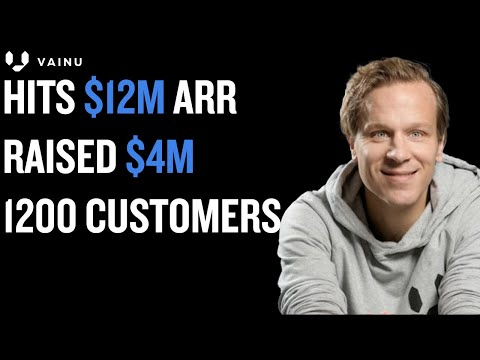
How Vainu Reached $12M ARR with 1,200 Customers and 100% Net Dollar Retention (Interview with CEO Pietari Suvanto)
- Interview Date
- October 26, 2022
- Interviewee
- Pietari SuvantoCo-Founder and CEO
Company Metrics at Interview Time
ARR (2022)
$12M
Customers (2022)
1,200
Net Dollar Retention (2022)
100%
Team Size (2022)
130
Total Funding Raised
$4M
Historical Snapshot
These numbers were reported by Pietari Suvanto during his interview with Nathan Latka in October 2022 and are a historical snapshot, not current figures. See Vainu’s current numbers.
Key Takeaways
- 01Vainu reached $12M ARR in 2022 with 1,200 customers after deliberately cutting its customer base from 2,500 in 2019
- 02Net dollar retention improved from 98% in 2019 to 100% in 2022 as the company moved upmarket
- 03Gross revenue retention stood at 85% in 2022, up from 88% implied by 12% gross churn in 2019
- 04The company raised only $4M in total external funding against $12M ARR, making it highly capital efficient
- 05Vainu employs 50 engineers and 15 quota-carrying sales reps out of a 130-person team
- 06The biggest customer pays approximately $300,000 per year for firmographic data delivered to Snowflake or AWS
- 07Vainu charges per account and per data point on an annual basis, not per update
- 08Revenue grew from $4M in 2017 to $10M in 2019, then to $12M in 2022
- 09Organic SEO, blog content, and live events targeting RevOps audiences are the primary growth tactics
- 10The company was founded in 2014 and bootstrapped to $10M ARR before taking any external capital
Company Metrics at Time of Interview
| Metric | Value | Source |
|---|---|---|
| ARR (2022) | $12M | Founder interview, Oct 2022 |
| ARR (2019) | $10M | Founder interview, Oct 2022 |
| ARR (2017) | $4M | Founder interview, Oct 2022 |
| Customers (2022) | 1,200 | Founder interview, Oct 2022 |
| Customers (2019) | 2,500 | Founder interview, Oct 2022 |
| Net Dollar Retention (2022) | 100% | Founder interview, Oct 2022 |
| Net Dollar Retention (2019) | 98% | Founder interview, Oct 2022 |
| Gross Revenue Retention (2022) | 85% | Founder interview, Oct 2022 |
| Gross Annual Churn (2019) | 12% | Founder interview, Oct 2022 |
| ARPU (2019) | $600 | Founder interview, Oct 2022 |
| ARPU (2017) | $400 | Founder interview, Oct 2022 |
| Biggest Customer ACV (2022) | $300,000 | Founder interview, Oct 2022 |
| Total Funding Raised | $4M | Founder interview, Oct 2022 |
| Team Size (2022) | 130 | Founder interview, Oct 2022 |
| Engineers (2022) | 50 | Founder interview, Oct 2022 |
| Sales Reps (quota-carrying) (2022) | 15 | Founder interview, Oct 2022 |
| Customer Success Headcount (2022) | 20 | Founder interview, Oct 2022 |
| Year Founded | 2014 | Founder interview, Oct 2022 |
Growth Breakdown
Revenue
Vainu grew from $4M ARR in 2017 to $10M ARR in 2019, then reached $12M ARR by 2022. Growth was relatively flat between 2019 and 2022 as the company deliberately shed lower-value customers and repositioned toward enterprise and RevOps buyers.
Customers
The customer count fell from 2,500 in 2019 to 1,200 in 2022 as Vainu exited segments it considered strategically misaligned. The company accepted lower volume in exchange for higher-quality accounts with stronger retention and expansion potential.
Team
Vainu grew to approximately 130 people by 2022, including 50 engineers, 15 quota-carrying sales reps, and around 20 people in customer success. The engineering-heavy headcount reflects the company's emphasis on product and data infrastructure over sales-led growth.
Funding and Profitability
Vainu raised $4M in total external capital, with investors owning only a small percentage of the company. The founder described the business as capital efficient, having reached $10M ARR before taking any outside investment, and indicated the company was on track for good growth and profitability in the following year.
Growth Strategy
Organic SEO and Blog Content
Vainu built early traction in Finland by creating content aimed at salespeople, then shifted its content strategy toward RevOps and data quality themes as it repositioned globally. The company treats thought leadership in the RevOps space as its primary inbound channel.
Live Events and Community
Pietari Suvanto credited attending and speaking at RevOps events as a meaningful driver of awareness and pipeline, particularly in Europe where the RevOps category is still emerging compared to the US market.
Deep CRM and Data Warehouse Integrations
Vainu invested heavily in connectors to major CRMs and data warehouses such as Snowflake and AWS, making its firmographic data easy to embed in core customer workflows. This stickiness supports retention and justifies higher contract values with enterprise buyers.
Moving Upmarket and Shedding Low-Value Customers
Rather than chasing volume, Vainu deliberately allowed high-churn, low-fit customers to leave and focused resources on larger accounts. This shift drove net dollar retention from 98% to 100% and increased the spread between its smallest and largest contracts significantly.
Product-Led Data Specialization
Vainu chose to specialize in firmographic and company website data globally rather than competing across contact, technographic, and outreach categories. This focus allowed the company to build a defensible position and a confidence-scored segmentation product that larger enterprises are willing to pay for.
Best Quotes
“Well, I think 2019, we were a little bit more focused for the sales people and now we're more focused to the revenue ops people. So how it differs in the product is really that we've built good integrations, good connectors so that we are very good at integrating our data into the platforms where the actual work really these days happen.”
“It's actually a funny story. I think we had 2,500 when we talked last time. Now we have 1,200. So we've actually because we've shifted the strategy a bit. We get rid of those customers that we felt is not good for our strategy and double down on those at work. And then, yeah, that's the situation now. So we have actually half of the amount we had last time.”
“Well, we don't pay attention to them. So, I mean, if they wanna pay, then then they do. But but, of course, that that customer segment that that we don't wanna keep, typically, churn is very high. So the problem sort of takes care of them itself on a natural basis, I would say. And then you put your time and money to those that you want to keep. Then of course, the churn and the returns just go significantly up.”
“We we charge today, we charge practically per account and then per data point. So I mean, if there's a let's say you want 1,000,000 companies and then you want, like, five different data points, then it has a certain certain price for it. And then we don't charge per update. We charge sort of per annually that we keep that updated on an annual basis.”
“It's been more or less grown a little bit, but more or less flat, I mean, in that sense. So but now I think that that thing is done and next year we're expecting like good growth and good profit. So next year is really a testament of our transformation that it's been working. So I'm looking very excited for it.”
“It's really about creating good quality content, not only blogs, but videos on demand stuff. We go to the events and talk to people, to RevOps people and all that kind of stuff. It works for us very well.”
“The net yeah. The dollar net retention is is it's actually a 100, a little bit over a 100, and then the gross is on 85 to 90. So they actually remained more or less same actually.”
“Like, 50, maybe something like that. So it's for bootstrap. Yeah. For bootstrap. Yeah. It's a lot. It's it's a lot when when when you're when it's not like this money.”
What Happened Next
This interview captured Vainu at a deliberate inflection point in October 2022, when the company had just completed a multi-year repositioning from a high-volume, lower-ARPU model toward a smaller base of higher-value enterprise customers. The numbers here reflect what Pietari Suvanto reported at that moment and will not match the company's current state. Visit the Vainu company profile on GetLatka for the latest available metrics.
View Vainu’s current profile and metricsFull Transcript
Chapters
- 0:00Introduction and Company Overview
- 0:20Positioning vs. ZoomInfo, Cognism, and Clearbit
- 0:47Product Evolution Since 2019
- 1:50Firmographic Data as the Core Specialization
- 2:38ARPU Growth and Enterprise Contract Spread
- 3:19Enterprise Use Cases: Snowflake and AWS Delivery
- 7:28Pricing Model: Per Account and Per Data Point
- 8:22Customer Count Drop from 2,500 to 1,200
- 9:54Funding: $4M Raised on $10M ARR
- 16:47SEO and Content Strategy for RevOps Audience
- 18:33Team Breakdown: Engineers, Sales, and CS
- 19:45Net Dollar Retention and Gross Retention Update
- 20:36Famous Five Rapid Fire
- 22:01Closing Summary
Introduction and Company Overview
Nathan Latka
00:00Hey, folks. My guest today is Pietari Suvantu. He's the cofounder and CEO of Vainu. His mission is to generate revenue for his customers by collecting firmographic data and making it actionable by integrating it to his customers' business processes, such as their CRMs, market automation tools, and data warehouses. Alright. Peetar, are you ready to take us to the top?
Pietari Suvanto
00:18>> Yes. Of course. Let's do it.
Positioning vs. ZoomInfo, Cognism, and Clearbit
Nathan Latka
00:20So in The States, folks are really familiar with maybe Pitchbooks or or CB Insights or sort of some of these companies. Would you put yourself in that same category? Would you say you're different?
Pietari Suvanto
00:31>> Maybe a little bit of different. I think I'd put ourselves in the ZoomInfo, Cognism, Clearbit mostly in that category. I think that's more more closer, to marketing and sales instead of instead of like venture capitals and financial people.
Product Evolution Since 2019
Nathan Latka
00:47Makes tons of sense. Now you came on. We're just joking about this back in '19. Actually, you came on in 2017 and 2019. Yeah. So regular guest. Regular guest. Well, we we got to catch up. It's been three years. So help me understand today, how is the product different or is it pretty much still the exact same thing?
Pietari Suvanto
01:03>> Well, I think 2019, we were a little bit more focused for the sales people and now we're more focused to the revenue ops people. So how it differs in the product is really that we've built good integrations, good connectors so that we are very good at integrating our data into the platforms where the actual work really these days happen. The other thing that has been a big difference, I think we served the Nordic audience back in three
01:31>> years ago, we just launched a global product. So now we can serve the customers all over the world and we're very specialized, not specifically globally, not in contact data, but the firmographic data and that specifically data from company websites to understand and analyze that. And that's what we do globally these days.
Firmographic Data as the Core Specialization
Nathan Latka
01:50And why did you use firmographic data as sort of your beachhead, your first thing versus technographic data or some other dataset about a company?
Pietari Suvanto
01:58>> Well, I think there's an just to understand understood understand content from company website and sort of categorize segment the company. We felt this is space that hasn't been filled yet. There's a lot of contact providers. There's a lot of technographic providers. There's a lot. But we're very good at segmenting the company, giving sort of a confidence score on certain values. I think that's our sweet spot on a global basis. Of course, The Nordics, we're like full
02:31>> suite when it comes to company data. So where we can offer really anything. It's a tiny piece of the whole world.
ARPU Growth and Enterprise Contract Spread
Nathan Latka
02:38Now when you came on last time, I asked you what's the average customer paying and you said about $600 a month, which was up from $400 a month in 2017. I'm gonna guess you've probably expanded that even more. What's the average customer paying per month today?
Pietari Suvanto
02:52>> Is the average customer is around annually, it's like 10,000. So it's it's gone. It increased a bit. So not that much. But if we look at the spread, how much is the biggest customer paying versus the lowest, that has increased significantly. So we have customers that pay several hundreds of thousands, and then we have customers that pay 1 or 2,000.
Nathan Latka
03:12So Tell me that story.
03:14So your if your biggest customer, what, pays $300,000, $400,000 a year?
Pietari Suvanto
03:17>> Something like that. Yeah. Yeah.
Enterprise Use Cases: Snowflake and AWS Delivery
Nathan Latka
03:19So if if if don't name the customer, obviously. But if someone's paying you $400,000 per year, what are they getting for that? Why is it is it number of bits of information, number of seats? What allows you to upsell?
Pietari Suvanto
03:29>> It's really the amount of data and then how we deliver that data. And for these customers that pay hundreds of thousands of dollars per year, it's really about a lot of data. And then it's delivered really to their Snowflake or AWS, some core processes in those enterprises are run with our data. So for example, if there's a CRM and they want to form a new company or they want to send a bill or whatever they want to do,
03:57>> that data comes from our database and it's very crucial for them. So that's why they want want that it flows securely and surely. That's why they're willing to pay for it.
Nathan Latka
04:06Oh, what's going on there, YouTube? Good to see you guys. Now imagine this. You love watching these interviews with SaaS founders. But imagine if we took all of the valuation data out from over 2,807 interviews I've done manually saves you a lot of time. Well, we've done this. We've built it into the beautiful interface inside of Founderpath. Check this out. I'll show you how you can access this in a second, but you log in, you connect
04:30your Stripe account, you see your valuation real time. You can see what it changed over the past eighty eight days and even set goals for valuation this year. Now the secret evaluation is there's many different ways to value a SaaS business. So the reason you're gonna see three or four different valuations inside of your Founderpath dashboard, this is all free by the way, is because depending on who's doing the buying of your SaaS company, you're gonna
04:54get a different valuation. A VC is gonna pay a different valuation. Private equity firm is different. If you're gonna do a minority sale, that's different. And if you sell the whole business, that's a different valuation. You can see all those when I hover over here.
05:07Right? So
05:08the teal is what a VC would pay. Yellow is what private equity and red is if you sold the whole thing outright. Now what's cool about this is this is not built off random data. Again, you guys hear these interviews on YouTube. All these datas are built from real time valuation data points founder share with us on the show. So traction, 1,200,000 seed round, 3.7 raise. They sold 22% of their business. Go in here and filter
05:31by the event. Maybe you only wanna see companies that have sold the whole business. Well, here are a bunch that have been acquired, the valuation and the multiple. Maybe you're going out right now and you're raising your seed round. We'll go in here and look at all this recent seed deals that went down, what they raised, what valuation they raised at, and what percent that they sold. There's never been a larger dataset of SaaS valuations than
05:57what you can get now inside of Founderpath. And we're thrilled to bring it to you. Alright. We're gonna go back to the YouTube video here in a second. But if you wanna check this tool out, if you wanna jump in and sign up, you can check it out for free to get your valuation at this link. This link, founderpath.com/products/valuations. Or if you go to founderpath.com and hover over products, click on get your valuation here, and go
06:22ahead and sign up to give it a whirl. Again, all that valuation data live right inside the platform. I hope to see you there. Alright. Let's jump back into the interview. Can you give me an example of the a kind of piece of data you might deliver to someone's Snowflake database or AWS database or servers on a on a on a monthly basis who's paying some of the enterprise enterprise prices?
Pietari Suvanto
06:45>> Yeah. I mean, for for some cases, might be official data, very likely business ID related data. And for some, it's really about the segmentation models I was just talking about on a global basis that that we deliver, like, continuously for a few million companies that segmentation data in the Snowflake. And then they operate, for example, their marketing campaigns to the marketing automation CRM systems, data and take actions from there forward. So that's that's that's really the
07:17>> the the more of the data, the the k, really. The seeds that
Nathan Latka
07:21matter the amount of data? Like, what is it quantified by? Is it bits transferred per month? Or how do you
Pricing Model: Per Account and Per Data Point
Pietari Suvanto
07:28>> We we charge today, we charge practically per account and then per data point. So I mean, if there's a let's say you want 1,000,000 companies and then you want, like, five different data points, then it has a certain certain price for it. And then we don't charge per update. We charge sort of per annually that we keep that updated on an annual basis.
Nathan Latka
07:51So at least one update per year or something like that?
Pietari Suvanto
07:54>> Yeah. Yeah. Something like what they really pay for us is that they they feel secure that that company data is updated. And never if it's 100 times or zero, that doesn't matter.
Nathan Latka
08:04Okay. I see. I see. That makes sense. Got it. And then again, officially, I forget, launched it was 2013 or 2014?
Pietari Suvanto
08:12>> As a company, it's 2014.
Nathan Latka
08:15It was 2014. Okay.
Pietari Suvanto
08:16>> Yeah.
Nathan Latka
08:17And then fast forward to today, how many customers are you now working with?
Customer Count Drop from 2,500 to 1,200
Pietari Suvanto
08:22>> It's actually a funny story. I think we had 2,500 when we talked last time. Now we have 1,200. So we've actually because we've shifted the strategy a bit. We get rid of those customers that we felt is not good for our strategy and double down on those at work. And then, yeah, that's the situation now. So we have actually half of the amount we had last time. Not the typical story I would imagine in your podcast,
08:47>> I think It it has been a big
Nathan Latka
08:49takes so much discipline to fire effectively fire customers. So Yeah. Exactly. Someone else listening want to learn from you, they might go, man, I don't know how to tell customers to stop paying me. I don't wanna piss them off and have them tweet about it. How do you how do you, like, nicely tell people we don't want you as a customer anymore?
Pietari Suvanto
09:03>> Well well, we don't pay attention to them. So, I mean, if they wanna pay, then then they do. But but, of course, that that customer segment that that we don't wanna keep, typically, churn is very high. So the problem sort of takes care of them itself on a natural basis, I would say. And then you put your time and money to those that you want to keep. Then of course, the churn and the returns just go
09:27>> significantly up.
Nathan Latka
09:30Even with less customers, so has you been have you been able to grow revenue since 2019 or is it have you been flat?
Pietari Suvanto
09:36>> It's been more or less grown a little bit, but more or less flat, I mean, in that sense. So but now I think that that thing is done and next year we're expecting like good growth and good profit. So next year is really a testament of our transformation that it's been working. So I'm looking very excited for it.
Funding: $4M Raised on $10M ARR
Nathan Latka
09:54That's awesome. Now, have you guys bootstrapped or raised capital?
Pietari Suvanto
09:58>> We have like 4,000,000. We raised 4,000,000. So there's an VC owns maybe a few percentages of us. So we're not significantly. That that was last year, I think. Yeah. Last year, it's been two different sets. So last year and the year before.
Nathan Latka
10:14Okay. So last year okay. Got it. So 4 sort of 4,000,000. You call those like I mean, you're bigger because but you bootstrapped to so much revenue before you raise any external capital. Right? I mean, you had what? Like, $7, 8, 9,000,000 in ARR before you took on external capital. Right?
Pietari Suvanto
10:28>> Yeah. Like, 10,000,000, something like that. Yeah.
Nathan Latka
10:3010,000,000. Yeah. And today, like, if I take 1,200 customers times $800 a month, you're doing, like, $12,000,000, $13,000,000 run rate, something like that.
Pietari Suvanto
10:37>> Yeah. Yeah. Twelve, thirteen. That's pretty accurate. Yeah.
Nathan Latka
10:40Yeah. This this is still great. So, I mean, anytime a founder to me, if you've raised less than what your total ARR is, I call you bootstrapped. I think it's very capital efficient. Right? It's very capital efficient.
Pietari Suvanto
10:51>> Yeah. Yeah. Yeah. That's true.
Nathan Latka
10:53Compared to, like look. I'm I'm friends with James, right, at Cognism. Right? They've got 34,000,000 in ARR, but they've raised, I think, like, 50 or something. Right? So he's backwards in that sense. ZoomInfo is a different story.
Pietari Suvanto
11:04>> Yeah. Of course. Yeah.
Nathan Latka
11:05Now what I will say is when you watch how Henry approached the Chorus deal, right, when he bought Chorus for 450,000,000, he could have bought Gong. Like, there's a lot of you could bought SalesLoft. There's a bunch of other tools. But because Chorus was more capital efficient, their valuation was, like, lower, and he didn't have to negotiate with VCs. They already get that deal done for $500,000,000. Are you have you had any conversations with Henry
11:27about exiting to ZoomInfo?
Pietari Suvanto
11:29>> No. Not not not not really. I think, of course, the market is very active. The go to market space is very active these days. So, of course, discussions are all over the place, but nothing like nothing concrete and not not really with the zooming for today's funky.
Nathan Latka
11:45What would you look for? Right. If you saw someone else and you sort of chatted with him or her, another founder like, hey, we should think about coming together. Like, what would you look for in someone like that, whether it's a merger or an acquisition?
Pietari Suvanto
11:55>> Yeah. Well, I would look at from what are advantages and then what would be a good fit. I think our advantage is definitely the firmographic data. And that's one thing. And then the other thing is like the connectors and the integrations to these. We put a lot of effort that our company data integrates well with these most known CRMs and the data flows well into these data warehouses and such. So that's our strength. Of course, where
12:24>> we lack things is contact data is one, IP based data is one,
12:31>> outreach tools. That's something we're not that much into. But of course, if you look at the whole puzzle, I think IP and contact data are the ones that really is being asked most by our customers. So maybe somewhere around there. I don't know.
Nathan Latka
12:47Okay. Interesting. Would you ever go? I mean, assume you guys are very profitable. Right? Would you ever go buy a company in that space or would you prefer to build it from scratch?
Pietari Suvanto
12:55>> Well,
12:57>> it really depends. I think it's how how I think we need to look at is that what is best for the company and what's the best possible deal? Is it that we would buy some somebody? I don't know. Is it that we would join somebody? I don't know. Would we go bootstrapped along the way? I don't know. I think it just needs to be the best possible decision for the company. And yet there's nothing like that.
13:18>> Now we're just focused on what we are what we're doing or what we wanna do now.
Nathan Latka
13:21And who is we? How many folks on the team today?
Pietari Suvanto
13:25>> So we have, like, three three o three main owners, two founders that are still active, and the the third one is a shareholder. Then we have around 130, 140 people working, and then a very big chunk of those also own the company through share shares or option program.
Nathan Latka
13:45How big? I mean, there's a lot of bootstrappers or capital efficient founders that always go, Nathan, how big I don't want VCs, so they're the board's not gonna set the ESOP pool, but I wanna give a little bit of equity to founders. How did you guys decide how big to set up your employee stock option pool?
Pietari Suvanto
13:59>> Well, I mean, I think we just came up with the number really and and something that felt right. I think we we combined the amount of how we feel back then when we did the option plan, felt right for the existing people that were there. And then also we thought that there will be in the future, there will be also good people. So we need to secure some for them. And then we added sort of those
14:23>> two and came up with the numbers. So I think today,
14:28>> around 10% of the company is owned by outside founders and then we
Nathan Latka
14:33just Now you mentioned earlier, three co founders, two are still active, one's one's not. Are you one obviously, you're one of the two that are still active. Right?
Pietari Suvanto
14:41>> Yep. Yeah. Yeah. Definitely. Yeah.
Nathan Latka
14:43There's a lot of founding teams listening where there's, like, a third cofounder or even a second cofounder that's just not active anymore. It sounds like you guys sort of went through this. It can be hard sometimes. It can be even nasty sometimes. So when when that third co founder for you guys told you, hey, I don't wanna be sort of actively involved in operations anymore. How did you handle that?
Pietari Suvanto
15:00>> Well, I think we handled it very well. Of course, those discussions are always very truthful. You need to discuss what do you really want, what are the ambitions. But I think all of us three, we are like, we think for the company's best interest in the end when those kind of decisions come. And I think we're all very happy where we are right now and we talk to each other and discuss with each other and we're
15:23>> still friends and all that. There's not like that sort of drama involved. It's just how life evolves sometimes.
Nathan Latka
15:30That's good. All right. So you three own a big chunk. The ESOP is about 10%. And then you said the 4,000,000 from the seed they own, what, under 5%, a couple percentage points?
Pietari Suvanto
15:39>> Yeah. Some yeah. Ballpark that. Yeah.
Nathan Latka
15:42Okay. Interesting. Got it. I mean, I guess, look, if you raised 4,000,000 and sold 5%, I mean, what would that valuation be? Something like what? That's like a 100,000,000 valuation.
Pietari Suvanto
15:52>> Oh, I mean, you can do the math. Yeah. Well, I I won't comment on that, but you can do the math from there. I
Nathan Latka
15:58guess the reason I'm asking is you've taken a nontraditional approach. I mean, would you ever go buy out the investors so you can go back to being fully bootstrapped?
Pietari Suvanto
16:06>> I mean, never thought. I mean, never thought about that. I think right now when it comes to all these, you know, raising raising money, doing MMAs, all these things, it's really we're focused on what we're doing right now. So that's why I'm I'm just shouting out thoughts. No thinking, no ideas, you know, just focusing on focus.
Nathan Latka
16:25Well, if your investors are going, hey, markets are terrible. Our LPs won't give us any more money. We'd love to get our money back. And you say, fine, we'll pay you two x what you put in. So 8,000,000 on four. Let me know. I'll give you 8,000,000 out of our fund. It's debt. You pay it back over five years. Well, it'll be a beautiful deal.
Pietari Suvanto
16:41>> Alright. Alright. Yeah. Yeah. That's that's good to know. That's good to know.
Nathan Latka
16:45So we
Pietari Suvanto
16:45>> have at least one one one chance.
SEO and Content Strategy for RevOps Audience
Nathan Latka
16:47Yeah. I I'm kidding. No. It's look. I I've I've long admired what you've built. When I was focused on GetLatka, my data engine was this audio data. Obviously, it doesn't it doesn't scale, but I've done 3,500 episodes now. You've done a much better job building this. So 143 folks, I guess last thing I'll talk about is productized SEO. I mean, you guys are killing it because I mean, it it works nicely with your business, but walk
17:10me through how you guys thought about your SEO strategy in terms of getting free traffic.
Pietari Suvanto
17:15>> Well, that's actually a good question. So I think what we started out with, we're very sales focused, so how a salesperson could do a better job in their life. So that's how we got at least very good traction in Finland and we create a lot of content. With this new product, with this new strategy, we've sort of focused and then we're speaking more about RevenueOps and RevOps and how the importance of data and we speak about
17:42>> what consists of good quality of data. So it sort of shifted a bit. So that's the space what we want to win. I know in The US, the rev ops is already booming in Europe. It's sort of coming a few steps back. And I think that's the space we're gradually getting. And it seems to work very well. And we get a lot of good traffic by just being sort of the opinion leader in that sense, you
18:06>> could say. First, when it was the active data driven salesperson, now it's with the RevOps, and that's how we get it. So it's really about creating good quality content, not only blogs, but videos on demand stuff. We go to the events and talk to people, to RevOps people and all that kind of stuff. It works for us very well.
Nathan Latka
18:26Got it. Of the 145 people on the team, how many are a sales rep that that carries carries a quota?
Team Breakdown: Engineers, Sales, and CS
Pietari Suvanto
18:33>> New business sales reps, it's, I would say, like 15 at the moment. So it's it's not too we don't spend actually that much. I mean, compared to our competition, we don't spend that much on on sales and marketing out of out of our revenue. So it's it's more of product development where we put a lot on yeah. And then
Nathan Latka
18:53How many engineers?
Pietari Suvanto
18:55>> Like, 50, maybe something like that. So it's for bootstrap. Yeah. For bootstrap. Yeah. It's a lot. It's it's a lot when when when you're when it's not like this money.
Nathan Latka
19:05Yeah. Yeah. So and you guys are based in Finland, you said?
Pietari Suvanto
19:09>> Yeah. That's right.
Nathan Latka
19:10Yeah. So 50 engineers, 15 sales reps that carry a quota. What are the other 80 employees doing?
Pietari Suvanto
19:17>> There's a lot actually. Well, we have 20 to 30 now in CS working with the customers. Then we have admin marketing, that kind of stuff, the rest. That's and then we have few few just onboarded. I counted to 140. A few onboarded, a few new people that doesn't I don't count yet to be salespeople because they don't have a quota. That's when they will.
Net Dollar Retention and Gross Retention Update
Nathan Latka
19:45Fair enough. Fair enough. Well, hey, listen. This is a super exciting story. I'm thrilled to hear you're still doing well. Last question before we wrap up. When we last spoke, I asked you about net dollar retention. Right? To your point, smaller customers who churned a bunch, you said that you had 12% gross annual churn and 10% expansion for 98% net dollar retention in 2019. What is that today?
Pietari Suvanto
20:07>> The net yeah. The dollar net retention is is it's actually a 100, a little bit over a 100, and then the gross is on 85 to 90. So they actually remained more or less same actually. And now when we speak about it. Yeah.
Nathan Latka
20:21Yeah. Looks like 90. So if you churn 10% gross and you add 15% expansion, your net dollar retention gets up to that 105 number. But that's a big I mean, look, going from under 100% to above 100%, that's a big move. So congratulations.
Pietari Suvanto
20:34>> Yeah. Yeah. Thank you. Thank you. It's cool.
Famous Five Rapid Fire
Nathan Latka
20:36All right. On that note, let's wrap up with a famous five. Number one, favorite book.
Pietari Suvanto
20:40>> Favorite book. The last one I read, it's Moby Dick. I think it was very good.
Nathan Latka
20:44Moby Dick.
20:45Love that. Number two, is there a CEO you're following or studying?
Pietari Suvanto
20:50>> Actually, let me see. Currently, actually, no. I have a lot of lot of of ones I follow. And let me see. Let me let me put you on my it's one thing is one. You don't know it. But Give me
Nathan Latka
21:02give me me give me a founder, a SaaS founder in Finland that you really like.
Pietari Suvanto
21:06>> Well, I really like. Well, I like actually I know you interviewed him as well, the the Supermetrics CEO is I like him a lot. He's cool.
Nathan Latka
21:14Do you also have a sauna on your rooftop?
Pietari Suvanto
21:20>> In our in our office. Actually, we do have in the office buildings, but there is a sauna, but it's not only for us. So not quite not quite where where Supermetrics is, unfortunately.
Nathan Latka
21:29That's amazing. Alright. Number three. What's your favorite online tool for building Vainu?
Pietari Suvanto
21:34>> Favorite tool for well, I need to say it's from the sales center, HubSpot. I like HubSpot on on the sales. That's the number one.
Nathan Latka
21:42Number four.
Pietari Suvanto
21:43>> How many
Nathan Latka
21:43hours of sleep do you get every night?
Pietari Suvanto
21:45>> I sleep seven hours per night.
Nathan Latka
21:47And situation, married, single, kids?
Pietari Suvanto
21:50>> I'm married. No kids.
Nathan Latka
21:52Married. No kids. And how old are you?
Pietari Suvanto
21:54>> I'm 39.
Nathan Latka
21:5539.
21:56Last question. Something you wish you knew when you were 20.
Closing Summary
Pietari Suvanto
22:01>> To tell myself that things take time. I think that's good.
Nathan Latka
22:05Guys, things take time. Vainu.com launched back in 2014, broke 4,000,000 in revenue in 2017, broke 10,000,000 revenue in 2019. They're now doing about 12,000,000 in revenue. But the nice thing is, might go, why do they not grow faster over the past four years? Well, the thing they're very capital efficient. Only 4,000,000 raise for 12,000,000 ARR, very capital efficient founder here. Again, helping folks understand and get firmographic data to feed into their CRMs, their their their
22:32databases, their Snowflake instances, etcetera, growing nicely as they move upstream. Less customers, higher ARPU. We'll see what happens next. Pietary, thank you for taking us to the top.
Pietari Suvanto
22:42>> Thank you. Thank you very much.
Nathan Latka
22:45One more thing before you go. We have a brand new show every Thursday at 1PM central. It's called Shark Tank for SaaS. We call it deal or bust. One founder comes on, three hungry buyers, they try and do a deal live and the founder shares back end dashboards, their expenses, their revenue, ARPU, CAC, LTV, you name it, they share it and the buyers try and make a deal live. It is fun to watch every Thursday one
23:10p. M. Central. Additionally, remember these recorded Founder interviews go live. We release them here on YouTube every day at two p. M. Central. To make sure you don't miss any of that, make sure you click the subscribe button below here on YouTube, the big red button and then click the little bell notification to make sure you get notifications when we do go live. I wouldn't want you to miss breaking news in the SaaS world, whether it's
23:31an acquisition, a big fundraise, a big sale, a big profitability statement or something else. I don't want you to miss it. Additionally, if you wanna take this conversation deeper and further, we have by far the largest private Slack community for B2B SaaS founders. You want to get in there. We've probably talked about your tool if you're running a company or your firm if you're investing. You can go in there and quickly search and see what people
23:53are saying. Sign up for that at nathanlatka.com slack. In the meantime, I'm hanging out with you here on YouTube. I'll be in the comments for the next thirty minutes. Feel free to let me know what you thought about this episode. And if you enjoyed it, click the thumbs up. We get a lot of haters that are mad at how aggressive I am on these shows, but I do it so that we can all learn. We have
24:12to counter those people. We got to push them away. Click the thumbs up below to counter them and know that I appreciate your guys'support. Alright, I'll be in the comments. See you.