
Founder Interview
How Yobs Reached $20K Monthly Revenue and 20 Enterprise Customers with a Freemium Strategy (Interview with CEO Raphael Danilo)
- Interview Date
- December 15, 2021
- Interviewee
- Raphael DaniloCo-Founder and CEO
Company Metrics at Interview Time
Monthly Revenue (2021)
$20K/month
Enterprise Customers (2021)
20+
Year-over-Year Growth (2021)
200%
Total Funding Raised
$2.5M
Team Size (2021)
12
Historical Snapshot
These numbers were reported by Raphael Danilo during his interview with Nathan Latka recorded in December 2021 and are a historical snapshot, not current figures. See Yobs’s current numbers.
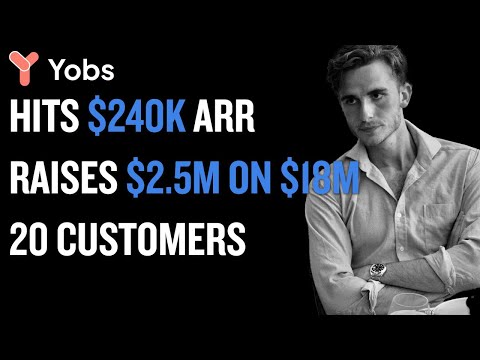
Key Takeaways
- 01Yobs was generating $20,000 per month in MRR as of December 2021 across 20-plus enterprise customers
- 02The company grew approximately 3x year over year, representing roughly 200% growth
- 03Enterprise contracts were priced at $10K per year and up, based on the number of recruiter seats
- 04ARPU ranged from $1,000 per month at the low end up to $5,000 per month for larger enterprise accounts
- 05Yobs closed a $2.5M seed round in 2021, raised on SAFE notes with investors including Adam Grant
- 06The team had 12 people, with 6 engineers and a couple of PhDs in organizational psychology
- 07Nissan was among the first two or three customers, acquired through a personal connection and conference outreach
- 08A free-forever plan was launched two to three months before the interview to pursue a product-led growth strategy
- 09The company was founded in 2018 and incorporated that same year
- 10Raphael Danilo also runs Evening Fund, a $3M operator fund writing $50K to $100K checks, separate from Yobs
Company Metrics at Time of Interview
| Metric | Value | Source |
|---|---|---|
| Monthly Revenue (2021) | $20K/month | Founder interview, Dec 2021 |
| Enterprise Customers (2021) | 20+ | Founder interview, Dec 2021 |
| Year-over-Year Growth (2021) | 200% | Founder interview, Dec 2021 |
| ARPU (low end) (2021) | $1,000/month | Founder interview, Dec 2021 |
| ARPU (high end) (2021) | $5,000/month | Founder interview, Dec 2021 |
| Average Contract Value (2021) | $10K/year and up | Founder interview, Dec 2021 |
| Total Funding Raised | $2.5M | Founder interview, Dec 2021 |
| Seed Round (2021) | $2.5M | Founder interview, Dec 2021 |
| Team Size (2021) | 12 | Founder interview, Dec 2021 |
| Engineers (2021) | 6 | Founder interview, Dec 2021 |
| Year Founded | 2018 | Founder interview, Dec 2021 |
Growth Breakdown
Revenue
Yobs was generating $20,000 per month in recurring revenue at the time of the interview, driven entirely by enterprise customers paying annual contracts. The company grew approximately 3x year over year, reaching roughly 200% growth. Raphael noted the company could have grown faster by focusing solely on revenue, but chose to invest in a free plan to pursue a longer-term land-grab strategy.
Customers
Yobs had 20-plus paying enterprise customers as of December 2021, with notable logos including Nissan. The company also had dozens of companies on its free-forever plan, which had launched just two to three months before the interview. Enterprise customers were charged based on the number of recruiter seats, with contracts starting at $10K per year.
Team
The team had grown to 12 people, with 6 engineers and a couple of PhDs in organizational psychology serving as domain experts in interviewing and assessments. Raphael Danilo, based in Brooklyn, New York, co-founded the company with a European co-founder.
Funding
Yobs bootstrapped for a period before closing a $2.5M seed round in 2021, raised on SAFE notes without a single lead investor. Notable angels included Adam Grant. Raphael indicated the round was structured at a cap in the range of $18M to $20M, consistent with standard seed dilution targets of 10 to 20 percent.
Growth Strategy
Free-Forever Plan for Product-Led Growth
Yobs launched a free plan two to three months before the interview, allowing companies to integrate Greenhouse, Zoom, and Google Calendar at no cost. The goal was to acquire users early, get them hooked on the product, and layer on paid features over time. Raphael described this as a deliberate land-grab strategy while competitors focused exclusively on enterprise sales.
Enterprise-First Customer Acquisition
Yobs landed Fortune 500 accounts like Nissan as its first customers, skipping the typical startup-to-enterprise progression. Early enterprise deals were won through personal connections and conference outreach. While this approach generated large contracts quickly, Raphael acknowledged it also required significant customization and handholding.
Operator-Angel Network and Investor Credibility
The seed round was built around operator-investors, and bringing in high-profile angels like Adam Grant added credibility with enterprise buyers and future investors. Raphael emphasized the value of operator-investors as the most value-added type of backer for a company at this stage.
Proprietary Interview Intelligence Technology
While Yobs used third-party transcription vendors for table-stakes functionality, the core technology that analyzed transcripts and call content was proprietary. This differentiation, combined with domain expertise from organizational psychology PhDs, positioned Yobs as more than a recording tool.
Ease of Doing Business
Raphael described the company's go-to-market philosophy as being the easiest company to work with, allowing prospects to sign up for free, book an onboarding call, or explore the product independently. This contrasted with competitors spending heavily on conference advertising and requiring large upfront commitments.
Best Quotes
“So our our enterprise accounts are in the 5 figure annual contract value. So I mean, it it it depends, but it's kind of like 10 k per year onwards. So roughly $1,000 a month up to, like, $5,000 a month.”
“We have 12 people on the team.”
“Yeah. So we we roughly three x ed since last year. And then the free plan is something that we launched two months ago, exactly two, three months ago.”
“It was crazy because, actually, Nissan and another huge, huge, huge Fortune 500 company were our first customers. So Nissan, I think, was, like, number two or number three.”
“Yeah. So we we bootstrapped for a while, and then we we just raised our seed round earlier this year. So we ended up raising 2,500,000, mostly from, you know, angel investor operators who, obviously, as I mentioned, like, I'm a big believer in the whole operator investor model.”
“It wasn't twenty $100,000 checks, but we didn't we didn't have, like, a strong lead. We raised on safe notes, so it was it was basically just like, you know, we set the terms, and then we brought in who we wanted to bring in. And then had a couple of, you know, cool kind of, like, superstar angels like Adam Grant come in who've been awesome to to work with.”
“I think, like, the the like, raising venture dollars allows you to tap into strategies that, like, long run can actually work out better.”
What Happened Next
This page captures Yobs as it stood in December 2021, when the company had just closed its $2.5M seed round and was generating $20,000 per month from 20-plus enterprise customers. The numbers and strategy described here reflect that specific moment in the company's growth. For the latest recorded revenue, customer count, funding, and team size, visit the Yobs company profile on GetLatka.
View Yobs’s current profile and metricsFull Transcript
Chapters
- 0:00Introduction: Raphael Danilo and Yobs
- 0:24Evening Fund: Raphael's Operator Investment Vehicle
- 1:51What Yobs Does and the Problem It Solves
- 3:32Pricing Model: Free Plan vs. Enterprise Seats
- 5:33Enterprise Contract Value and ARPU
- 6:10Company Founding Story and Remote Hiring Origins
- 8:25First Customers: Landing Nissan as an Early Enterprise Account
- 9:33Current Scale: 20 Enterprise Customers and Revenue
- 9:59Growth Rate and Freemium Land-Grab Strategy
- 11:49Seed Round: $2.5M Raised on SAFE Notes
- 12:16Investor Mix and Adam Grant's Involvement
- 12:56SAFE Cap and Valuation Discussion
- 13:57Why Venture Funding Enables the Free Plan Strategy
- 14:49Famous Five Rapid-Fire Questions
Introduction: Raphael Danilo and Yobs
Nathan Latka
00:00Hey, folks. My guest today is Raphael Danilo. He's a French entrepreneur and investor based in Brooklyn, New York. By day, he's the co founder and CEO of Yobs, an interview intelligence platform on top of Zoom. Yobs is backed by industry leaders like Adam Grant and trusted by dozens of high growth companies like Nestle, HomeTap, and Nissan. On nights and weekends, he runs Evening Fund, a 3,000,000 operator fund out of which he writes fifty to one hundred
00:18k checks in the early stage companies. Raphael, you ready to take us to the top?
Raphael Danilo
00:23Let's do it.
Evening Fund: Raphael's Operator Investment Vehicle
Nathan Latka
00:24What came first, by the way? The the the Evening Fund or Yobs?
Raphael Danilo
00:28So Yobs came first. Evening fund is something that I started just earlier this year, and we've done about 25 investments so far in 2021.
00:43And, yeah, as you said, something that I do just on nights and weekends to, you know, kinda give back and support other founders.
Nathan Latka
00:49Very cool. Well, give back and support, but you need to make a return if you plan on I mean, who did you raise capital from?
Raphael Danilo
00:56So well, so some of the capital so I I drew it with a partner. Her name is Kat. She's also a a full time founder of a of a VC backed company called Baretto. So some of the capital is ours. Some of the capital is from friends of mine, you know, industry connections, and then we have a couple of larger funds. I can't name all of them, but Bain Capital is one that I can name. And
01:22then, yeah, there's a couple of other kind of, like, multistage funds that are LPs in the fund. And yeah. Absolutely. And and, honestly, like, you know, we very often fit into kind of angel allocations because we only write fifty, hundred k checks. So they're pretty small checks. We're not trying to lead rounds or anything. And and it's super fun. And we actually got our first unicorn a month ago after less than a year of investing. So
01:47so far, it seems like it's going pretty well and, you know, most importantly, we're having a ton of fun.
What Yobs Does and the Problem It Solves
Nathan Latka
01:51Alright. Tell me more about Yobs. Who's buying this technology, and when what are they and how are they using you?
Raphael Danilo
01:56Yeah. So, you know, with Yobs, the the kind of the premise behind it is that, you know, interviews have the highest impact on the quality of of hires. But interestingly, they're also, you know, the process with the highest error rate. You know? And so even within the hiring process. So about, like, 50% of interviews basically have a conclusion that doesn't end up being true post hire. Like, we thought that this person was, you know, you know,
02:26very extroverted. Turns out they weren't, etcetera, etcetera. And they also have the biggest impact on the time to hire, like, how long it takes to hire someone. 60 to 80% of it comes back to the interviews. And in the past, like, this wasn't too big of a deal because you could do multiple interviews on sites over, like, weeks, and you could still get good candidates. But now you have so much competition for talent, especially because of
02:49remote work and the talent shortages and just everything that's happening at the macro level, that if you're not going fast, and I'm talking, like, three interviews max for a whole process for, you know, per per per candidate, And you still have to be precise and you still have to be engaging. If you're not like, if this is not your bar, you're you're not gonna get great talent. And so this is particularly painful. Well, so this is
03:11a problem that everybody's facing, you know, from the smallest start up to the biggest companies. As you mentioned, like, we work with Nissan all the way down to, like, small startups. But the the companies that kind of have you know, feel the pain the most are what we call high growth companies. And so high growth companies are typically venture backed. They don't have to be, but, you know, oftentimes they can be.
Pricing Model: Free Plan vs. Enterprise Seats
Nathan Latka
03:32So Raphael, just just just jumping in for a second. So so Yeah. Understand the platform. I think my audience will clearly understand what you're doing based on that description you just gave. Help me understand how you're pricing. Is it per interview, per month?
Raphael Danilo
03:44So we actually have a free forever plan, and we just came out of beta. So so right now, we're not even charging for our entry level plan. We're only charging You're
Nathan Latka
03:53pre you're pre revenue today.
Raphael Danilo
03:55We so we'd only charge enterprises. So we have some larger customers that we charge. But these high growth companies, we don't charge them today. We'll start charging in q one or q two.
Nathan Latka
04:06Okay. Tell me, I guess, can you tell me more about the enterprise folks today? How do you model their plans?
Raphael Danilo
04:11Yeah. So it's it's it's basically based on the number of recruiter seats that you need to have on the platform. So, you know, we will serve recruiting teams largely, but then you also have interviewers that are, you know, functional heads, you know, head of sales, head of engineering, so on and so forth. So depending on the number of people that you need, you know, collaborating on the platform, that's what we charge you based on. But, you
04:32know, unlimited number of interviews, ATS integration, all of that stuff. And then in the free plan, you can you can basically integrate Greenhouse, Zoom, Google Calendar. And if that's your stack, then we give the tool away for free today.
Nathan Latka
04:48I see. So these enterprises, why not give it to them for free as well? Are we just talking like these are, like, two or three of your buddies that run enterprise things, so you you know, it made sense to charge them?
Raphael Danilo
04:57Yeah. No. Because the the enterprise guys typically have, you know, different requirements when it comes to, you know, security, data privacy. There's things around, like, custom integrations or, like, small customizations. And then also just, the whole service component of, like, they may want support around just making sure their process is being run properly. So, you know, they they have the budgets, but they need a little bit more handholding. Just the nature of enterprise sales.
Nathan Latka
05:23I I wanna go back to your free choices, the freemium plan choices you made in a second and your back story. But before that, so give me sort of an average. Right? What is what's an enterprise account gonna pay you per month to use the technology?
Enterprise Contract Value and ARPU
Raphael Danilo
05:33Yeah. So our our enterprise accounts are in the 5 figure annual contract value. So I mean, it it it depends, but it's kind of like 10 k per year onwards. So roughly $1,000 a month up to, like, $5,000 a month.
Nathan Latka
05:49What would how many how many recruiters does someone paying you a thousand bucks a month likely have?
Raphael Danilo
05:56Probably about a dozen, I would say. Like, you know Okay. Like, 10 plus. When we work with high growth companies, they typically have, like, up to 10. So enterprise typically kicks in when you start to have, like, you know, ten, fifteen plus people on your recruiting team.
Company Founding Story and Remote Hiring Origins
Nathan Latka
06:10Yep. That makes sense. Give me the backstory here. When did guys launch the business?
Raphael Danilo
06:14Yeah. So so, you know, we launched three years ago, and it's funny because I'm so I'm from France originally, as you mentioned, and
Nathan Latka
06:23your backstory is 2019, right?
Raphael Danilo
06:26Yeah. Exactly. Yeah. Yeah. Yeah. 2018 actually is when we when we incorporated the business. Okay. And, so before COVID, like, I was always working remotely for startups. Like, I worked for an Israeli startup remotely while I was in LA. Like, we worked with some European companies with my cofounder. We're both European transplants in The US. So we've always done the remote hiring thing. And so we've always kinda felt the pain of interviewing over Zoom and not
06:51being able to collaborate efficiently and effectively when you're interviewing people remotely. Like, you have to consolidate your notes. You have to make sure you're capturing the key moments, and it's it's pretty hard. And so we we came up with this idea of, like, well, what if you could, like, actually, like, record conversations, transcribe them, make it really easy to, like, you know, grab the key moments, share them. And then, you know, as your recruiting team starts
07:13to do this more and more and more, you know, kind of like what gong.io does for for sales calls, you can actually start coaching recruiters. The same way that with Gong, you can start coaching your sales reps based on, like, what closes more deals. Well, here's the same thing. Like, what closes more candidates? What engages them the most?
Nathan Latka
07:29Are you licensing someone else's, like, call flagging or call tagging technology, or have you guys built that in house?
Raphael Danilo
07:36So the the transcription technology, we work with a couple of different vendors, because that's pretty sort of table stakes. And then the the the whole technology to sort of, like, look into what's happening in the transcript and the call that's that's ours. That's proprietary.
Nathan Latka
07:54I see. I see. How many folks are on the team today?
Raphael Danilo
07:57We have 12 people on the team.
Nathan Latka
07:58Okay. So how many of those are engineers?
Raphael Danilo
08:04About half of them.
Nathan Latka
08:05Okay. Six.
Raphael Danilo
08:06And we have a couple of PhDs in organizational psychology who are kind of like domain experts in interviewing and assessments. So they're they're deeply technical, you know, in their own way, just not, you know, software engineers per se.
Nathan Latka
08:18You get going in 2018. You're experimenting. What was it like? Do you remember closing your first customer, and who was it? How'd you get them?
First Customers: Landing Nissan as an Early Enterprise Account
Raphael Danilo
08:25Yeah. It was crazy because, actually, Nissan and another huge, huge, huge Fortune 500 company were our first customers. So Nissan, I think, was, like, number two or number three.
Nathan Latka
08:34How'd you get Nissan?
Raphael Danilo
08:35It was so I actually knew someone who worked at Nissan at the time who's not who's not there anymore. And we went to a conference, and one of their colleagues heard about us, and they just, like, very organically like, that person reached out, and
08:49we ended up making a pilot happen. But what was interesting is, like, we totally kind of skipped the whole, you know, work with startups and then work your way up to enterprise. We did it, you know, exactly the other way where started with Fortune 500 accounts, which had its pros, namely that you can get really big contracts really quickly. I think, like, as an advice, I guess, to other founders on this front, like, you know, just
09:11get ready to get bogged down and also it's, like, a lot of customization and some stuff that, like, when you're on your road to product market fit, you probably don't wanna waste your time doing. So I think that's one, like, flag I would raise when you're going after, like, big, big enterprises as as first customers.
Nathan Latka
09:25So Nissan was number one or number two. And then you obviously, you're now two years later scaling up. How many enterprise customers are you serving
Current Scale: 20 Enterprise Customers and Revenue
Raphael Danilo
09:3320 plus. And then on the free plan, have dozens of companies using us.
Nathan Latka
09:37Yeah. Yeah. Yeah. But but all those 20 ones, again, are the enterprise folks you alluded to earlier where you are charging them per recruiter per seat.
Raphael Danilo
09:44Yep.
Nathan Latka
09:45Okay. Can I take that ARPU you told me earlier of a thousand bucks a month multiplied by 20? You guys are doing about $20,000 a month right now in revenue?
Raphael Danilo
09:53Yeah. That's that's about right. Yeah.
Nathan Latka
09:55Okay. And just to calculate growth rate, where were you exactly a year ago? Do you remember?
Growth Rate and Freemium Land-Grab Strategy
Raphael Danilo
09:59Yeah. So we we roughly three x ed since last year. And then the free plan is something that we launched two months ago, exactly two, three months ago. So the the strategy for us has been really about, like, really playing the long game. So I think, like, we probably could have five x this year or more if we fully focus just on revenue. But, you know, I think, like, we're in a space where it's basically a
10:24land grab. Like, there's a couple of other companies that raised a bunch of funding to do, you something similar as what we're doing. But there there
Nathan Latka
10:30Who are those companies? Just name one or two of them.
Raphael Danilo
10:34You know, there's a company called Clovers out of LA that just raised a good amount of funding from, like, you know, pretty solid investors and a couple of others. And, you know, they're they're they've raised, like, you know, 10 to 30,000,000, you know, roughly is the range. So still pretty early, but, you know, kind of, like, the stage after. And and I think, like, the strategy that a lot of the folks in this space are taking
10:54is focus entirely on the enterprise accounts. And I think, like, you know, it makes sense. I understand why they do it. But I think there's such a huge long tail of businesses that don't wanna shell out 10 to 20 k today, but may want to in a year or two. And capturing them today because they already feel the pain in something like a free plan and, you know, tapping into more of, a product led growth go
11:16to market, I think in the long run, it could be the winning strategy. And so while everybody's focused on, like, enterprise sales and, you know, paying tens of thousands of dollars to advertise at conferences, we're taking more of a, you know, hey. Let's be the easiest company to do business with. So you go on our website today, like, you can sign up for free, book an onboarding call, or explore yourself. Like, we're trying to be super,
11:37super easy to work with, and that's that's basically the strategy.
Nathan Latka
11:40And we're wrapping up — we have about two or three minutes left here. So we'll do this and then jump into the famous five. But in terms of funding, have you stayed bootstrapped, or did you decide to sell some equity and raise as well?
Seed Round: $2.5M Raised on SAFE Notes
Raphael Danilo
11:49Yeah. So we we we bootstrapped for a while, and then we we just raised our seed round earlier this year. So we ended up raising 2,500,000, mostly from, you know, angel investor operators who, obviously, as I mentioned, like, I'm a big believer in the whole operator investor model. I think it's, you know, oftentimes, like, the the most value added investors.
Nathan Latka
12:10So was there a lead in that 2.5, or was it, like, twenty $100,000 checks?
Investor Mix and Adam Grant's Involvement
Raphael Danilo
12:16It wasn't twenty $100,000 checks, but we didn't we didn't have, like, a strong lead. We raised on safe notes, so it was it was basically just like, you know, we set the terms, and then we brought in who we wanted to bring in. And then had a couple of, you know, cool kind of, like, superstar angels like Adam Grant come in who've been awesome to to work with.
Nathan Latka
12:36And then when you're obviously thinking about funding, minimizing dilution is obviously important. So you're doing a note, so cap's important. Most people on a seed round are doing, you know, effectively 10 to 20% if they convert it out to cap where you serve in that same standard range.
Raphael Danilo
12:48Exactly. Yeah.
Nathan Latka
12:49Okay. Pretty big safe. I mean, that means you was, a $20,000,000 cap or 18 to $20,000,000 cap, something like that. That's pretty large.
SAFE Cap and Valuation Discussion
Raphael Danilo
12:56Yeah. I mean, I I think, like, especially in 2021, like, you know, especially if you have traction and you're you're you've proven that you're you're hitting on some of the themes that will be, you know, no brainers over the next few years. You have a good team, and you've shown traction. I think, like, understand that some of these markets are gonna be land grabs, and so you gotta move quick. And so in the long run, you
13:20know, there every invest and we think about it the same as as investors. Like, we're looking for these, like, 1,000,000,000 or $10,000,000,000 companies when we're doing venture investments because 80% of companies are gonna die at that startup stage. So whether you pay 10 or 18,000,000 on a cap is not really like that's not what's gonna make or break it.
Nathan Latka
13:38Mhmm. Well, I mean, more about optionality, though. Right? I mean, you basically put yourself on a track where you have to do something faster. Either hit growth faster or you end up dying faster. Right? So Yeah. Why is it important to have that, like, short term focus versus, you know, buy yourself time, be default alive, be cash flow positive, and play the long game?
Why Venture Funding Enables the Free Plan Strategy
Raphael Danilo
13:57I think, like, as I mentioned, like, playing the long game in the sense of, for example, raising venture funding is what allowed us to play that long game in terms of, like, having a free plan, which I think in the long run is what's gonna allow us to win. Because while everybody's gonna be focused on charging $10,000 for a product that probably isn't worth it, we're able to play that longer game, acquire users, give them a
14:19free version of the product to, like, get them hooked, and then over time start layering on more and more of those features, more and more integrations that actually make the tool really worth it. So I think, like, the the like, raising venture dollars allows you to tap into strategies that, like, long run can actually work out better. So just as you said, it it's more about optionality. And I think you can also do it the bootstrapped
14:43kind of, like, look for, you know, profitability way, and, you know, we see a lot of great businesses do that too.
Famous Five Rapid-Fire Questions
Nathan Latka
14:49Alright. Raphael, let's wrap up here with the famous five. One word answers if you can. Number one, favorite book.
Raphael Danilo
14:56Zero to One, I would say, is the one.
Nathan Latka
14:58Number two, is there a CEO you're following or studying?
Raphael Danilo
15:03I think Jason Lemkin, not a CEO anymore, but a great guy to follow.
Nathan Latka
15:06Number three, what's your favorite online tool for building Yobs?
Raphael Danilo
15:13FullStory is awesome.
Nathan Latka
15:14Number four, how many hours of sleep do get every night?
Raphael Danilo
15:18I'm anal about that. I would say seven or eight hours.
Nathan Latka
15:21Nice.
Raphael Danilo
15:22In situation, married, single kids?
15:24My current situation?
Nathan Latka
15:25Yep.
Raphael Danilo
15:27Girlfriend, not married yet.
Nathan Latka
15:29No kids running around?
Raphael Danilo
15:31Just a dog.
Nathan Latka
15:32Alright. And how old are you?
Raphael Danilo
15:34I'm 23.
15:3523.
Nathan Latka
15:36Last question. Something you wish you knew when you were 20.
Raphael Danilo
15:42Sleep more.
Nathan Latka
15:45Guys, there you have it. Yobstech.com, helping you do interviews more effectively faster and make sure when you end them, there's good follow-up, strong follow-up with a tech stack that they integrate directly with doing about $7,000 a month about a year ago, now $20,000 a month. So three x year over year growth scaling. They just closed a $2,500,000 seed round earlier this year at a called 18 to $20,000,000 valuation as they look to continue
16:04to scale. Raphael, thank you for taking us to the top.
Raphael Danilo
16:07Appreciate it, man.
Nathan Latka
16:10One more thing before you go. We have a brand new show every Thursday at 1PM Central. It's called Shark Tank for SaaS. We call it deal or bust. One founder comes on, three hungry buyers. They try and do a deal live and the founder shares back end dashboards, their expenses, their revenue, ARPU CAC, LTV, you name it, they share it. And the buyers try and make a deal live. It is fun to watch every Thursday one
16:34p. M. Central. Additionally, remember these recorded founder interviews go live. We release them here on YouTube every day at two p. M. Central to make sure you don't miss any of that. Make sure you click the subscribe button below here on YouTube, the big red button and then click the little bell notification to make sure you get notifications when we do go live. I wouldn't want you to miss breaking news in the SaaS world, whether it's
16:56an acquisition, a big fundraise, a big sale, a big profitability statement or something else. I don't want you to miss it. Additionally, if you want to take this conversation deeper and further, we have by far the largest private Slack community for B2B SaaS founders. You want to get in there. We've probably talked about your tool if you're running a company or your firm if you're investing. You can go in there and quickly search and see what
17:17people are saying. Sign up for that at nathanlatka.com/slack. In the meantime, I'm hanging out with you here on YouTube. I'll be in the comments for the next thirty minutes. Feel free to let me know what you thought about this episode and if you enjoyed it, click the thumbs up. We get a lot of haters that are mad at how aggressive I am on these shows, but I do it so that we can all learn. We have
17:37to counter those people. We got to push them away. Click the thumbs up below to counter them and know that I appreciate your guys'support. Alright, I'll be in the comments. See you.