HubSpot Revenue: $3.13B in 2025, and a Market That Cut Its Value in Half Anyway
HubSpot reported $3.13B in 2025 revenue, up 19%, with 288,706 customers at year end. It guided 2026 to $3.7B — and the market cut its valuation in half anyway. The filed numbers, year by year.
On this page
HubSpot's revenue was $3.13 billion in 2025, up 19% from $2.63 billion in 2024, according to the company's Q4 and full-year 2025 results released February 11, 2026. The company ended 2025 with 288,706 customers, up 16% year over year. Through the first half of 2026 the pace has held: Q2 2026 revenue came in at $911.7 million, up 20%, and management guided the full year to $3.69–3.70 billion.
The strange part is what the market did with those numbers. Despite beating estimates, HubSpot stock fell 20.2% on the August 5, 2026 Q2 print, and by mid-August 2026 the company's market cap sat around $11.2 billion — down roughly 51% in a year, per stockanalysis.com. A business compounding revenue at ~20% now trades at about 3x its own 2026 revenue guidance.
$3.13B
2025 revenue, up 19% (Q4 2025 earnings release, Feb 11, 2026)
306,446
customers at June 30, 2026, up 14% (Q2 2026 earnings release)
$11,800
average subscription revenue per customer, Q2 2026
~$11.2B
market cap, mid-August 2026 — down ~51% in a year
What is HubSpot's revenue, year by year?
HubSpot has been public since October 2014 (NYSE: HUBS), so every row below comes from an SEC filing or the company's own earnings releases — the S-1 for the pre-IPO years, 10-Ks after that.
| Year | Revenue | Growth | Source |
|---|---|---|---|
| 2007 | $255K | first full year | S-1 filing |
| 2010 | $15.6M | — | S-1 filing |
| 2014 | $115.9M | IPO year | 2014 10-K |
| 2017 | $375.6M | +39% | 2017 10-K |
| 2020 | $883.0M | +31% | 2020 10-K |
| 2021 | $1.30B | +47% | 2021 10-K |
| 2022 | $1.73B | +33% | 2022 10-K |
| 2023 | $2.17B | +25% | FY2023 earnings release |
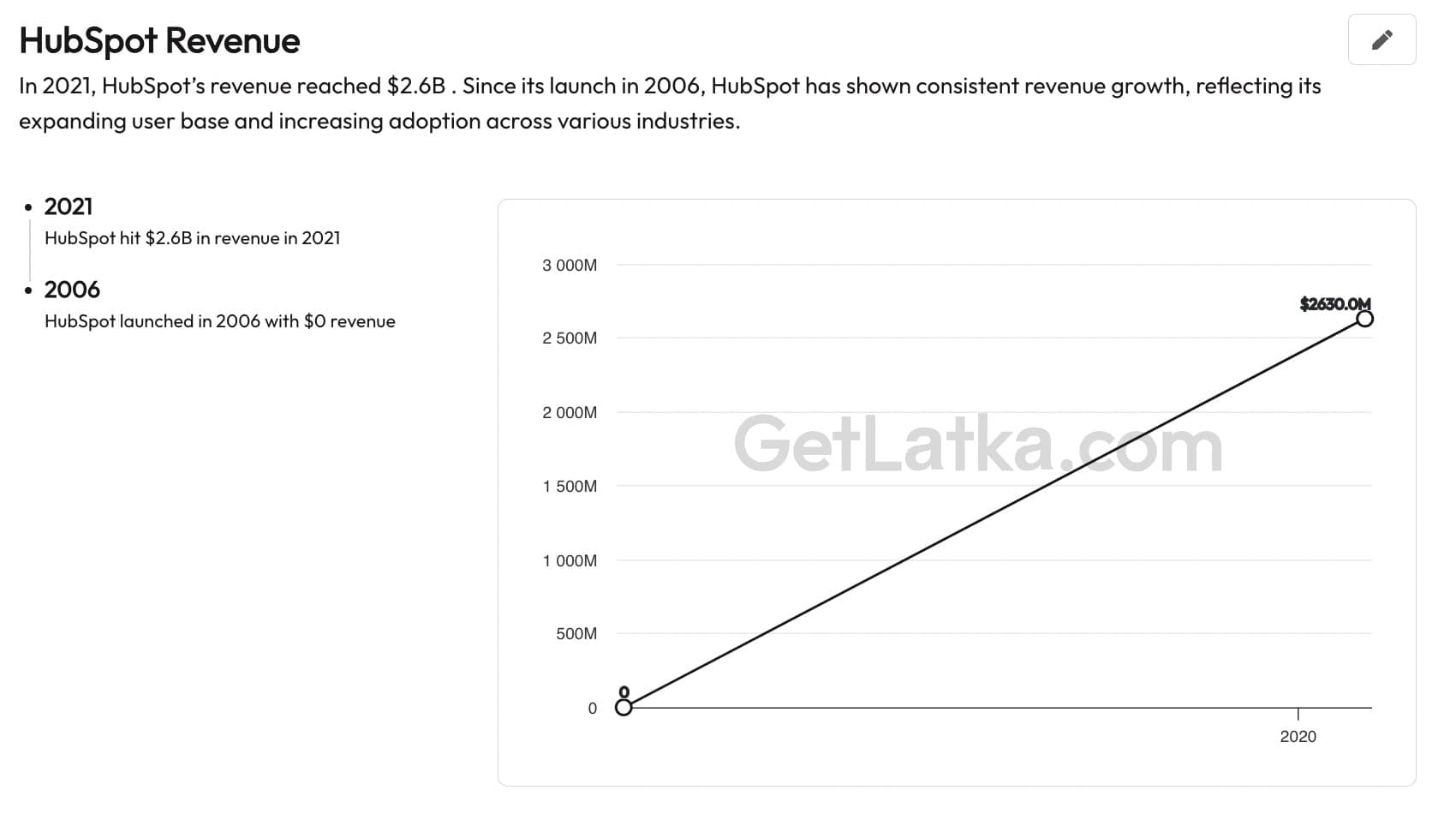
| 2024 | $2.63B | +21% | FY2024 earnings release, Feb 12, 2025 |
| 2025 | $3.13B | +19% | FY2025 earnings release, Feb 11, 2026 |
Growth rates are as-reported. HubSpot guided 2026 revenue to $3.69–3.70 billion, which would be roughly +18%.
The shape of that table is the whole HubSpot story: nineteen consecutive years of growth, from $255,000 in 2007 to $3.13 billion in 2025 — about a 12,000x increase — with the growth rate stepping down a few points a year as the base compounds. Nothing in the filings shows a growth cliff. The stock chart says otherwise, and we'll get to that.
Correcting our own record
An earlier version of this article contradicted itself, and our database has one quirk worth flagging. In the interest of not doing the thing we criticize other people for:
- The old article claimed "184,000 customers driving $879M annual revenue" in one section and $2.63B / 247,939 customers in another. The $879M-era figures were years stale (they roughly describe 2020); the 2024 figures were the correct ones at the time.
- The old revenue table listed $883M as HubSpot's 2021 revenue. Per the 10-Ks, $883.0M was 2020; 2021 was $1.30 billion. Fixed above.
- The old article said HubSpot expanded into CRM "by 2010." HubSpot launched its free CRM in 2014, announced at its Inbound conference the same year it went public.
- Our live HubSpot company page lists 2025 revenue of $3.1B ARR — consistent with the filed $3.13B — and $100.5M raised across six rounds, which matches HubSpot's pre-IPO venture total. But its valuation field currently reads "$12B (2007)," which is a data-entry artifact: $12B happens to sit near HubSpot's August 2026 market cap, and 2007 is when the company raised its first institutional round. In 2007 HubSpot was a seed-stage startup, not a $12B one.
Does the math close? Customers x price vs. reported revenue
HubSpot reports two unit-economics numbers each quarter: customer count and average subscription revenue per customer (annualized quarterly subscription revenue divided by average customers in the period). The arithmetic checks out. Q4 2025 subscription revenue was $829.0 million; annualized, that's $3.32 billion. Divide by the reported $11,683 average subscription revenue per customer and you get roughly 284,000 average customers for the quarter — consistent with the 288,706 HubSpot reported at December 31, 2025.
The more interesting signal is the mix. Customer count grew 16% in 2025 while revenue per customer grew only 3%. HubSpot's growth is volume-driven: more small and mid-market companies coming in at starter and seats-based pricing, not existing customers paying dramatically more. By Q2 2026, average subscription revenue per customer was $11,800, up 4% — so a typical customer pays HubSpot just under $1,000 a month.
2026 so far: a beat, a buyback, and a 20% haircut
Q2 2026 (reported August 5, 2026) was, on paper, a good quarter: revenue of $911.7 million, up 20% as-reported; GAAP net income of $43.3 million, or $0.86 per share, versus a loss a year earlier; a $1 billion addition to the share repurchase program. Full-year 2025 had already delivered HubSpot's first full year of positive GAAP operating income as a public company — $7.4 million, against a $67.6 million loss in 2024 — alongside $594.9 million in non-GAAP free cash flow.
The stock still dropped 20.2% on the print, and the market cap has roughly halved over the past year, from north of $30 billion in early 2025 (the stock traded above $700 then; it closed at $237.08 on August 26, 2026, per stockanalysis.com). Guidance explains part of it: Q3 2026 was guided to $924–925 million, about 14% growth as-reported — a visible step down from 20%. The rest is a story question the filings can't settle: HubSpot built its business on inbound marketing — companies finding you through search and content — and investors are pricing in the risk that AI assistants and AI search results erode exactly that channel. HubSpot's counter-argument on the Q2 call was AI adoption inside its own product. The revenue line hasn't cracked; the multiple has.
How HubSpot got here, briefly
Brian Halligan and Dharmesh Shah founded HubSpot in Cambridge, Massachusetts in 2006, out of MIT, around the inbound-marketing thesis: publish useful content and let buyers come to you, instead of cold-calling them. The company raised about $100.5 million in venture funding before going public on the NYSE on October 9, 2014, priced at $25 per share, and used the following decade to expand from marketing software into a full CRM platform — free CRM in 2014, then sales, service, content, and operations hubs.
Yamini Rangan, HubSpot's first chief customer officer, took over as CEO in September 2021, the same year revenue crossed $1 billion. Under her, revenue has grown 2.4x — $1.30B in 2021 to $3.13B in 2025 — with the customer base more than doubling to 306,446 by mid-2026.
For current figures on HubSpot and its competitors — Salesforce most directly — see the HubSpot page in the Latka database.
Sources
- HubSpot Q4 and Full Year 2025 results, February 11, 2026 — https://ir.hubspot.com/news-releases/news-release-details/hubspot-reports-strong-q4-and-full-year-2025-results
- HubSpot Q2 2026 results, August 5, 2026 — https://ir.hubspot.com/news-releases/news-release-details/hubspot-reports-q2-2026-results
- HubSpot Q4 and Full Year 2024 results, February 12, 2025 — https://ir.hubspot.com/news-releases/news-release-details/hubspot-reports-q4-and-full-year-2024-results
- HubSpot S-1 and annual 10-K filings — https://www.sec.gov/cgi-bin/browse-edgar?action=getcompany&CIK=0001404655
- HUBS market cap and price history — https://stockanalysis.com/stocks/hubs/market-cap/
- Q2 CY2026 market reaction coverage — https://finance.yahoo.com/markets/stocks/articles/hubspot-nyse-hubs-q2-cy2026-221143867.html
- GetLatka HubSpot company page — https://getlatka.com/companies/hubspot.com