Valuation
$4M
2024 Revenue
$55.7K(Est.)
Customers
1
Funding
$500K
Avg ACV
$55.7K
Team
1
Founded
2021
Artial Revenue, Valuation & Funding (2024)
Artial is an AI-driven urban drone safety software company founded in December 2021 and headquartered in Barcelona. The company develops an autonomy engine that provides obstacle avoidance, BVLOS navigation assistance, and AI-driven flight intelligence for commercial drone operators and manufacturers, sold as a licensed software layer installed above a drone's existing firmware.
As of April 2022, Artial was four months old and running its first pilot with Yawas, a U.S. drone manufacturer, targeting deployment across 20 to 25 drones. Three to five additional potential customers were in active negotiation under NDA. The company raised a pre-seed round of approximately $500,000 (stated as roughly 100,000 euros by the founder) from Autonomous Solutions Fund in 2021, at a valuation described as slightly below $5,000,000.
Egor Folley, 24 years old at the time of the interview, leads the company alongside a co-founder with a decade of experience in drone technology and safety AI. The team consisted of five full-time members plus a part-time CTO and adviser. Folley set a target of 100,000 euros in total revenue by the end of 2022.
Last updated
Artial Revenue
Artial had not yet generated revenue as of April 2022, four months after incorporation. Folley set a target of 100,000 euros in total revenue by the end of 2022, not as a monthly recurring figure but as a cumulative annual amount. He told Latka he was not confident the company would reach positive cash flow by December 2022, given the complexity of delivering the product.
| Year | Milestone | Source |
|---|---|---|
| 2024 | Artial Hit $55.7k revenue in October 2024 | Estimated |
| 2023 | Artial Hit $44k revenue in December 2023 | Estimated |
| 2022 | Artial Hit $100k revenue in April 2022 | |
| 2021 | Launched with $0 revenue |
The company was preparing its MVP in simulation at the time of the interview and planned to purchase five to six drones within approximately one month for real-world testing, with a goal of reaching a stable beta version by December 2022. Revenue projections beyond 2022 were not discussed. A forward estimate is not calculable from a zero-revenue base without a confirmed growth rate; any such figure would be speculative and is not produced here.
Founder / CEO
Egor Folley
CEO
Egor Folley is the CEO and a founder of Artial. He was 24 years old at the time of the April 2022 interview. His background includes work as an AI tech lead in research and development covering robotics, deep learning, and computer vision, and he previously ran AI for a nanobiotech company. He enrolled in a PhD program and dropped out before founding Artial.
Artial's co-founder brings approximately a decade of experience in drone technology and safety AI navigation, which Folley cited as a core competitive advantage. The co-founder was not named in the interview. Folley met his pre-seed investor while working at a prior company, where the investor was traveling through Barcelona and the two began a mentorship relationship that eventually led to the funding arrangement.
Net worth was not discussed in the interview. No equity percentage held by Folley was disclosed, so no net worth estimate can be derived.
Q&A
| Question | Answer |
|---|---|
| What's your age? | 27 |
| Favorite online tool? | - |
| Favorite book? | - |
| Favorite CEO? | - |
| Advice for 20 year old self | - |
Customers
Artial's first confirmed customer is Yawas, a U.S.-based drone manufacturer that builds helicopters for automation. As of April 2022, the pilot with Yawas was targeting installation of Artial's software on 20 to 25 drones. Folley told Latka that potential customers in active negotiation typically discussed fleets of 40 to 100 drones, and that three to five such prospects were in discussions under NDA at the time of the interview.
Pricing varied significantly by use case. Folley described three tiers: a basic certified pilot safety package priced at approximately 300 euros or $300; a commercial drone tier for platforms such as DJI priced at $3,000 to $5,000; and a specialized inspection or logistics tier priced at $20,000 to $50,000. Folley acknowledged that final pricing with early customers was still being negotiated and that the company was flexible given its pre-product stage. A planned omnidirectional 360-degree observation upgrade was expected to be available in approximately one year from the interview date.
Artial serves 1 customers.
Artial Business Model
Artial's primary monetization model is software licensing, with the autonomy engine sold as a per-drone software layer to drone manufacturers and operators. Pricing is tiered by application: roughly $300 for basic certified pilot safety software, $3,000 to $5,000 for commercial drone platforms, and $20,000 to $50,000 for specialized inspection or logistics deployments. Folley also described a revenue-sharing option for specific vertical applications, though terms were not detailed.
The product roadmap at the time of the interview included three layers: a base autonomy engine covering safety flight and dynamic obstacle avoidance; a weather-condition upgrade adding enhanced computer vision for night, snow, and rain environments; and a planned omnidirectional 360-degree observation system expected roughly one year out. Profitability was not discussed beyond Folley's comment that positive cash flow was not expected by the end of 2022. Gross margin, churn, LTV, CAC, and burn rate were not discussed in the interview.
Artial Employees & Team Size
Artial had five full-time team members as of April 2022, including Folley and his co-founder. The remaining three full-time employees were working remotely from Georgia and Turkey and had not yet been formally onboarded due to the situation in Russia at the time. In addition to the five full-time staff, a CTO and adviser contributed 20 to 40 hours per week depending on the company's needs.
Artial employs approximately 1 people as of 2026, down from 2 in 2023. It serves 1 customers that rely on its solutions.
| Year | Milestone | Source |
|---|---|---|
| 2024 | Reached 1 employees (October 2024) | |
| 2023 | Reached 2 employees (December 2023) | |
| 2022 | Reached 5 employees (December 2022) | |
| 2022 | Reached 5 employees (April 2022) | |
| 2021 | Reached 2 employees (December 2021) |
Frequently Asked Questions about Artial
What is Artial's revenue?
Artial generates an estimated $55.7K in annual revenue.
Who founded Artial?
Artial was founded by Egor Folley.
Who is the CEO of Artial?
The CEO of Artial is Egor Folley.
How much funding does Artial have?
Artial raised $500K across 1 round.
How many employees does Artial have?
Artial has 1 employees.
Where is Artial headquarters?
Artial is headquartered in Redwood City, California, United States.
Compare Artial to the industry
Artial operates across multiple industries. Browse revenue, funding, and growth data for Artial in each sector below.
Full Interview Transcripts
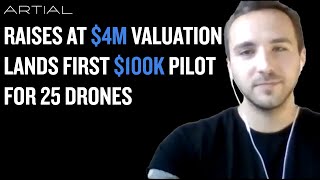
Drone Safety Software Raises at $4m Valuation, Lands first $100k Pilot for 25 DronesApr 27, 2022
[00:00] Hey, folks. My guest today is Egor Folley. He's an experienced AI tech lead in r and d robotics, deep learning, and computer vision. He's got solid knowledge of problem solving and strong leadership skills and ran AI for nanobio tech, a PhD, and and and it was a program dropout in that in that program. He's now building artial dot c o. That's a r t I a l dot c o, an AI driven urban safety drone platform. [00:24] Egor, you ready to take us to the top? [00:25] >> Yeah. Let's go ahead. Nice to meet you. [00:28] Alright. So who who's buying this? Are these drone operators like like Amazon or delivering packages or what? [00:34] >> Well, right now, we're focusing on delivering the software as a license. We're building autonomy engine that brings a new level of drone intelligence, basically, by providing the high higher level of autonomy that exists right now. And we're mostly focused on licensing it for the drone manufacturers or autopilot programs. And we also have revenue sharing options for the specific applications, like flying in making inspections of the building bridges in the obstacle dense environment, public safety, basically providing [01:06] >> the assistance for the police department or maybe some kind of guardian, urban guardians, security and surveillance, of course, and smart and safe air. And I mean by that, we're providing the options right now for the companies who want to apply drones for their smart cities or urban environments. [01:24] So, to be clear, when you say you're selling a software into manufacturers, these are not like Department of Defense kind of people. These are not military capabilities. These are more like for inspecting telephone lines or water treatment plants, things like that. [01:37] >> Yeah. Right now, we're mostly focusing on providing the safety technology for drone crew to fly safe, make less crashes, and to be more accurate in the delivery task. It's not like super autonomous. [01:49] But for who, Egor? I'm trying to get the use case. Is this for defense, killing people in Ukraine and Russia? I mean, what's it for? [01:56] >> No. No. No. It's for the companies who want to make the drones stability flight. So they are applying it for different use cases in cities. So it's mostly for the people who want to make a drone safe safer. More drones safer technology and fly accurately without fear of crashes. [02:13] The using the drones are doing things like inspecting skyscrapers in New York or telephone lines or gas pipelines in the middle of the country or these sorts of use cases. [02:22] >> Yeah. Yeah, absolutely. [02:23] Okay. And so, does your software help them do? Is it literally don't run into other drones or don't run into trees or things like that? [02:31] >> Yeah. Well, mostly we focus on leveraging the BVLOS technologies like beyond visual line of sight. Basically, it helps the certified pilot who can show the drone to automate the more majority of the task and to help them fly more secure and more safely within the obstacle dense environment that I mentioned before. And it helps them to be more, I would say, more prominent on the task delivery. So it has a native obstacle avoidance and AI driven [02:57] >> navigation. So imagine the situation when a drone is really easily to crash in some kind of building obstacle, like, as as you mentioned, like the branches of the tree or maybe power lines. And we're making the technology so the drone could have a self awareness to perceive it and make an accurate decision based on its intelligent and make a decision making system. [03:19] I see. Okay. And so what are companies paying on average per month or per year to use this technology? [03:25] >> Right now, it depends. Like, the certified pilot cost like €300 or $300. It depends on the use cases. And drone, it may cost like 3,000 or maybe 5,000 for the commercial use, like DJI drones, and up to 20, maybe 50 k for the specific inspection or the specific task delivery, like logistics. [03:48] Oh, what's going on there, YouTube? Good to see you guys. Now imagine this. You love watching these interviews with SaaS founders. But imagine if we took all of the valuation data out from over 2,807 interviews I've done manually Saves you a lot of time. Well, we've done this. We've built it into the beautiful interface inside of Founderpath. Check this out. I'll show you how you can access this in a second, but you log in, you connect [04:11] your Stripe account, you see your valuation real time. You can see what it changed over the past eighty eight days and even set goals for valuation this year. Now the secret evaluation is there's many different ways to value a SaaS business. So the reason you're gonna see three or four different valuations inside of your Founderpath dashboard, this is all free by the way, is because depending on who's doing the buying of your SaaS company, you're gonna [04:35] get a different valuation. A VC is gonna pay a different valuation, Private equity firm is different. If you're gonna do a minority sale, that's different. And if you sell the whole business, that's a different valuation. You can see all those when I hover over here. Right? So the teal is what a VC would pay. Yellow is what private equity And red is if you sold the whole thing outright. Now what's cool about this is this is [04:57] not built off random data. Again, you guys hear these interviews on YouTube. All these datas are built from real time valuation data points founder share with us on the show. So traction 1,200,000 seed round 3.7 raise. They sold 22% of their business. Go in here and filter by the event. Maybe you only wanna see companies that have sold the whole business. Well, here are a bunch that have been acquired the valuation and the multiple. Maybe you're [05:23] going out right now and you're raising your seed round. We'll go in here and look at all this recent seed deals that went down, what they raised, what valuation they raised at, and what percent that they sold. There's never been a larger dataset of SaaS valuations than what you can get now inside of Founderpath. And we're thrilled to bring it to you. All right, we're gonna go back to the YouTube video here in a second, but [05:45] if you wanna check this tool out, if you wanna jump in and sign up, you can check it out for free to get your valuation at this link, this link, founderpath.com/products/valuations. Or if you go to founderpath.com and hover over products, click on get your valuation here, and go ahead and sign up to give it a whirl. Again, all that valuation data live right inside the platform. I hope to see you there. Alright. Let's jump back into [06:11] the interview. I guess I don't understand. So you're not actually building a drone. You're selling software that these manufacturers So, install on the how do you know, like, do you know whether to charge 20,000 for the software install or 300 for the software install? [06:25] >> Well, no. I mean, the drone itself goes this way. But we're providing the software layer above the drone, so they could install it above their own software. So we're leveraging their capabilities of the drone, so extending the feature pack that they have right now. We are mostly focused on the software delivery tasks, not the hardware application or hardware automation stuff. [06:46] So do you charge based off the number of drones they install your software on? [06:51] >> Yeah. Well, let's just be clear. We are only four months old. We just established, incorporating in December. And we have a prominent drone manufacturer, Yawas from United States. And they have a really good, like, company building the helicopters for automation. And they're like, okay, guys, we need this software. Let's just combine some kind of skills. So basically, they are our our valued customer. And we are now mostly focusing on them, but we have three to five [07:17] >> right now potential customers who are willing to pay the price we provide. And we are in a stage of agreement right now. We're under NDA and we're more flexible on the prices because we're not already product that could be Yeah. [07:30] So you don't know what the price is gonna be. You're doing consulting work to figure it out. You have a first customer that sounds like they're paying you, what, 50 to $100,000, something like that to figure out the use case for them? [07:40] >> Yeah. Well, we have potential customers when they say, okay, have this x, for example, prices. And say, yeah, we're fine with it, but we need some kind of upgrades for the specific task delivery. Because we are mostly focusing on the three types of software. The first one is just basic autonomy engine for safety flights and dynamic obstacle avoidance, and some upgrades depending on the weather conditions, like it could be enhanced computer vision technology, maybe night vision, [08:06] >> maybe snow, rain, all that stuff. And we are building Are [08:09] those the two things? There's basic and then there's weather upgrade. Any other upgrades? [08:13] >> Yeah. That upgrade is going to be in approximately one year. We're going to be creating the omnidirectional system. It's going to be a three sixty degree of observation of the surroundings. [08:24] Okay, got it. So, safety to start, upgrade for weather, snow, rain, and then another upgrade a year from now, you'll have an option for three sixty omnidirectional views? [08:32] >> Yes, absolutely. [08:33] Okay, but this first test you're running with this one customer, how many drones are they going to install your software on? [08:39] >> Right now, we're focusing on 20 to 25 drones, depending on the need. And we have, as I said before, potential customers, and we're discussing the agreements right now. Mostly people are focusing on buying like 40 to 100 drones to install the software and to apply it. [08:55] Very cool. Okay. How are you funding the business to date? Are you bootstrapped or have you raised? [09:01] >> Originally, we met with my investor and it was just a small talk. He eventually, like, okay, if you do the product, I will invest in you. And I did the proof of concept. The video is on our website. You can see it. And he's like, okay, I like it. Let's work. Let's collaborate. And he invest in us, like, €100,000. And this is the only our proceed investor right now. He's a leading one. But we are flexible [09:24] >> with investments coming from the other sides. And right now, we had the Plug and Play accelerator. We have a potential collaboration with them, but they're waiting for the MVP to have some more potential contacts with us. And other people wanna invest, but we're not accepting, like, every people because we need to have a strong collaboration. We're looking for the strong partnership who's gonna be really useful for us, not just some guys with the money. [09:50] Understood. So you started coding this last year in 2021. You raised $500,000 pre seed from this one guy? [09:57] >> This is not one guy. It's just the autonomous solutions fund. They are building they're investing But [10:03] you raised 500,000 total last year? [10:04] >> Yeah. [10:05] Yeah. Okay. And did you do that? Most people these days pre seed round, you're doing it like a 5,000,000 cap, something like that? [10:11] >> I don't think I can discuss it, we just incorporated, have split the shares, and that's it right now. [10:20] Well, I mean, it's your company, you can discuss whatever you want. I'm just asking, did you do basically a standard sort of pre seed investment, which was a note or a cap or an uncapped safe? How did you structure the first deal? [10:31] >> We just paid the shares. Like, gave him the specific percentage of the company, to the funding. [10:37] Oh, so it's not in convertible? No. You actually have a valuation and you sold them a number of shares for 500. [10:42] >> I see. I see. Okay. [10:44] I guess then the right question is most folks are doing these pre seed rounds at like a 5 to $10,000,000 valuation. Were you sort of in that range? [10:50] >> No. Slightly less than 5,000,000. [10:53] Okay. Fair enough. Fair enough. And then I guess, why let this person in? Was he very strategic? Or what's the story? [10:59] >> Well, originally, met him when I was temp leading at my previous company. And it was like, okay, hello, I'm just traveling to Barcelona, let's have a talk. And we've been talking a lot and he told me stories about the startups. And he was sort of mentoring me how to do these things in a proper way. And for me, it was just okay, it's so cool. And we made a good connection. And I saw him that he [11:22] >> has a lot of companies, and the companies are specific interest in drone and computer vision and AI. And we're like, okay, let's do this way. I will help you out. You'll build the technology. So it was like a mentorship at first with whom I have the warm connection. And right now it's like, okay, he's my investor. We're basically collaborating. [11:40] Okay, that makes sense. And how many folks are full time on the team today? [11:44] >> Right now, it's me, my co founder, three people who work full time, but they're not an official in the state because we're now I'm not trying to relocate them here because of the situation in Russia right now. Some people in Georgia, some people in Turkey, but they're working full time. So it's five of us. And we have my CTO. There's five full time. Yeah. Yeah. And there's my CTO and adviser. He works, like, from twenty [12:08] >> to thirty to forty hours a week, depending on the needs. [12:11] And so what do you believe? You're running this first test with this first company right now on 20 to 25 of their drones. When do you think you'll be able to release a SaaS product? And what do you think you'll release in terms of the pricing? [12:23] >> Right now, we're having the MVP preparing in the simulation, and we're expecting within one month to buy at least five to six different drones and then have a installation there to provide some kind of real world test. But we're aiming for the full beta version of the products, because we're gonna be at least stable enough to fly in a with a real drone by the end of this year in December. [12:47] And what I mean, this is a competitive space. There's a lot of folks sort of selling software for drones right now. Some of them are obviously safety focused, right? DroneDeploy is a good example here, right? So so what is your what's your use case? Like, what's your wedge here where you're gonna be able to steal market share from them? [13:03] >> Well, I guess our most advantage, unique value proposition that we're have been already experienced, and my co founder has a decade of experience in drone technology and the safety AI technology for the navigation. And we're basically providing the algorithms that are suitable enough for the people to use it instead of our collaboration. And right now, we're mostly focused on the safety, but we are willing to accept the feature pack and going to be way more useful [13:31] >> than the traditional approach, hardware approach. So basically, we're trying to use more AI software stuff than the hardware stuff related to the, like, GPS navigation or any anything related to hardware so hardware centric approach. [13:45] And and what's your goal this year? What do you hope to drive monthly recurring revenue to by December? [13:50] >> By December, we I am not right now sure that we will be, like, have a positive cash flow because it's not easier to deliver the task immediately. [14:00] Well, not cash flow. I asked about revenue. What do you think revenue will be? [14:03] >> Well, at least we'll Well, maybe have at least €100,000 for sure. Per month? Total, around. By the end of the year, in total. [14:14] Total. And then and then what do you think you have to grow revenue to to go raise a competitive sort of seed round? [14:20] >> I think we'll provide the technology, we'll test it, and then we'll just confirm on the round. And have already potential collaborations that I've mentioned before with the government public structures. And I think we'll just provide the technology for them. And this next seed round is gonna be depends on the needs. If we have enough money as a revenue, so maybe we will not raise, and maybe we'll extend our features on the another market share, like, in [14:42] >> Europe right now. Maybe we'll go to United States. But it's for me just a little bit in the road map, but it's changing every day. So [14:52] Sounds good, Egor. On that note, let's wrap up here with the famous five. Number one, what's your favorite book? [14:57] >> I would say the Feynman Lectures on Physics and Think and Grow Rich by Napoleon Hill. [15:02] That's good. Those are two very different books. I like the diversity. [15:06] >> I know. [15:07] Number number two, is there a CEO you're following or studying? [15:11] >> I wouldn't mention some specific name. I would like to say that I have a perfect vision of myself in the future from the autobiographies I've been reading a lot, like from Henry Ford to to Elon Musk, of course, and Alexander the Great. Like, a lot of people, I'm trying to make the best of the version of myself from reading all the autobiograph all the books of them. [15:30] Number three, what's your favorite online tool for building Artial? [15:34] >> I guess, mural boards sounds really cool. [15:38] Mural boards? [15:39] >> Yep. Yep. [15:40] Number four, how many hours of sleep do you get every night? [15:43] >> That's also not constant value. Sometimes it's five, sometimes it's seven, sometimes you don't sleep for a few nights in a row. [15:52] Fair enough. And what's your situation? Married, single, kids? [15:56] >> I would say mentally married, but that's not not officially. [16:01] And no kids? [16:02] >> No kids. [16:03] And how old are you? [16:04] >> I'm 24. [16:06] >> 24. [16:07] Last question. What's something you wish you knew when you were 20? [16:10] >> I think I would suggest to myself, like, be more courageous and be more flexible and adaptive to the world and your ideas in your mind. Don't stick to specific one goal. Just be flexible. [16:21] Guys, there you have it. Artial.co launched last year, 500,000 pre seed raised, maybe a little less than a 5,000,000 valuation. Team of five trying to help folks do things like inspect skyscrapers or inspect power lines or inspect water treatment plants or facilities without the drones running into things, right? So they sell basic safety package software into these drones, working with their first customer now with the potential deployment across 20 or 25 drones live in operation [16:48] today as they work to continue to scale. We'll see what happens next. Egor, thanks for taking us to the top. [16:53] >> Thank you. Thank you and goodbye. [16:56] One more thing before you go. We have a brand new show every Thursday at 1PM Central. It's called Shark Tank for SaaS. We call it deal or bust. One founder comes on, three hungry buyers, they try and do a deal live and the founder shares back end dashboards, their expenses, their revenue, ARPU CAC, LTV, you name it, they share it and the buyers try and make a deal live. It is fun to watch every Thursday 1PM [17:21] Central. Additionally, remember these recorded Founder interviews go live. We release them here on YouTube every day at 2PM Central. To make sure you don't miss any of that, make sure you click the subscribe button below here on YouTube, the big red button and then click the little bell notification to make sure you get notifications when we do go live. I wouldn't want you to miss breaking news in the SaaS world, whether it's an acquisition, a big [17:43] fundraise, a big sale, a big profitability statement or something else. I don't want you to miss it. Additionally, if you wanna take this conversation deeper and further, we have by far the largest private Slack community for B2B SaaS founders. You want to get in there. We've probably talked about your tool if you're running a company or your firm if you're investing. You can go in there and quickly search and see what people are saying. Sign up [18:05] for that at nathanlatka.com/slack. In the meantime, I'm hanging out with you here on YouTube. I'll be in the comments for the next thirty minutes. Feel free to let me know what you thought about this episode and if you enjoyed it, click the thumbs up. We get a lot of haters that are mad at how aggressive I am on these shows, but I do it so that we can all learn. We have to counter those people. We [18:25] got to push them away. Click the thumbs up below to counter them and know that I appreciate your guys'support. Alright, I'll be in the comments. [18:31] >> See you.
Data and Sources
All figures on this page are taken directly from interviews or are estimates from public sources and proprietary models. Not financial advice. Read full disclaimer.
Claim this profilePeople Also Viewed
Mini Course Generator
Create mini-courses fast with AI and great practicality.
Meteosource
Meteosource Weather API
Ilo
Dashboards for Twitter data. Ilo effortlessly surfaces helpful tweet metrics so you can understand...
Freshly Squeezed
Content Writing Subscription For Startups
Feather
Notion to Blog in minutes. Write your content on Notion and Feather automatically publishes it to...
Makerlog
Makerlog is a community of 7000+ makers achieving their goals together.