

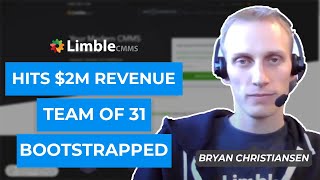
 Watch: Limble is Maintenance Automation Software, hits $2m Revenue, Bootstrapped Using 5% Debt
October 2020
Limble is Maintenance Automation Software, hits $2m Revenue, Bootstrapped Using 5% Debt
Read the transcript
hello everyone my guest today is brian christensen he's a full stack developer with a passion for entrepreneurship he's a father of three little boys ages six four and four he's married his lovely wife yvette when he's not working or uh he loves reading about various topics but has a passion for everyday sci-fi and fantasy now building limbo cmf cmms.com a b2b maintenance management software sweet brian you're ready to take it to the top yeah let's do it now all right so walkers with the company who's buying this and how are they using it yeah so our typical customer is a facility manager or maintenance manager and their main pains are they're trying to manage all this different uh like work orders pms all throughout a wide range of different types of equipment and so they're the primary user that that comes to us and purchases our software and what do they typically pay you per month on average yeah so right now it's about 335 per month although we're recently trending like the last three months it's closer to 500. okay and walk me through what enables you to charge someone cheaper or more like 500 upselling seats upselling by the number of pos per month or what yeah it's all based on seats and so there are different plans so like the starter plan is cheaper than the enterprise plan but it's all based on seats so a pretty traditional sas one price against any other utility metrics like number of po orders through the system or things like that yeah we did actually try that with a per asset model way early on and that like worked to get some early adopters but we found that it just wasn't it wasn't as good when it came to trying to to like compare against our other competitors and also raise the overall acv and so we'd get some customers that pay us like 10 a month and then load up like 30 users and they get tons of value from it but it was just you know the incentives were misaligned i see interesting and when did you launch the company brian when did you launch you broke up a little bit there yeah back in 2015. so 2015 is go live date and how much time energy has been building up the code in the mvp before your first sale oh it took us probably two and a half years so limbo's fully bootstrapped so at the early days it was literally just me coding at night trying to like get an mvp these these type of systems have been around for like decades right we weren't trying to do anything necessarily new as when it comes to features and so there was a large run or initial get uh to go to actually get it built and so it took about two and a half years to get that first paying customer they were on the per asset plan they were a whopping twelve dollars a month i was ecstatic uh my wife thought i was kind of crazy uh all these years to get it going and i mean how are you paying bills during that time yeah so well like when you know how to code you don't have to pay a developer right and so there was just a lot of sweat equity and then also i'm really blessed to have my father help um with uh you know with just a bunch of advice but also giving us office space and so um i was working full-time for him in a family company and he was like okay if you finish all of your work for the family company then you can spend all the rest of the time on your other company and so it was just basically working a lot of 12-hour days i'd spend four to six hours on the on the day job right and then i would spend the other you know you know eight to six hours on you know just coding and building limbo and what year was that so was it 2017 you got your first customer yeah roughly yeah okay interesting and um how many customers are now working with today yeah we're up to about 470 right now oh wow okay so how are you getting customers today where are you finding them so uh a content strategy so through seo and today we're still getting the majority through that way um about a year and a half ago we started an outbound arm and so since then we've uh made it so that about 30 of our our deals come from just like cold outreach um but yeah in the early days you know full stack developer was kind of shy to call people you know it wasn't the typical like biz dev and so i was like well i'm pretty good at seo so i'm going to build up you know our web presence as i'm actually building the product itself because i knew it was going to take a while and so those kind of aligned right we were starting to rank well right when um the mvp was starting to get to be something for whatever ps4 oh cmms cmms software maintenance software maintenance management software there's there's tons of terms out there where it really landed well for us was more around topics not necessarily like the money keywords for like cms software because there's so much competition there but we built stuff like uh the ridiculously simple guide to a pm checklist for example and so if you google i think it's preventative maintenance plan you'll see we're ranked number one there and so we we ranked really well for a bunch of topics around the space and then we just did the right conversion on those blogs to get them to come check out our you know look at our software and that's typically how we get a lot of our our inbound leads okay got it that makes sense do you remember in 2017 when you closed your first customer do you remember what run revenue was that year uh 2017 you know and i might actually have this right here i think we ended the year at about 2800 mrr in 2017 2800 okay got it and in mrr or arr run right uh mrr mr and can you bring those forward 2018-2019 or no yeah 2018 we finished at 14 225 uh end of 2019 we were at 61 uh basically 61 000 and then end of 2022 we'll probably get this is we're starting to swap to arr because the numbers are getting larger but uh the end of 2020 i think we'll be able to get to 2.4 million er and you're what doing about 158 grand a month right now on revenue something like that we're doing about 160 grand a month in revenue right now yeah 470 customers times 335 is about about that 160 mark so you're close i mean you're not far off from getting up to 2.1 2.2 yeah and we've seen like some really good months the last couple months like last month we added on about 210k arr and so it's it's ramping up well a lot of 2020 was just built on systems honestly i didn't think customers were going to buy as much in this year just because of covid so we were kind of like okay let's actually invest in people and systems like we redid our text we redid our sell stack and we you did a whole bunch of other stuff because we were assuming right like this is the time to build build people build systems so that in 2021 we can do really well but um we've just done really good this year for a variety of reasons um the systems what are some of those yeah what are some of those reasons i mean if you added a hundred grand a new mrr about 1.2 million an aor over the past 12 months what's driven the growth yeah so one of the big things is like a big shout out to our sales team they're doing absolutely awesome we redid our entire sales presentation um really over the last like 14 months or so really nailed it down on how do we present limbo and how do we talk with the customers to make sure that they're they feel that their their problems are going to be solved with us and so that was one big thing we redid um our cell systems our cell stack to outreach and hubspot and really made it like before we weren't really using a good crm or at least we weren't using hubspot to the power it could be and our vp of cells jake westbrook did a great job setting that all up and i didn't think it was really going to pay off until 2021 but started paying off in the middle of the year which uh that was a huge help we were starting to actually get real metrics on like how are we handling the leads and like how quickly are we closing them and where is it going wrong and that that all factored in a lot also our our success team has started to do a really good job onboarding people which is uh greatly expanded our expansion efforts and made people like basically after the first month or two immediately start up selling again i thought that was actually going to be like payoffs 6 to 12 months in the future or longer but because they're getting onboarded really well they're they're upselling even quicker and so the systems are just paying off quicker than i i anticipated how many are on the team today uh we just hired our 31st and how many quota carrying sales reps we have four well we have three now but we had four because we moved her to a a more important position and how many engineers do you have uh six six so six engineers three quarter carrying reps there's another 20 people floating around out there what are they doing yeah so we have uh eight sdrs so cold calling we're a little overstaffed on those right now because we're trying to ramp them up i don't think any of them i think the oldest one has been there only six months um uh we have seven in customer success that we have me um and then we have a couple support roles and i don't know if i did the math fully correct sdrs and customer success do you give a group quota target to customer success in terms of expansion uh not yet we're really careful on giving quota to um the customer success because we don't want them to just be like an extension of the sales arm like our like our first core value is you know we really care about our customers we call our customers obsessed and a lot of companies say that but we actually live it and so if we if we put quotas on our customer success they may uh not act the way that we want them to act now we do uh pay commissions on it because we do want to motivate it right and we want we we always want our employees to share in our success but we don't be like hey you have to hit at least this amount this month or else you know there's a problem now brian if you were hiring me as one of your sales reps that actually had quota what would my quota be in year one yeah so we have a ramp period just depending on when you get hired so the first month it's a thousand mrr the second month it's 2000 mrr the third month is 3000 mr and then you're then you're ramped and we have aes that get all the way up into six or seven um kmrr a month so how much new like arr do you want to rep to close in the first year in the first year let's see [Music] it'd be about 30 000 mrr in the first year yeah so 360 in terms of ar and what would i earn if i hit that quota in the first year what would my full comp be yeah so we we pay really good commission to our account executives so basically the before quota you get 2x mrrs so if you close you know 3 000 let's say you're fully ramped you close 3 000 that's a 6 000 commission check to you if you get over um quota it's 3x mrr so if you close like 5000 mrr you're starting to bring in a lot of money uh on just commissions and let's see 5 000 would be like a 10 000 commission check if i'm doing the math right i'm not doing the math right it'll be sorry yeah and so uh then there's of course a base pay now we don't pay high base right we really want everyone to succeed with us and so if we aren't doing well then no one's getting paid well what would you pay me if i joined and i didn't close sales like what my base be probably um it varies i mean it's around 50k about for the basis okay i mean that's still i mean that's not horrible most sales reps i mean 50k base plus another 50k 16 commissions you can really earn you know so what do you expect a sales person who's really good that hits quota you think they're going to earn what 110 120 annually no they if they're doing really good and they're over quoted they really should be over 150. okay got it got it that makes sense okay got it your quota target is you know three four five x that ideally yeah yeah super interesting now talk to me about capital have you bootstrapped the company or raised yeah it's completely bootstrapped uh uh i only thanks it's been a an interesting journey and it's uh very tempting to go raise money when you're when you it's like oh it's starting to work i should go raise and uh but yeah no we uh you know i've been incredibly blessed to have my father be able to like give me a spot to work and then also be like hey you don't have to work you know all eight hours here at the family company and come work on it so i haven't had to do what a lot of people typically do where they're like you know top ramen and you know complete you know devotion and whatnot invest in the company did he write a check into the company it's mostly been um like support like you know a portion of my salary or the office space or whatnot but once it started getting some traction and we're starting getting some paying customers then he did put some cash in and it was about a 150 over probably a year and a half okay so you could argue that you didn't maybe like an angel round but it's really your dad yeah yeah basically and this is that i don't want to minimize that he's you know again he's very blessed to have him and that was back in 2017. yeah well he did a little bit each month so it wasn't like we raised one one round it was like hey dad this is starting to work there's an opportunity to spend five grand here you know can we do this and he's like okay let's do it and then we you know we repeatedly did that you know some months higher than others and so it wasn't like a typical angel fund it was just like if i found opportunities he's like okay go after it churn's critical obviously in any sas company how do you think about churn today yeah it's really important um some of our numbers our dollar turn is 7.8 percent annual and then our net negative turn is 111.28 so it's not bad but it's also not fully world-class i've heard you say on the podcast many times 130 is uh is world class and so we're trying to get there our customer success department really is is actually our youngest department we only started it back in february and so i think once that even starts paying off more we're going to be able to see those numbers you know go up a good amount yeah so eight percent annual revenue dollar churn 19 expansion gets you 111 net revenue retention is where you're at yep and what are you spending on full weighted cac to get a new what a four thousand dollar acv account yeah so our cac based in months is 9.45 and our fully weighted cac uh let's see it's about 4k where we're at right now so we probably spent about 3 000 maybe a little bit over 3 000 to get a customer and where do you spend most of that um a lot of it is in the sales team so we do spend a good amount on our content marketing we probably spend close to 15 to 20k a month now on content but that's because we're ramping it up a bunch for a good while for a good long time we didn't even have a market it was literally me coordinating with a vendor to get all of our content written and so we were only spending like 4k a month so a lot of the inbound leads we just didn't really have to spend that much where our cac numbers started getting higher where we jump from you know like four or five months up to you know nine or even you know some months we fluctuate into ten or eleven is uh the sales people are expensive right and uh you know scr is expensive good a's are expensive but that's okay we want to share you know the the success with the team so as long as we keep the cac under 10 i think it can be really profitable makes all makes a lot of sense now would you consider raising like capital today or do you think you just could sort of keep operating as you are and grow how fast you want yeah so we're doing um we are getting some capital but it's through debt so like we just uh and i was going to tell you this but we just got our approval to get about 350k from a local bank through the sba and so that's going to help growth and then we have another you know x number of dollars lined up just all in debt so no equity um and so we're going to see what we can do with that i think over the next like six months but if everything's doing the way that we want it to be and it's like we're at 5 million are by middle of next year there's probably a chance we will actually look at getting some growth capital where we can go raise at a pretty good multiple i hope because we are growing really fast and be able to have someone come by you know 10 to 20 percent of the company or whatever and be able to really use that to grow additionally um some of the foundation how much did you raise for 10 to 20 percent well as much as possible obviously yeah but uh yeah no i mean on on multiples we're looking for i mean it really depends where we're at middle of next year right like if we get to 5 million by middle of next year we're growing really really fast and that's an awesome story and and it's awesome traction to tell you know the investors right but if we're only at like you know 3.5 million we're still growing really good but not it's a totally different story and based on the story is is where we'll set expectations on multiples on the sba loan would you have to personally guarantee it and what's the interest rate yeah we did have to personally guarantee which kind of stinks but it's you know that it's really cheap it's like interest rate is like one and a half plus prime or two and a half plus prime or something like that i'd have to say five four five percent yeah it's something like that it's it's so small it's it's you know it's you know compared to what we can turn that money into it's you know it's just not a factor yeah all right let's wrap up here with the famous five number one brian what's your favorite business book yeah lean startup number two is there a ceo you're following or studying uh not very closely but i do look at bezos yeah he does great stuff number three what's your favorite online tool for building limbo probably uh g suite we use that very heavily so docs and all of that spreadsheets number four how many hours of sleep breaking every night six to eight probably that's pretty good in situation married single kids uh married uh three kids six four and four yeah i remember that actually and how old are you i'm 35 35 last question what's something you wishing you knew when you were 20 uh learn how to learn faster i made a lot of mistakes on like i spent five years trying to build a software company that i could have basically shrunk that all and down into like one year's worth of lessons and gotten four years back um that's a big one learning to sell earlier um with with like anyone that's a developer out there that's doing this please go learn how to sell like the the role of possibilities that opens up are insane when you have the power to build something and to sell it like those two things i wish i would have learned to sell earlier and i wish i would have learned how to learn a little bit quicker if that makes sense guys automation software for all your maintenance needs limbo cmm they're doubling year over year bootstrap now at about 1.8 million dollars in arr they're serving 470 customers they uh have done it basically bootstrap.com outside except outside of an angel check 100 000 sort of angel check back in the first uh call a year and a half 31 people on the team today six engineers three quota carrying sales reps 111 net revenue retention might do a traditional vc around mid next year if they get up to four or five million bucks in ar we will see brian thanks for taking us to the talk anytime thank you one more thing before you go we have a brand new show every thursday at 1 pm central it's called shark tank for sas we call it deal or bust one founder comes on three hungry buyers they try and do a deal live and the founder shares back end dashboards their expenses their revenue arpu cac ltd you name it they share it and the buyers try and make a deal live it is fun to watch every thursday 1 pm central additionally remember these recorded founder interviews go live we release them here on youtube every day at 2 p.m central to make sure you don't miss any of that make sure you click the subscribe button below here on youtube the big red button and then click the little bell notification to make sure you get notifications when we do go live i wouldn't want you to miss breaking news in the sas world whether it's an acquisition a big fundraise a big sale a big profitability statement or something else i don't want you to miss it additionally if you want to take this conversation deeper and further we have by far the largest private slack community for b2b sas founders you want to get in there we've probably talked about your tool if you're running a company or your firm if you're investing you can go in there and quickly search and see what people are saying sign up for that at nathan lacka dot com forward slash slack in the meantime i'm hanging out with you here on youtube i'll be in the comments for the next 30 minutes feel free to let me know what you thought about this episode if you enjoyed it click the thumbs up we get a lot of haters that are mad at how aggressive i am on these shows but i do it so that we can all learn we have to counter those people we got to push them away click the thumbs up below to counter them and know that i appreciate your guys support all right i'll be in the comments see ya
 UpKeep