Latka logo

How SmartSuite CEO Jon Darbyshire grew SmartSuite to $3M revenue and 400 customers in 2024.

Smartsuite.com is a comprehensive productivity suite that empowers individuals and teams to work smarter and more efficiently. With Smartsuite, users have access to a range of integrated tools and applications that streamline tasks, enhance collaboration, and boost productivity. The suite includes features such as project management, task tracking, document sharing, communication tools, and more, all designed to simplify workflows and improve efficiency. Smartsuite.com provides a centralized platform for seamless collaboration and enables users to stay organized, focused, and productive in their work endeavors.

Last updated

SmartSuite Revenue

In 2024, SmartSuite's revenue reached $3M. The company previously reported $4.2M in 2023. Since its launch in 2021, SmartSuite has shown consistent revenue growth.

SmartSuite Revenue GrowthReported revenue / ARR by year$0$1M$2M$3M$4M$5M2021202220232024$0$1M$4M$3MSource: GetLatka.com interview on Mar 10, 2022 with SmartSuite CEO Jon Darbyshire
YearMilestoneQuote
2024SmartSuite Hit $3m revenue in November 2024Source
2023SmartSuite Hit $4.2m revenue in December 2023
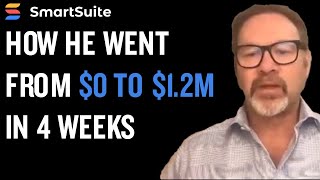
2022SmartSuite Hit $1.2m revenue in February 2022
2021Launched with $0 revenue

SmartSuite Valuation, Funding Rounds

SmartSuite's most recent disclosed valuation is $100M.

SmartSuite is a bootstrapped Team Collaboration Software startup. Founded in 2021, SmartSuite has grown to $3M in revenue without raising any venture capital or outside funding.

As a self-funded Team Collaboration Software SaaS company, SmartSuite has built its business with no outside investment.

SmartSuite Capital Raised & ValuationCumulative capital raised and post-money valuation by roundCapital raised (cum.)Valuation$0$120212021 cumulative: $0 • 2021 Founded: $02021 Founded: $0 valuationSource: GetLatka.com interview on Mar 10, 2022 with SmartSuite CEO Jon Darbyshire
YearRoundAmountValuation% SoldQuote

SmartSuite Employees & Team Size

SmartSuite employs approximately 18 people as of 2026, up from 17 in 2023.

SmartSuite has 18 total employees in different roles and functions and 1 sales reps that carry a quota. They have 400 customers that rely on the company's solutions.

SmartSuite Team GrowthReported headcount over time01325385063202120222023202410101818Source: GetLatka.com interview on Mar 10, 2022 with SmartSuite CEO Jon Darbyshire
YearMilestone
2024Reached 18 employees (October 2024)
2024Reached 17 employees (March 2024)
2023Reached 17 employees (December 2023)
2023Reached 51 employees (December 2023)
2023Reached 14 employees (July 2023)
2023Reached 51 employees (July 2023)
2023Reached 13 employees (January 2023)
2022Reached 16 employees (December 2022)
2022Reached 9 employees (February 2022)
2022Reached 12 employees (January 2022)
2021Reached 13 employees (December 2021)
2021Reached 10 employees (January 2021)

Founder / CEO

Jon Darbyshire

Jon Darbyshire is listed as Founder / CEO at SmartSuite.

Q&A

QuestionAnswer
What's your age?-
Favorite online tool?-
Favorite book?-
Favorite CEO?-
Advice for 20 year old self-

Customers

See how SmartSuite acquires and retains customers with data on acquisition costs and revenue performance. Log in to access the complete customer economics dashboard.

Locked

Frequently Asked Questions about SmartSuite

What is SmartSuite's revenue?

SmartSuite generates $3M in revenue.

Who founded SmartSuite?

SmartSuite was founded by Jon Darbyshire.

Who is the CEO of SmartSuite?

The CEO of SmartSuite is Jon Darbyshire.

How much funding does SmartSuite have?

SmartSuite raised $0.

How many employees does SmartSuite have?

SmartSuite has 18 employees.

Where is SmartSuite headquarters?

SmartSuite is headquartered in Newport Beach, California, United States.

People Also Viewed

NextME logo

NextME

NextME makes it simple for businesses to manage waitlists and serve more customers. Track visits and wait times, engage your customers in real-time with a custom virtual waiting room, and grow your business like never before. NextME leverages proprietary historical data to help businesses quote more accurate wait times during peak hours. We believe in superior customer service and that waiting in line can be done virtually, not physically. NextME's digital waitlist for businesses is available to download in the App Store today: http://apple.co/1IUTQWw We're hiring! See our current opening positions here: https://bit.ly/3llzOho Need an extra hand with a product demo? Give us a call at (877) 639-8631

BluAgent logo

BluAgent

BluAgent Technologies is a fully integrated SaaS platform that streamlines and simplify the entire safety and compliance process

Filtered.ai logo

Filtered.ai

Filtered uses performance data to maximize the quality of your current and future workforce.

Headway Essex logo

Headway Essex

Headway Essex is a charity that supports people living with acquired brain injury, ensuring they can live a fulfilling life.

Digital Horizon logo

Digital Horizon

Digital Horizon is a VC firm focused on backing exceptional entrepreneurs building B2B software-based solutions and marketplaces. With a presence in London, Tel Aviv and Moscow, Digital Horizon aims to seek out early-stage technology companies with the ultimate goal to assist them in building and scaling their business.

Trefis logo

Trefis

Provider of a business analysis technology. The company provides a data analytics technology for investors and decision-makers in business that allows users to share, use, and collaborate on analysis.

Compare SmartSuite to the industry

SmartSuite operates across multiple industries. Browse revenue, funding, and growth data for SmartSuite in each sector below.

Full Interview Transcript

Read transcript

founders what's going on you guys know i love in-person events and they are back the recording you're about to hear is from our most recent event where we had hundreds of founders come together share intimate details templates kpis okrs about their business and it was something special something special we'd love to meet you in person if you want to see the next live events we have coming up via our schedule the link will be down below in the description if you're listening on itunes check this out on youtube you'll see the links in the description or you can just google founder path or latka next event we'd love to see you in person in the meantime though enjoy this recording it's a good one so we're going to focus today really based on nathan's request on on kind of a journey and let me get this slide figure this out real quick here we go kind of a three-part story from being an operator building a company becoming a leader in the space selling that company kind of transitioning to an advisor investor where i then invested through either directly or through some venture groups and about 400 companies set on the boards of lots of companies beyonce got bored with that and wanted to move back into the operator space kind of with the next journey which is a pretty typical story for a lot of founders that are probably in this room that once you're an operator it's hard not to be an operator and i also found that i wasn't a great advisor i was an okay advisor but i always wanted to actually do the work and the founders don't like that like they want you to advise stay out of their business i wanted to actually get in and do some of the work that was there so to kind of kick things off we're going to start with the story of a company called archer technologies archer was a company that i founded in 2001 i'm going to share just some basics of the company with the products and the revenue to set the stage and then we'll jump into kind of lessons learned things that we did right and then things we didn't do so good that i would would have changed that's there so from a growth perspective uh what's interesting about archer was that we were profitable in the first year of doing business and i'll share with you how we did that in just a minute it was a very different market back in 2000 2001 there wasn't a lot of funding that was available 911 it just happened things began to kind of shut down so we really had to focus on we were bootstrapped as well through year eight we really had to focus on customers and revenue and how we could hire employees and you'll kind of see the growth rate here through the last year when we sold the company we're around 33 million excuse me in revenue as a company we focused on uh seven core products i'll share the idea in just a minute but the overall idea was to help manage security and compliance processes in the same way that a business would manage accounts payable accounts receivable hr those types of processes and organizations we had seven core solutions that we eventually had in the company each of those solutions were priced at fifty thousand dollars a pop an average customer for us was around four hundred grand with some add-ons uh that were there okay and i'll tell you the story and how we sold that in a minute which is interesting as well so here's kind of the basics of the story so my background prior to founding archer was i had the opportunity to build the global cyber security practice at ernst young and i had the chance to travel the world we had about 1500 consultants in that practice i meet with customers to understand how they're managing security in the organization mainly from an aspect of things were going online they had online stores online banking was coming on and they needed us to help them understand how do we secure those systems so that we can stay online so the opportunity was for archer was to take that service that we've been providing at ernst young and turn that back into a product that we could sell and manage as a process and organization the challenge that we had was that it hadn't been done before and as a small startup with the big idea how do you approach people with a new way of thinking about how to manage security and organization right at the same time archer was bootstrapped from day one um we didn't take funding until year eight which i'll share some of that in just a minute um from you so we didn't have a lot of capital i put in i think 750 000 to start the company to kind of get things kicked off the market focus for the organization uh started with financial services moved into telco moved into healthcare moved into technology at the end of the day i think we had 76 of the fortune 100 where customers after like the first six years of the company so mainly enterprise level accounts an average customer would have 80 to 100 000 users of our product inside of the organization renewal rates were pretty interesting over nine years 97.6 renewal rate so we only lost three customers in nine years two of those customers were because of acquisitions by another customer uh that had them one of those was lehman brothers that went out of business that was there so we found that things were very sticky that was there we sold the product as a sas offering but sas wasn't really around in 2001 so we approached eds which was our first customer with an idea and said hey we can come in and solve this problem for you we're going to treat it as a process and oh by the way you're going to pace the same amount of money every year and they said well how much money is that and i said eight hundred thousand dollars and they came back and said we'll pay you 1.1 million dollars and i'll share why they said that in just a minute so they became our very first customer before we ever wrote a line of code so i went to eds with a little three and a half inch diskette for those of you that remember diskettes had an html version that basically was a powerpoint that showed all the different screens on how things would would look and at the end of that presentation they stood up and said we need your product how soon could you have it developed if we move forward with you and i'm like oh my god like i don't have a developer we haven't written a line of code so i just shared it with them i was just up front and said hey here's where we're at it's an idea i've got everything documented we need to go build it it's there and i'll share a little bit more in just in a minute about that um the next thing that we did i told you in year eight um we raised capital for the first time uh in the organization not because we needed cash you saw from the prior screen that we were we had a pretty good cash flow in the business it allowed me to take some money off the table as a founder and it really opened up to stop thinking about money every day you know every day i would come in the office and the first thing i would look at is the bank balance just to make sure that we were in a good position to pay everybody that was on the team but it freed me from that and it allowed us to really grow the business in the last 9 months to 12 months after that investment from bain and if you go out into one of my breakout sessions after this i'm happy to share more information about what was so valuable with the bain relationship that we had and then what happened after the bain investment was that in year bain came in in year eight and about seven months later we were started getting approached by outside organizations about partnerships acquisitions we weren't planning on selling the company at that time but it just happened pretty quick so we went from bain came in and invested i think it was a 70 million dollar pre it allowed me to take some money off the table they bought about 20 of the company they allowed the employees to cash out a portion of their stock options at that time so it was it was kind of a good event for everybody looking back it wasn't a great event because then we sold the company for 200 million dollars nine months later that was in there which the employees would have kind of hung on to those options some of them so as nathan was saying when we when we found out that we needed to kind of start a process and people were looking at us bain capital came in and said look we need to hire an investment banker we need to create a deck we really need to go after this to make sure that we get the best price for the company you have an offer in hand but the minute that they know you have a deck an investment banker and that you hire the best of the best they're not going to retrade that value with you right it's only going to go up from that point forward so it allowed us to send this deck out not to the world we were pretty selective i think we sent it out to about seven organizations that we thought would have interest back in in this space three of them responded um only one of them was super serious and that was emc and they wanted to do the deal in four weeks in one month which was unheard of uh emc i don't know if if you emc has eventually sold to dell a couple of years ago but they had 43 000 employees i don't remember their revenue but we were their 51st acquisition so they were a company that grew by acquisition they...

This is an excerpt. The full unedited transcript is available through GetLatka exports.

Source Attribution

Source: all data was collected from GetLatka company research and founder interviews. Revenue, funding, team, and customer figures are presented as company-reported or GetLatka-estimated metrics where the profile data identifies them that way.

Company data last updated .

Data Disclaimer

All figures on this page are GetLatka estimates from public sources and proprietary models. Where a button appears next to a number, that figure is a direct quote from the CEO interview — tap to hear them say it. You can verify other figures against the interview transcript.

Not financial advice. Read full disclaimer.

Claim this profile