
Founder Interview
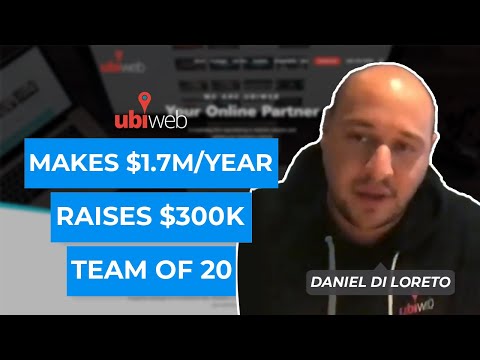
How Ubiweb Reached 550 Live Customers and 109% Net Revenue Retention Serving Blue-Collar SMBs (Interview with Co-Founder Daniel Di Loreto)
- Interview Date
- September 29, 2020
- Interviewee
- Daniel Di LoretoCo-Founder and Head of Sales
Company Metrics at Interview Time
Live Customers (2020)
550
ARPU (2020)
$265 per month
Net Revenue Retention (2020)
109%
Gross Margin (2020)
65%
Historical Snapshot
These numbers were reported by co-founders Daniel Di Loreto and Patrick Desrochers during the interview recorded in September 2020 and are a historical snapshot, not current figures. See Ubiweb’s current numbers.
Key Takeaways
- 01Ubiweb had 550 live customers and another 150 to 200 signed and going live within three to four months as of September 2020.
- 02Average ARPU was $265 per month, up from $180 to $190 in the company's first year.
- 03Net revenue retention was 109%, driven by customers upgrading packages in year two.
- 04Gross margin was approximately 65%, and Ubiweb was profitable at the time of the interview.
- 05Positive cash flow ranged from $10,000 to $40,000 per month, fluctuating with sales team scaling costs.
- 06The company raised about $250,000 to $300,000 in non-dilutive funding from Investissement Québec, a government program, and the BDC, giving up no equity.
- 07The sales team of six reps operated entirely on cold outbound calls with no inbound leads.
- 08Ubiweb was founded in 2017 and grew to a team of 20 people, including six to seven in sales and the rest in operations.
- 09Google Ads management was an add-on service generating roughly $20,000 to $25,000 per month in management fees on about $60,000 in monthly client ad spend.
Company Metrics at Time of Interview
| Metric | Value | Source |
|---|---|---|
| Live Customers (2020) | 550 | Founder interview, Sep 2020 |
| Signed Customers (pending go-live) (2020) | 150 to 200 | Founder interview, Sep 2020 |
| ARPU (2020) | $265 per month | Founder interview, Sep 2020 |
| Net Revenue Retention (2020) | 109% | Founder interview, Sep 2020 |
| Gross Margin (2020) | 65% | Founder interview, Sep 2020 |
| Cash Flow (2020) | $10,000 to $40,000 per month | Founder interview, Sep 2020 |
| Total Non-Dilutive Funding Raised | $250,000 to $300,000 | Founder interview, Sep 2020 |
| Team Size (2020) | 20 | Founder interview, Sep 2020 |
| Sales Reps (2020) | 6 | Founder interview, Sep 2020 |
| Sales Rep Quota (new sales per week) (2020) | 2 per week | Founder interview, Sep 2020 |
| Average Sales Rep Commission per Unit (2020) | $600 | Founder interview, Sep 2020 |
| Client Ad Spend Managed per Month (2020) | $60,000 | Founder interview, Sep 2020 |
| Google Ads Management Fee Revenue (2020) | $20,000 to $25,000 per month | Founder interview, Sep 2020 |
| Year Founded | 2017 | Founder interview, Sep 2020 |
| Package Price Range (2020) | $180 to $500 per month | Founder interview, Sep 2020 |
Growth Breakdown
Revenue
Ubiweb's subscription revenue is anchored by 550 live customers paying an average of $265 per month, up from $180 to $190 in the company's first year. An optional Google Ads management service adds roughly $20,000 to $25,000 per month on top of the core WaaS subscription revenue, though the team views it as lower-priority given its thinner margins and higher operational demands.
Customers
The company had 550 customers live at interview time, with another 150 to 200 signed and scheduled to go live within three to four months. Ubiweb targets blue-collar SMBs such as plumbers and roofers in less competitive, often rural markets across Canada, where basic SEO and a clean web presence can deliver strong results.
Team
The team had grown to 20 people total, with six to seven in sales and the remainder covering onboarding, customer service, web development, campaign management, and a growing SEO team. The company scaled from two sales reps to six in a short period, accepting a temporary cash flow drag as new reps ramped over one to three months before their signed customers went live.
Profitability and Funding
Ubiweb was profitable at interview time, with gross margins of approximately 65% and positive monthly cash flow of $10,000 to $40,000 depending on sales team scaling activity. The company raised about $250,000 to $300,000 in non-dilutive funding from Investissement Québec, a government program, and the BDC, which charged eight and a half points of interest with no warrants, avoiding equity dilution entirely.
Growth Strategy
Pure Cold Outbound Sales
All of Ubiweb's leads were outbound, with no inbound leads at all. The company gave its reps lists, scraped sites and went after competitors, and the six reps cold called business owners all day. Dan contrasted this with companies that rely on freemium offers, marketing plans or drip campaigns, and said straight cold calling is much more intensive, which is why the company rewards reps for the effort.
Partner Co-Marketing and Channel Referrals
Ubiweb was signing partnerships with companies such as Booksy to cross-sell new products to its existing customers and include them in its packages. The partnerships were meant to work both ways: Ubiweb would generate leads for its partners, and partners whose customers keep asking whether they also do websites could send those businesses to Ubiweb instead of turning them away. Patrick said the team started working on partnerships at the beginning of 2020.
Package Upsell and Organic Expansion
The three-tier bronze, silver, and gold package structure was designed to let customers start conservatively and upgrade in year two once trust was established. Dan said existing customers grew their spend by 9% with no new sales, just from upgrading their packages, which is the 109% net revenue retention.
Non-Dilutive Government Funding
Rather than raising venture capital, Ubiweb took non-dilutive funding from Investissement Québec, a government program that funds small businesses, and from the BDC, a bank for entrepreneurs that charged eight and a half points of interest with no warrants. The founders kept their equity, but scaling the sales team meant carrying two to six months of rep salaries before those reps' customers started paying, which Dan called the challenge of bootstrapping.
Residual Commission Structure to Retain Sales Talent
Ubiweb paid sales reps a flat renewal commission each year for every customer they originally signed, creating a snowball incentive for reps to stay with the company long-term. Dan said the commission is flat rather than a percentage of the sale on purpose: paying reps on dollars sold would push them to force bigger packages on customers who do not need them, and those customers churn at a higher rate.
Best Quotes
“We're about 700, we have about five fifty live, and we've got another 150 to 200 signed that are going live the next three or four months. Because we're always signing three, six months ahead of time.”
“The ARPA right now is at about $265 monthly.”
“Our positive cash flow, let's say on any given month is gonna fluctuate between ten and forty k.”
“So our secret sauce I guess for a commission is we take a two month security deposit when we sign an agreement and that's the last two months of your last year with us. So that we use that, that is straight up used to pay the sales rep's commissions.”
What Happened Next
At the time of this interview in September 2020, Ubiweb was a profitable, bootstrapped Website as a Service company with 550 live customers and a growing sales team, having raised about $250,000 to $300,000 in non-dilutive funding from Investissement Québec and the BDC. The founders had just started construction to triple the size of their office within three to four months and planned to grow to about 20 sales reps over the next twelve to eighteen months. These figures reflect the company as it stood during this conversation and should be treated as a point-in-time snapshot. Visit the Ubiweb company profile on GetLatka for current data.
View Ubiweb’s current profile and metricsFull Transcript
Chapters
- 0:00Introduction and Company Overview
- 0:22Co-Founder Roles and Origin Story
- 1:51Current Customer Count and Pipeline
- 2:40ARPU and Pricing Evolution
- 3:32Monthly Revenue and the Google Ads Add-On
- 5:06Net Revenue Retention, Upsells and SEO at Scale
- 9:11Non-Dilutive Funding from Government Programs
- 9:54Team Size and Structure
- 11:21Margins, Profitability and Cash Flow
- 12:30Sales Quotas and Commission Structure
- 15:03Cold Outbound and the Residual Commission
- 17:32Growth Plans: More Reps and Channel Partnerships
- 20:08Famous Five Rapid Fire
Introduction and Company Overview
Nathan Latka
00:00Hello everyone, my guest today is Dan Di Loreto, he's the co founder of ubiweb. With fifteen plus years of sales experience, fifteen in online marketing, he developed a turnkey all in one solution for SMBs for their online marketing, primarily targeting Canada currently. He started out of his basement with one partner and bootstrapped their way so far to over 700 clients and over 20 plus colleagues. Dan, you ready to
00:19take us to the top?
Daniel Di Loreto
00:19Absolutely.
Co-Founder Roles and Origin Story
Nathan Latka
00:22Alright, introduce us to your partner here. What's Patrick working on?
Daniel Di Loreto
00:25This is Pat. So I am the head of sales, I run more the sales side and Patrick is more the president, so runs more the operations component. And that's it. So both of us started this shindig out of our basement, in my basement, our basement, my basement in 2017.
Nathan Latka
00:42And who owns more equity?
Daniel Di Loreto
00:4445, 45 and somebody else.
Nathan Latka
00:44Wow.
Daniel Di Loreto
00:44Yeah.
Nathan Latka
00:48Very... Right down the middle. I like that. It's very... Is this someone else's VC? Did you raise capital or no? You're bootstrapped?
Daniel Di Loreto
00:53Bootstrapped. So what happened was, is actually a childhood friend of mine, I gave him this idea back in the day and he started as a pilot project at a web agency of his own. And we had the concept of potentially leasing websites and doing open ended leases and turnkey solutions for small business owners that just don't have the time to deal with this and want to centralize everything with one person. So we started this in 2014
01:14or 2013 and we picked up about fifteen-twenty clients with zero sales effort. Never courtesy called them, barely followed up with them and they stayed for over two and a half, three years. So basically validated the model and the concept, and then we decided to go all in. So he became our web provider if you will, I guess our manufacturer of our websites, and in exchange he took a percentage of the business.
Nathan Latka
01:38When did guys launch the company? Your first customer, what year?
Daniel Di Loreto
01:4107/2017. 02/17, yeah. That was our first client but we inherited the 15 or 20 clients that were on before us as a pilot project.
Current Customer Count and Pipeline
Nathan Latka
01:51How many customers today?
Daniel Di Loreto
01:53We're about 700, we have about five fifty live, and we've got another 150 to 200 signed that are going live the next three or four months. Because we're always signing three, six months ahead of time.
Nathan Latka
01:53What does it take
02:04to get a customer live? What does that mean?
Daniel Di Loreto
02:07You want take that one?
Patrick Desrochers
02:08Yeah, sure. So one of the biggest challenges is the type of person that we... Rather the type of business that we target, so that's a lot of blue collar. These are people that are super busy in their day to day. So what does it take to get someone online?
02:26Tenacity, making things simple, and a streamlined onboarding process, and then afterwards streamline customer experience is essentially my job. From day one, it's been my job. Yeah.
ARPU and Pricing Evolution
Nathan Latka
02:40So these customers, these 550 that are live currently, about how much do they pay you guys per month to use the technology?
Daniel Di Loreto
02:46The ARPA right now is at about $265 monthly.
Nathan Latka
02:49$265, okay. And has that, I mean, that been pretty consistent over time or are guys drastically moving sort of up or downstream?
Daniel Di Loreto
02:56Upwards, I'd say that about two years ago in our first year, we were around 180, 190, And now we're just slowly... There's organic growth because people throughout the years will upsell themselves to our packages because every year you have the option of downgrading, renewing or changing your package upwards. And then, so you have your organic growth within your churn. So our churn is actually 109. So that's part of the...
Nathan Latka
03:20Well that would be not good churn. Your retention, your net retention is 109%.
Daniel Di Loreto
03:24Yes, so sorry. In other words, my organic revenue, our organic revenue rose 9%. We don't lose clients, basically.
Monthly Revenue and the Google Ads Add-On
Nathan Latka
03:32Let's come back to that in a second. Real quick, so five fifty customers at $265 a month, I mean you guys are doing what, $150,000 a month right now in revenue, something like that?
Daniel Di Loreto
03:32Basically.
Nathan Latka
03:32Which is about a $1,800,000 run rate?
Daniel Di Loreto
03:43A little more because we sell Google Ads as well, we do SEM. That's not a subscription based model, that's an add on product.
Nathan Latka
03:50How much ad volume do you guys process per month currently? Add up all the ad spend.
Daniel Di Loreto
03:55Not much. Our media spends around 60 ks a month.
Nathan Latka
03:58Okay. For your customers?
Daniel Di Loreto
04:00Yeah. So we have about a 30% management fee on top so we're making about 20 ks, 25 ks monthly on that.
Nathan Latka
04:07Yep. Is that included in the $150,000 per month or it's extra?
Daniel Di Loreto
04:10That's on top, that's gravy.
Nathan Latka
04:12Yeah, interesting. That to me sounds like an interesting growth opportunity, right? If you can get that 60 ks up to 600 ks or 6,000,000, that starts to become very interesting.
Daniel Di Loreto
04:20So we don't like that revenue too much because it's less profitable and a lot of time and energy versus our subscription based model or our WaaS if you will, our website as a service. The advantage there is that when we have that client, they don't leave and the more they spend, the higher they become more poachable. A very competitive industry, so we don't like the big spenders. Know that sounds but the least you spend, the harder
04:46it is to poach that person and with the service we give, it's very difficult to get one of our clients.
Nathan Latka
04:52That's fair. So you're gonna go for a high volume of customers at a lower ARPU versus less customers paying you, you know, putting millions through your platform per month.
Daniel Di Loreto
05:00You got it. Rather have 10 clients at 500 a month of Google Ads than one client at five ks.
Net Revenue Retention, Upsells and SEO at Scale
Nathan Latka
05:06Fair enough, fair enough. Let's go back to the churn stuff that you were just talking about. I understand your net revenue retention is about 110% or 109% but peel back that onion for me, there's two components to that, your gross revenue churn then you add back your expansion to get to 110. What is your gross revenue churn annually?
Daniel Di Loreto
05:23So our existing clients, in other words, our existing clients, maybe I'm answering your question incorrectly, but our existing clients actually grow 9% without any new, just because they upgrade their packages.
Nathan Latka
05:35I know I understand that. What I'm asking is if you look at your customer base from exactly a year ago, some portion of those folks will have churned and others will have pay you... They'll pay you more now. The amount they pay you more is 9% higher than the amount that churned which is why you have a 109% net retention. What I'm asking is what is gross? What percent did you lose before you add back expansion?
Patrick Desrochers
06:00It's about percent.
Daniel Di Loreto
06:01It's hard to tell. Lost...
Nathan Latka
06:03Okay, fair enough.
Daniel Di Loreto
06:03We lost... Year. We lost four.
Nathan Latka
06:05And Pat, that's 5% monthly or on an annual basis?
Patrick Desrochers
06:09On an annual basis.
Nathan Latka
06:10Okay, got it. So 5% gross revenue churn, you then gotta get up to 109%. So you have about 14, 15% expansion that gives you the 109 net revenue retention. Correct. Bingo. Where is the expansion coming from? Are you upselling seats or product? What are you upselling?
Daniel Di Loreto
06:24Packages. So like we have three packages, bronze, silver and gold. Whereas, I'll give you an example, bronze is just a basic website with zero SEO. Then we have a mid level SEO and then we have a higher end SEO. So you go anywhere between $180 a month and 500. So a lot of people will go with their bronze or silver because they don't really know us. They're hesitant, we wanna build a rapport and then usually in
06:44year two the trend is the renewal or the migrate up a package.
Nathan Latka
06:48Mhmm. How do you do this stuff at scale, right? So you upsell on your silver plan, things like quarterly search engine optimization, you introduce three topical keywords, things of this nature. Mean are you actually going out publishing articles, getting backlinks to every client?
Patrick Desrochers
07:01Yeah. So we work with a lot of different partners, Nate, that help us. Some of this is technology we've developed internally and some of it is also partners that we've partnered up with that allow us to do this at scale. Obviously, when we started bringing on these partners, we looked at doing some of this stuff internally, and oftentimes the cost just completely outweighs even if we have funding from a VC or we are able to get
07:29funding, just the cost to maintain it and continue to grow with our growing customer base doesn't make sense. Whereas someone has done it, has done it well, so it's just a question of going out there and getting the best part as possible.
Nathan Latka
07:40Interesting. I mean, that takes a lot of work. I mean, if you assume five fifty customers are on a plan like that and you got to give them three backlinks written, right, in articles on your partner blogs per month, I mean, that's 1,500 guest blog posts you're essentially making per month unless you put one blog post up and you can link to six of your customers in one shot. I mean how do you scale this?
Patrick Desrochers
07:58So to be honest, our... The blog post is not something that we do at the level of... We're actually working on another product which will actually have that type of SEO, that level of SEO rather. The type of SEO that we do for these are more SMBs and in rural, less competitive areas. So blog posts aren't really necessary to go get that top fold more rather.
Nathan Latka
08:25Like h1 tags will do the trick basically.
Patrick Desrochers
08:28H1 tags, backlinks, a good site structure, Google best practices when you build the site is gonna go get you usually a top three.
Daniel Di Loreto
08:37Picture you're a plumber in a rural city with a population of 8,000 people. It's not very cutthroat.
Nathan Latka
08:42Yeah, but so how do you go get a backlink? Let's say Tom the plumber in Idaho wants... Needs one backlink that says plumber Idaho on another blog. Don't you have to go find that partner and get a blog post written with a backlink?
Patrick Desrochers
08:51Backlink might be the wrong word. Citations is essential.
Nathan Latka
08:51Okay. What's the difference?
Patrick Desrochers
08:51Backlink is really going out there and like you said, making a connection with the blog, getting that link out there, whereas a citation might be a link on yellowpages.ca.
Nathan Latka
08:51Oh, see.
Non-Dilutive Funding from Government Programs
Nathan Latka
09:11Yeah. Got it. Okay. So, and you guys have scaled this all since 2017 bootstrapped, correct or have you raised?
Daniel Di Loreto
09:17Not at... Well, we raised. We've gotten money from IQ which is Investissement Québec which is a government body program. It's funding from the government to help grow small businesses. And then you have the BDC in Canada, that's the Bank of the Government of Canada. Once again, it's a mandated bank just for entrepreneurs. We've gone maybe two fifty ks, 300 ks of funding through these two, and then a couple $100 through banks.
Nathan Latka
09:40Got it. So $300,000 total raise, but none of it's been none of it's been dilutive?
Daniel Di Loreto
09:40Zero.
Nathan Latka
09:40Yeah. Interesting. What does BDC charge in terms of interest rate?
Daniel Di Loreto
09:49Eight and a half points.
Nathan Latka
09:50Any any... No warrants or anything?
Daniel Di Loreto
09:53Zero, no question.
Team Size and Structure
Nathan Latka
09:54That's pretty good, that's not bad. Talk to me about your team today, how many folks?
Patrick Desrochers
10:00So we're about 20. That is comprised of, sales is at the moment six, seven, and the rest is on the operational side. So everything from onboarding specialists, customer service agents, to obviously web developers and campaign managers, and we have a small SEO team that's actually growing very fast because obviously the demand in terms of our higher packages is becoming more and more.
Nathan Latka
10:27How many engineers are on the team?
Patrick Desrochers
10:31Engineers, so I guess in terms of our own, how we produce websites, we use a... We're not building WordPress sites or anything like that. So we're essentially building... We have a web builder that we've created that is actually part of our own IP that we're actually integrating into our own CRM ERP that we're building at the moment. Won't give too many details on it now because it's not in place yet. But having said that,
11:00the system that we have in place allows us to basically use graphic designers to build websites.
Nathan Latka
11:05Okay. So you don't have any engineers on staff that help you productize your offering?
Daniel Di Loreto
11:09So the 10%, the minority shareholder, that's that other web agency, we tap into them when it comes to tech dev.
Nathan Latka
11:16The one developer?
Daniel Di Loreto
11:18Yeah. So they have the they have the whole team they the whole team of devs. Yeah.
Margins, Profitability and Cash Flow
Nathan Latka
11:21Got it. So I mean, I mean, how do you manage margins in this business? I mean, are you guys probably profitable today?
Daniel Di Loreto
11:26Yeah. Yes. We're profitable today. Our margins of... We're going to roughly 60, 65 points.
Nathan Latka
11:34On a gross or net basis?
Daniel Di Loreto
11:36Gross. Sorry. 65 points.
Nathan Latka
11:38You mean 65%?
Daniel Di Loreto
11:40Mhmm.
Nathan Latka
11:41Got it. On a net basis, are you taking money to bottom line on a $150,000 in top line sales each month?
Daniel Di Loreto
11:45Yes. So we have two salaries and we take dips.
Nathan Latka
11:49Okay. Interesting. I mean, that's a great way to do it. So so on $150,000 a month, like last month in revenue, how much will actually, you know, hit the bank in terms of cash flow?
Daniel Di Loreto
11:58Our positive cash flow, let's say on any given month is gonna fluctuate between ten and forty k.
Nathan Latka
11:58I see.
Daniel Di Loreto
11:58Bear in mind that what happens is we're scaling up our sales force. We went from two sales reps to six in a very short amount of time, and sales reps take about one to three months to develop, and then the units that they sell are gonna start going live usually within two to four months. So there's this
12:20two to six month burn rate that really hurts in terms of salaries of sales reps where there's just no revenues coming in.
Nathan Latka
12:27Yep.
Daniel Di Loreto
12:27That's the
12:27challenge with the bootstrapping is that burn rate of sales reps.
Sales Quotas and Commission Structure
Nathan Latka
12:30That makes total sense. I see it all the time. I mean I usually see ramp periods taking three to six months. So if you figure out what to do even faster, that's great. What are you setting quota at for those sales reps?
Daniel Di Loreto
12:40Two sales a week per rep.
Nathan Latka
12:42Two sales a week per rep and what price
Daniel Di Loreto
12:42Pardon?
Nathan Latka
12:47So two sales a week at $265 a month, so they're adding about $500 a month in new MRR per week.
Daniel Di Loreto
12:47Yeah.
12:53That's... And I would say that they're always hitting that well.
Nathan Latka
12:57Got it. So $500 a month in new, again, is new MRR, they do that weekly, assume a four week month means they're adding on average $2,000 in new MRR per rep.
Daniel Di Loreto
12:57You got it.
Nathan Latka
12:57Or $24,000 in ARR per rep.
Daniel Di Loreto
13:12You got it.
Nathan Latka
13:13How do you make that math work? That's not enough ARR to pay like a reasonable, you know, a commission.
Daniel Di Loreto
13:18So our secret sauce I guess for a commission is we take a two month security deposit when we sign an agreement and that's the last two months of your last year with us. So that we use that, that is straight up used to pay the sales rep's commissions. Basically is the equivalent of their commission.
Nathan Latka
13:34So so if I'm a sales rep and I'm working for you guys and I close $2,000 a month in new MRR, what percent will I get on that MRR?
Daniel Di Loreto
13:42The average commission payout is $600 a unit and they have a base salary. So our target salary for a rep is between 90 and 110.
Nathan Latka
13:52So this is where I'm confused. If your target on target earnings, so assuming the sales rep hits quota, that that person can earn base plus commission of a $100,000 per year, but they're only adding $72,000 in new ARR, the math doesn't work.
Daniel Di Loreto
14:0772,000 per month?
Nathan Latka
14:10No, Per year.
Daniel Di Loreto
14:11Per year.
Nathan Latka
14:12No, per year.
14:14Sorry, I said that wrong. No, no, it's not even 72,000, it's 24,000. They're adding $24,000 in new ARR because they're adding two
Daniel Di Loreto
14:23They're adding that per month. So times that by twelve months, starting 300 ks a year.
Nathan Latka
14:27Once they're at scale, but the first year for example, they're gonna do nothing the first two months because they're being on board and maybe month three they do a thousand in new sales and then they eventually scale. But yes, they get to the point where eventually at full capacity they're adding $24,000 in new MRR annually which is equivalent $300,000 in ARR. So full on target earnings is a $100,000, on quota target $300,000. Most companies that hit
14:54like scale, that ratio looks more like five to one versus your 300 to a 100. How do you sort of... Just walk me through the thinking of why you set the commission structure up this way.
Cold Outbound and the Residual Commission
Daniel Di Loreto
15:03We set it this way because all of our leads are outbound, there's no inbound leads here. So I'm assuming that the people that you deal with offer freemiums or have marketing plans in place or do drip campaigns or whatever it may be. The six people behind me on this side, they just cold call all day long. So we provide them lists, we scrape sites, whatever it may be, we find competitors and then we just try to
15:28eat them alive. Okay?
Nathan Latka
15:29So
Daniel Di Loreto
15:29to do that straight cold calling, much more intensive, so we want to reward them for their efforts. And we didn't even talk about this, but we do a residual, we offer a residual program. So every unit that you bring in, the next year that they renew, you get a flat commission per year. So that snowball effect kicks in because two things. One, we wanna reward loyalty of reps that stay with us for a long time and
15:51it's hard to find good talent and to keep good talent. And at the same time,
15:56we wanna reward integrity of the sale.
Nathan Latka
15:58Flat? If you're rewarding integrity of sale, give you give percent basis, not a flat.
Daniel Di Loreto
16:04Yes, then what you're doing is you're encouraging reps to sell the biggest packages possible and our mindset has always been to have the best customer experience possible and to listen to your client and sell them the package they need. If we renumerate them too much based on dollars sold, then they're gonna force packages that clients don't need. In other words, think of the average plumber that refuses business books six months in advance for the last five
16:25years, they won't need our gold package, they need our bronze. But if we force the gold on them, they're gonna probably churn at a higher rate.
Nathan Latka
16:32Exactly. So why would your salesperson do that when they know that plumber is gonna churn in one month and they're not... They're gonna miss out on the full year and the second year of commissions? You already have an incentive in place to disincentivize selling something they don't need.
Patrick Desrochers
16:43Yeah, I mean the answer, the simple answer to that is that sales reps, this is a general blanket statement, but sales reps are definitely going to less think, they're not going to so much think about the long term reward of things. It's a small incentive just to encourage loyalty more than it is to, I guess, incentivize someone to sell a specific package.
Nathan Latka
17:07Okay.
Patrick Desrochers
17:08Yeah. Whereas that structure right off the bat is what's going to...
Daniel Di Loreto
17:13The renewal is everything and that's what we've made blatantly clear and that it's much easier to satisfy an existing client than to go get a new client. It's much less effort.
Nathan Latka
17:21Yeah. That is why you wouldn't sell a plumber a plan that you know they're not gonna use and that they're gonna churn in two months. You already sort of have that built in. So I get it. I get it. You're you're testing. It's great.
Growth Plans: More Reps and Channel Partnerships
Nathan Latka
17:32So I mean, how do you go from a $2,000,000... $1,800,000 run rate to just call it a 4 or $5,000,000 run rate? How do you scale this thing?
Daniel Di Loreto
17:39So I... Do you wanna break that down? How much time do
17:43we have?
Nathan Latka
17:43Let me let be more specific to save us time. Do you think it's gonna come from expanding your current customers to paying more or no? You've gotta widen your top of funnel, go get more net new customers?
Daniel Di Loreto
17:54I guess we'll answer the question in three different parts. So the first one is you're obviously going to scale more sales reps. So the office here is actually tripling in size in the next three to four months. We just started construction. So we're go to about 20 reps in the next twelve to eighteen months. The second thing we're going to do is we're obviously always focusing on upselling and cross selling our existing clients with new add
18:14ons and we're signing partnerships with, I don't know you've heard of Booksy. And there's other ones as well. So we're looking at partnerships to cross sell and add new products to our existing stream and just include them to our packages.
Patrick Desrochers
18:27And that ties into the third one. Through those partnerships that we're going to obviously do lead gen for them, we're going to bring in new revenues for those partnerships. We're gonna end up... The idea here is to have a give and take relationship, obviously. So through these partnerships, be able for them to cross sell our products. So this is this is something that we've started working on at the beginning of twenty twenty, And we had a
18:53lot of partnership with the pipeline and now we've just closed on...
Daniel Di Loreto
18:57Which is tying in to all
18:58the tech that we're talking to you about, right?
18:59What we're basically doing here, these guys, what they're trying to do on our team is trying to build a cash cow to launch us into the next step, which is reselling and creating inbound leads through partners that get asked all the time. Do you guys do websites? Let me just say no. So instead you say yes, you send them somewhere and then you just get recurring.
Nathan Latka
18:59Mhmm.
19:18Why would someone keep paying you after the website's built?
Daniel Di Loreto
19:21So the way you have to see it is like a car. And that's our sales pitch, So when you look at a car, it's not just the price of the car but it's the maintenance, it's your driver's license, it's the gas, it's the warranty, it's...
Nathan Latka
19:31I mean unless you're lazy as shit like me and your oil change lights been on for three years.
Daniel Di Loreto
19:35And that's most of these... The types of business owners we're dealing with, that's exactly what we're dealing with. People that have websites still in flash, they don't have websites. The Google My Business page is a picture of their house. It's just... It's a mess. It's backwards. They get cold called and they buy placements on directories but they don't have their own website. So it's saying, listen, let's keep things simple, you tell us all your clients are
19:55word-of-mouth, what is word-of-mouth in 2020? It's, hey, this is my roofer, well what are you gonna do? You're gonna Google that roofer. Simple as that. So you need to have that clean image to convert that lead and protect those
Nathan Latka
19:55Got
Famous Five Rapid Fire
Nathan Latka
20:08it, cool. So channel partnerships will be a test that you guys run as you continue to scale your sales team. Very good, guys. Let's wrap up here with the famous five. Number one, pal, let's start with you. Favorite business book?
Patrick Desrochers
20:19Favorite business book. I'm actually into one right now.
Nathan Latka
20:25Scaling up?
Daniel Di Loreto
20:26Scaling up, there you go.
Nathan Latka
20:27Number, number two, is there a founder you're following or studying currently?
Daniel Di Loreto
20:34I'm big on, I'm actually big on Coveo. I don't know if you were there for SaaS North, don't if you saw that keynote. I follow him very well because he's from Quebec.
Nathan Latka
20:44Which company? Coveo, Coveo. Spell it.
Daniel Di Loreto
20:47Oh Coveo. Yeah yeah.
Nathan Latka
20:48Yeah, very good. Number three, Pat. Favorite online tool for building your company?
Patrick Desrochers
20:55Sorry, I cut off.
Nathan Latka
20:57Yeah yeah, your favorite online tool.
Patrick Desrochers
21:01Favorite online tool for building my company? HubSpot.
Nathan Latka
21:01Yeah, HubSpot. HubSpot's a good one.
Daniel Di Loreto
21:09For sure.
Nathan Latka
21:09Dan, let's take it home here with you. Many hours of sleep do get every night?
Daniel Di Loreto
21:13How many years of sleep do I get a night?
Nathan Latka
21:15Yep. Hours.
Daniel Di Loreto
21:16Five to six. I give credit to my kids and the business on that one.
Nathan Latka
21:21Okay. So what's your situation? Married, single, how many kids?
Daniel Di Loreto
21:25So I'm married, I have two kids aged four and six. Pat same thing, he's married, two kids that are age zero and two. Zero and two.
Nathan Latka
21:34Congrats Pat.
21:35That's exciting. Dan, how old are you?
Daniel Di Loreto
21:38I'm 33.
Nathan Latka
21:39All right, last question. What's something you wish you knew when you were 20?
Daniel Di Loreto
21:44Something I wish I knew when I was 20 was that, I'll give you a Gary Vaynerchuk one. Micro patience, macro. So micro speed, macro patience. So all good things take time, but you have to hustle on a day to day, but be patient big picture.
Nathan Latka
22:00Guys, ubiweb.ca, they've just passed a $1,700,000 run rate serving five fifty customers, 150 about to sign. They're profitable, taking $10,000 to $40,000 a month to the bottom line, but now they're really closer to breakeven as they look to scale their sales team. They've got quotas set at 288,000 in new ARR, again, built in annually, seven folks on that team, 20 people on their total team, one engineer, 5% gross revenue churn annually, 14% expansion, 109% net revenue
22:25retention. Done most of this bootstrap. They have been very creative with funding. They raised about $300,000 but all non dilutive. Talk BDC, banks, etcetera, grants, things of that nature up there in Canada as we look to continue to scale. Dan, Pat, thanks for taking us to the top.
Daniel Di Loreto
22:37Cheers. Thank you.
Nathan Latka
22:40One more thing before you go. We have a brand new show every Thursday at 1PM Central. It's called Shark Tank for SaaS. We call it deal or bust. One founder comes on three hungry buyers. They try and do a deal live and the founder shares back end dashboards, their expenses, their revenue, ARPU, CAC, LTV, you name it, they share it. And the buyers try and make a deal live. It is fun to watch every Thursday, 1PM
23:04central. Additionally, remember these recorded founder interviews go live. We release them here on YouTube every day at 2PM central. To make sure you don't miss any of that, make sure you click the subscribe button below here on YouTube, the big red button, and then click the little bell notification to make sure you get notifications when we do go live. I wouldn't want you to miss breaking news in the SaaS world, whether it's an acquisition, a big
23:26fundraise, a big sale, a big profitability statement or something else. I don't want you to miss it. Additionally, if you wanna take this conversation deeper and further, we have by far the largest private Slack community for B2B SaaS founders. You wanna get in there. We've probably talked about your tool if you're running a company or your firm if you're investing. You can go in there and quickly search and see what people are saying. Sign up for
23:47that at nathanlatka.com/slack. In the meantime, I'm hanging out with you here on YouTube. I'll be in the comments for the next thirty minutes. Feel free to let me know what you thought about this episode. And if you enjoyed it, click the thumbs up. We get a lot of haters that are mad at how aggressive I am on these shows, but I do it so that we can all learn. We have to counter those people. We gotta
24:06push them away. Click the thumbs up below to counter them and know that I appreciate your guys' support. Alright. I'll be in the comments. See you.