
Interview
How Almabase Reached $1.1M ARR and 240 Customers Helping Universities Manage Alumni Relations (Interview with Kalyan Varma)
- Interview Date
- August 5, 2020
- Interviewee
- Kalyan VarmaFounder and CEO
Company Metrics at Interview Time
ARR (2020)
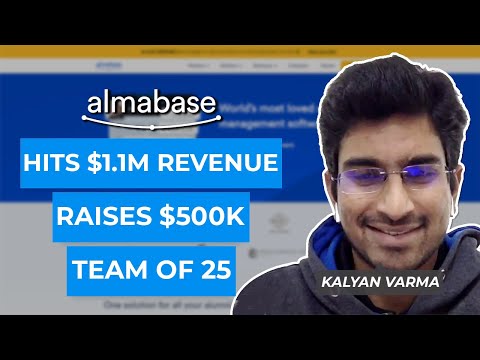
$1.1M
Customers (2020)
240
Team Size (2020)
25
Total Raised (Equity)
$500,000
Historical Snapshot
These numbers were reported by Kalyan Varma during the interview recorded in August 2020 and are a historical snapshot, not current figures. See Almabase’s current numbers.
Key Takeaways
- 01Almabase reached $1.1M in ARR as of August 2020 across 240 paying institutions
- 02Average contract value is $6,000 to $7,000 a year; the company sells annual contracts only
- 03About 90 to 92 percent of customers are based in the US, with a roughly even split between independent schools and higher education
- 04The company raised $500,000 in equity from angel investors and 500 Startups between 2014 and 2017
- 05Almabase has taken on $250,000 of revenue-based financing from Lighter Capital, a debt raised in two tranches in 2018 and January 2020
- 06There was zero churn among existing customers during COVID, though new sales slowed due to reduced budgets
- 07The company has 25 team members including five or six engineers, two product managers, and three account executives and three SDRs who all carry quota
- 08All-in customer acquisition cost is about $3,500 to $4,000 per new customer, with a payback period of six to nine months
- 09Monthly operating spend is approximately $65,000 to $70,000 per month
- 10Almabase offers three products: a digital fundraising solution, an alumni events solution, and an online alumni community platform
Company Metrics at Time of Interview
| Metric | Value | Source |
|---|---|---|
| ARR (2020) | $1.1M | Interview, Aug 2020 |
| Customers (2020) | 240 | Interview, Aug 2020 |
| Avg Contract Value (2020) | $6,000 to $7,000 per year | Interview, Aug 2020 |
| US Customers (share) (2020) | 90 to 92% | Interview, Aug 2020 |
| Team Size (2020) | 25 | Interview, Aug 2020 |
| Engineers (2020) | 5 to 6 | Interview, Aug 2020 |
| Sales Reps (AEs) (2020) | 3 | Interview, Aug 2020 |
| Total Equity Raised | $500,000 | Interview, Aug 2020 |
| Lighter Capital Debt (total) (2020) | $250,000 | Interview, Aug 2020 |
| Gross Churn (COVID period) (2020) | 0% | Interview, Aug 2020 |
| Monthly Operating Spend (2020) | $65,000 to $70,000 | Interview, Aug 2020 |
| CAC (fully loaded) (2020) | $3,500 to $4,000 | Interview, Aug 2020 |
| Product Count (2020) | 3 | Interview, Aug 2020 |
| Year Founded | 2014 | Interview, Aug 2020 |
| One-Time Implementation Fee (2020) | $3,000 to $5,000 | Interview, Aug 2020 |
| Community Product Pricing (2020) | $8,000 to $15,000-$20,000 per year | Interview, Aug 2020 |
| Fundraising and Events Product Pricing (2020) | $3,000 to $4,000 per year | Interview, Aug 2020 |
Growth Breakdown
Revenue
Almabase reported $1.1M in ARR as of August 2020, generated entirely through annual SaaS contracts with an average contract value of $6,000 to $7,000 a year. The company also earns supplemental revenue from one-time implementation fees, typically $3,000 to $5,000 per new customer, and a small transaction fee on donations processed through the platform.
Customers
The company serves 240 paying institutions, with 90 to 92 percent based in the US. Customers are split roughly evenly between independent schools and higher education institutions. Existing customer retention was perfect during COVID, with zero churn reported, though new customer acquisition slowed due to tighter institutional budgets.
Team
Almabase has 25 people in total, including five or six engineers, two product managers, and three account executives and three SDRs, all carrying quota. The team is split between India and the US, which Kalyan Varma noted gives the company a cost advantage at its current price point.
Funding and Cash Flow
The company raised $500,000 in equity from angel investors and 500 Startups between 2014 and 2017. It has been bootstrapped since then, apart from $250,000 of revenue-based financing from Lighter Capital, a debt taken in two tranches in 2018 and January 2020. Monthly operating spend is approximately $65,000 to $70,000, and Kalyan Varma said the company was not burning cash at the time of the interview.
Growth Strategy
Outbound Sales as Primary Growth Engine
Almabase has relied primarily on outbound sales, with SDRs and account executives reaching out directly to universities and high schools. This cold outreach model has driven the company to 240 customers and $1.1M in ARR without significant inbound marketing investment.
Geographic Expansion from India to the US
The company launched in India in 2014 and sold to top-tier Indian institutions including BITS Pilani, IIT Bombay, PAN IIT and Christ University. In mid-2017, seeing a much bigger opportunity in the US, Almabase shifted its focus there; by the time of the interview, about 90 to 92 percent of its customers were in the US.
Multi-Product Strategy
Almabase offers three distinct products covering digital fundraising, alumni events, and online alumni community building. Kalyan Varma said Almabase does best when an institution uses all of its products and Almabase runs the alumni program end to end, from data to engagement to fundraising. Customers can try fundraising for one campaign on a transaction fee alone, but then pay a subscription to keep going: he saw little value in a pure cut-of-donations model, which would bring in a lot of noise in the kind of customers it attracts.
Revenue-Based Financing to Fund Growth
After its early equity from angels and 500 Startups, Almabase chose revenue-based financing from Lighter Capital over more equity, taking $250,000 in total across two tranches. Kalyan Varma said the test was simply whether the money would generate revenue well above what Almabase would repay, and its bank offered too little. He called the approach value SaaS: no big equity rounds, and a little more debt whenever money becomes the bottleneck, which it was not at the time of the interview.
Expanding into Professional Services
Starting around the time of COVID, Almabase began offering professional services alongside its software, helping institutions improve their alumni programs operationally. Kalyan Varma described this as a new initiative begun two to three months before the interview, with ambitions to make it a larger part of the business.
Best Quotes
“So that's what we really help improve. I think the big issue here is that universities don't do a good job of maintaining a good relationship with their alumni. It's always one way traffic is to ask for donations all the time once you graduate. But obviously, student debt is increasing, donations are going down, which is a huge problem for universities. That's what we help solve.”
“It's a SaaS model primarily, but we've been recently, over the last, I would say, twelve months or so, we've, started making some revenue out of the cut of the donations as well.”
“So, I mean, it ranges between, I would say $4,000 a year some of our products to somewhere like $15,000 to $20,000 a year for some of our products. But if I had to like just take an average across all of our customers, all of our paying customers right now, I would say it's between 6 to $7,000 a year.”
“So today, in terms of paying customers, we have two forty institutions. Majority of them are in The US, about 90, 92% of them are in The US. Roughly a half and half split between independent schools and higher education.”
“I mean, so it's interesting because our existing customers have... There's been no churn at all. So, you know, they've seen a bigger need for Almabase during these times, but also, you know, reduction in tuition fees and, you know, fundraising during this time means that there's less budget for new purchases. So, yeah, I mean, renewals have been great. Sales is not as fast as we would have liked it to be.”
“So in terms of ARR, we're about 1.1, close to 1,100,000. So 90, 91, 92, something like that in terms of MRR.”
“The second one, I mean, we call that value SaaS actually. I don't know if you've heard that before, but what we mean by value SaaS is creating value for every stakeholder. So right, like founders for sure, but employees, customers, making sure everybody has value in this equation is what we build for.”
“I think our CAC from a lead gen perspective is obviously different for different channels, but I think it averages out to about 1,500 to $2,000 per customer in terms of lead gen. And then if I add the cost of the account executive as well, including salaries, commissions, and things like that, that's another 2,000. So it comes out to about between 3,500 to 4,000 to essentially bring in a new customer.”
“I keep telling this to myself all the time. Do less and get more done.”
What Happened Next
At the time of this interview in August 2020, Almabase had reached $1.1M in ARR with 240 paying institutions and was focused on building inbound marketing capabilities and expanding its professional services offering. Kalyan Varma expressed a preference for a capital-efficient, value-oriented growth path rather than large equity raises. Visit the Almabase company profile on GetLatka for current figures and updated metrics.
View Almabase’s current profile and metricsFull Transcript
Chapters
- 0:00Introduction and What Almabase Does
- 1:17SaaS Model and Donation Revenue
- 1:32Average Contract Value and Pricing
- 2:08Three Products and How They Are Priced
- 2:56Company Founded in 2014 and Origin Story
- 4:01First Customer and Expansion from India to the US
- 4:53Current Customer Count and COVID Impact
- 6:36Funding History: Angel, 500 Startups, and Lighter Capital
- 10:16Monthly Recurring Revenue and ARR
- 12:09Team Size, Engineers, and Sales Reps
- 13:06Monthly Spend and Cash Flow
- 13:49One-Time Fees and Professional Services
- 16:02Customer Acquisition Cost and Payback Period
- 16:41Famous Five: Books, Tools, and Habits
Introduction and What Almabase Does
Nathan Latka
00:00Hello, everyone. My guest today is Kalyan Varma. He strongly believes that technology should work towards improving human relationships instead of replacing them. The ability to bring communities together and benefit all stakeholders is what drives us. He's been personally impacted by the lack of scholarships, and with Almabase now, he's helping institutions make their education more accessible. Kalyan, you ready to take us to the top?
Kalyan Varma
00:22Let's do it.
Nathan Latka
00:23Alright. So what is Almabase?
Kalyan Varma
00:27So which school did you go to, Nathan?
Nathan Latka
00:30Virginia Tech.
Kalyan Varma
00:32Okay. How many times did you get asked for a donation after you graduated?
Nathan Latka
00:36I put them on my spam folder.
Kalyan Varma
00:40There you go. That's the story of so many of us. So that's what we really help improve. I think the big issue here is that universities don't do a good job of maintaining a good relationship with their alumni. It's always one way traffic is to ask for donations all the time once you graduate. But obviously, student debt is increasing, donations are going down, which is a huge problem for universities. That's what we help solve. So we
01:02help universities build really strong lifelong, you know, give and take, you know, very strong relationships with their alumni. And the value prop is obviously that we help them increase alumni participation so more and more alumni give back to the university.
SaaS Model and Donation Revenue
Nathan Latka
01:17Are you taking a cut of donations done through your platform, or is it just a SaaS model?
Kalyan Varma
01:23It's a SaaS model primarily, but we've been recently, over the last, I would say, twelve months or so, we've, started making some revenue out of the cut of the donations as well.
Average Contract Value and Pricing
Nathan Latka
01:32So we'll come back to that in a second. If we just focus on the SaaS side for now, what's the average university paying you per month or per year to use the tech?
Kalyan Varma
01:40So, I mean, it ranges between, I would say $4,000 a year some of our products to somewhere like $15,000 to $20,000 a year for some of our products. But if I had to like just take an average across all of our customers, all of our paying customers right now, I would say it's between 6 to $7,000 a year.
Nathan Latka
01:57Okay, got it. Something like $600 $700 $500 $600 per month.
Kalyan Varma
02:02Yeah, that's about right. We only do annual contracts, so we only count ARR.
Three Products and How They Are Priced
Nathan Latka
02:08Are they... Why would someone pay sort of $4,000 per year versus $10,000 for a year? What are you selling against?
Kalyan Varma
02:15Sure. So we have three different solutions primarily. One helps with purely like fundraising, so digital fundraising solution. And then we have one specifically focused on alumni events, virtual and in person events. And then we have a solution which is primarily around building a community of alumni online for any university or high school. So the community product is a little more expensive. So that's, again, depending on the size of your alumni, anywhere between $8,000 to like $15,000, $20,000
02:43dollars a year. The fundraising and the event solution come in at about $3,000 $4,000 a year to start with, along with a transaction fee for every donation or event ticket purchase.
Company Founded in 2014 and Origin Story
Nathan Latka
02:56When did you launch this idea? What year?
Kalyan Varma
03:00So this, I mean, the startup was officially formed in 2014. That's when we actually started Almabase. But the idea, the seed of the idea really happened in about 2007 or so. I'm from India. I went to school in India, and this happened with me where some of my classmates and friends had to drop out of school midway during my junior year. Right? And then that's what really led to me sort of starting a nonprofit at that
03:28point, which basically reached out to all of our alumni, raised money. And then I graduated, joined Goldman Sachs for a full time job, did that for a few years. But I was always running this on the side along with a friend of mine. And that's really when over those years where we were raising money from alumni of our institution, we realized that not just at our college, but institutions globally, the relationship between alumni and their alma mater
03:52is just based on loyalty and not like a true relationship, which is where we realized that this needs to get fixed. That's how we started Almabase in 2014.
First Customer and Expansion from India to the US
Nathan Latka
04:012014. And do you remember the first customer? Can you tell us that story?
Kalyan Varma
04:06That was actually my alma mater. So we started with selling in India because when we started being, it's really naive. I mean, we said, everybody in The US has already figured out how to do alumni relations and we're gonna do this for India. So we were like, let's just bring the best ideas from The US and implement it in India. We unfortunately did that for about three years. Sold pretty much all of the top tier institutions in
04:30India. Then we were like, okay. Where do we? So we have BITS Pilani. We have IIT Bombay. We have PAN IIT, you know, Christ University, etcetera. So some of these top tier institutions in India. But then we had nowhere to go after that. So then we were like, okay. You know, there's a much bigger opportunity in The US. So that's when we started shifting focus to The US, in like mid twenty seventeen or so.
Current Customer Count and COVID Impact
Nathan Latka
04:53Mhmm. And how many customers do you now have today?
Kalyan Varma
04:57So today, in terms of paying customers, we have two forty institutions. Majority of them are in The US, about 90, 92% of them are in The US. Roughly a half and half split between independent schools and higher education.
Nathan Latka
05:13And are you seeing people more reliant on you during COVID or less?
Kalyan Varma
05:19I mean, so it's interesting because our existing customers have... There's been no churn at all. So, you know, they've seen a bigger need for Almabase during these times, but also, you know, reduction in tuition fees and, you know, fundraising during this time means that there's less budget for new purchases. So, yeah, I mean, renewals have been great. Sales is not as fast as we would have liked it to be.
Nathan Latka
05:40Okay. And origin story here at SensiQ, you were at Goldman for a bit. Was Goldman right before 2014?
Kalyan Varma
05:48So I was at Goldman for three years right after I graduated. So 2008 to 2011. So I literally joined Goldman Sachs during the peak of that recession. I was there till 2011. 2011, I actually started an e commerce company because I thought that's what I was gonna be interested in. 2011, India e commerce was a big deal. Ran that for about three years. Again, that was again very focused on social impact primarily from a... So I
06:13started an e commerce marketplace, which would basically sell products that are being manufactured by nonprofits only. So every store, every product would have a story behind it. And that was the unique sort of angle to it, as opposed to just a product and a price, then you buy it. But then really didn't take off, didn't get the traction that I would have liked. And then 2014, I sort of switched to sort of starting Almabase. That's been
06:35an idea that I've had forever.
Funding History: Angel, 500 Startups, and Lighter Capital
Nathan Latka
06:36And have you bootstrapped Almabase?
Kalyan Varma
06:40That's an interesting story. Do say we are bootstrapped, but we did raise a little bit of money upfront, you know, between that 2014 and 2017 phase where we weren't really sure of what we were doing. We did raise some money from angel investors, again, alumni of my own alma mater, As well as 500 Startups, the accelerator program in the Bay Area.
Nathan Latka
06:59How much?
Kalyan Varma
06:59So we
07:00did raise a little bit of money. The total money we've raised is about 500 k
Nathan Latka
07:00Okay.
Kalyan Varma
07:00During that time. But what's interesting is during that whole three years where we raised 500 k, we didn't really a lot in terms of ARR. But then we've been bootstrapped since then. We raised a little bit of debt in the last couple of years from Lighter Capital. We raised, I think, $250 k in debt so far from Lighter Capital and
Nathan Latka
07:24When no more did you raise that debt?
Kalyan Varma
07:27So we raised a 100 K in 2018 and then a 150 K during like December 2019 or like closed in January 2020. About six months ago.
Nathan Latka
07:40You're from golden... Goldman, so I'm expecting you to be able to explain this very clearly so that anyone can understand it. How does a Lighter Capital RBF revenue based financing work?
Kalyan Varma
07:51It's pretty simple actually. I mean, the sense that you don't need to put any collateral upfront. It's revenue based financing. So they give you a certain amount of money based on how much revenue you have and what are the projections, etcetera. So it's a fairly safe bet from their side as well. So we are doing it at 40% over three years. So for example, if we raise a 100 k, we're repaying 140 k. And the way
08:12the repayment works is it's a cut or it's a percentage of monthly cash receipt. Right? So if you... Let's say in a certain month, let's say we get 100 k in cash, we pay 9 k, 10 k, something like that. And then it goes down over a period of time in terms of the percentage of the cash flow, etcetera. So it's a fairly straightforward instrument.
Nathan Latka
08:31What determines if it goes from 9% of gross monthly receipts down to 5% of gross monthly receipts?
Kalyan Varma
08:37It's the... I think they basically put a cap in terms of... For the first, I think million dollars per year in cash receipts, it's about 9 percent, if I remember correctly. And then between from anywhere over 1,000,000 to, I think 1.5 or 2,000,000, it's 5%. And then if it goes beyond 2,000,000, then it's like 0.1% or something like that.
Nathan Latka
08:57Got it. So just to summarize again, I've heard of terms, I've interviewed many people that have raised from Lighter, but there's essentially a repayment cap, which is usually between one point four and two x the total loan. You said you're at about 1.4, it sounds like. So if you raise 250,000 total, what you're gonna pay back total over time is about 350,000 or 1.4 x the $250 k. And the way that you pay that back is gonna
09:22be right now about 9% of your gross monthly receipts. And that could drop if you grow pretty quickly.
Kalyan Varma
09:30Yeah. Don't quite recall if 9% is accurate, but somewhere around that range.
Nathan Latka
09:35How do you compare that to just regular debt where it's just a flat, simple to understand interest rate? In other words, if I asked you, what's the interest on this money? How would you try and calculate that?
Kalyan Varma
09:46Yeah. It's not that straightforward. I think we just took it, based on the simple math that, I mean, if we're gonna get this 100 k, are we gonna generate revenue that's way more than a 140 k or not? Right? And if it is, then that's what we need. Right? So we didn't really... I mean, we did, I think, talk to a bank. Bank of America is our banker. We did talk to them, but there was lots
10:06of complications. And also they said, we can give you a maximum of 40 ks, 50 ks, something like that, which wasn't sufficient at the point that we raised. And we had a good relationship with Lighter, so that's what we went with.
Monthly Recurring Revenue and ARR
Nathan Latka
10:16And what's your monthly recurring revenue today?
Kalyan Varma
10:20So in terms of ARR, we're about 1.1, close to 1,100,000. So 90, 91, 92, something like that in terms of MRR.
Nathan Latka
10:29Yeah. So Lighter can usually go up to like three or four X of your MRR, which is exactly what it looks like. It sounds like here. If you wanna continue scaling the company and using debt, right? So that you and your founders keep owning a 100% of the equity, where would you go? Or how would you think about a bigger debt deal?
Kalyan Varma
10:47What do you mean? Like, would we be raising more debt or would we be doing equity? Is that your question?
Nathan Latka
10:52Yeah, I mean, there's two types of founders. Founders that want headlines and wanna go for a billion dollar win, which is high risk. And those that wanna keep as much of their company as possible and build it to a 10,000,000 profitable thing that they can get rich off of, which are you?
Kalyan Varma
11:09The second one, I mean, we call that value SaaS actually. I don't know if you've heard that before, but what we mean by value SaaS is creating value for every stakeholder. So right, like founders for sure, but employees, customers, making sure everybody has value in this equation is what we build for. So yeah, we're certainly gonna be... Not gonna be type A, which is like raise tons of money and hopefully get there. But yeah, we're more
11:32of... I mean, at this point, money is not really our bottleneck. There's a few things that we're solving for, but whenever money is a bottleneck, I think we will raise a little bit of debt to keep us going.
Nathan Latka
11:40What's the bottleneck?
Kalyan Varma
11:42I think marketing for me is I think the key bottleneck from a brand story. I think we just haven't really done that well. I mean, so far we've been focused on outbound sales, right? So we've done SDR, AEs, we go outbound, reach out to every single university and high school, see if they're interested in what we're doing. But from a marketing perspective, inbound demand gen, we haven't really done a lot. And so that's really the next
12:07few months for me in terms of focus.
Team Size, Engineers, and Sales Reps
Nathan Latka
12:09Interesting. What's the team size today? How many folks?
Kalyan Varma
12:13So we're 25 people total.
Nathan Latka
12:16And how many engineers?
Kalyan Varma
12:20Five, six engineers, two product managers.
Nathan Latka
12:24Yeah. And do you have, is this price point a price point where you can put salespeople on it with quota? Do you any quota carrying sales folks?
Kalyan Varma
12:32Yeah. We have quota carrying sales folks. We have three account executives and three SDRs. All of them have quotas obviously, top of the funnel, bottom of the funnel, etcetera.
12:42And yeah, so it works out for us because some of our people are in India and some of our people are in The US. We do some of us shuttle back and forth as well. And I mean, I were to build this team entirely in, let's say the San Francisco Bay Area, it's never gonna work out with that kind of price point. But yeah, we do have an advantage in being able to hire people from lower
13:05cost locations.
Monthly Spend and Cash Flow
Nathan Latka
13:06You wouldn't have raised the debt if you didn't see a way to reinvest it to drive growth, which probably means you're burning a little bit of capital per month right now. About how much are you burning?
Kalyan Varma
13:15But actually not at this point. I mean, we have significantly cut down costs in March when we started seeing COVID hit and like, you know, we wanted to obviously, you know, play it safe at that point. So our current monthly spend is about 65 to 70 ks per month.
Nathan Latka
13:29Got it. So you're probably saying about 20 ks per month right now.
Kalyan Varma
13:33Yeah, a little over that. I mean, because one is the... I mean, we spoke about the recurring revenue, but we also have other sources of revenue, which is, like I said, a little bit of transaction charges. For every new customer, do have an implementation and setup and training costs, which is like one time upfront kind
One-Time Fees and Professional Services
Kalyan Varma
13:49of
Nathan Latka
13:49How much is that usually?
Kalyan Varma
13:52It depends. Again, like it's anywhere between 3 to $5,000 one time. Right? But we also sometimes give a discount and things like that. So roughly right now, for example, this year, we're projecting that to be about hundred, hundred and fifty k terms over like one time. Obviously, that's not gonna recur next year unless we get new customers. That's one, but we're also starting to play a little more in the professional services side. So now we're actually
14:15going in, not just giving our software to schools, but then we're saying, hey, like what are the parts of the alumni program that you wanna run better? We're gonna come help you because we work with two fifty schools. We understand how this works for different kinds of institutions. We're gonna help you run the program, etcetera. Again, that's a new idea. We've been only doing that for about two to three months, especially since COVID, given the layoffs
14:36and things like that. But yeah, I'm hoping that that becomes a much bigger piece of the pie.
Nathan Latka
14:41And how many donations, GMV, have gone through your platform, say in twenty nineteen?
Kalyan Varma
14:48I don't have that off the top of my head, but the only stat that I do remember is very recently about, so May 5, I think it was, was called Giving Tuesday Now. It was like this one big charitable donation day. And on that day, I think we processed a little over $2,000,000 in terms of donations for our customers. That's one number that I remember.
Nathan Latka
15:08What's your thesis on scaling the sort of take a percent of the donations model, right? Which can be lower touch and potentially grow pretty quick.
Kalyan Varma
15:17Yeah. So, I mean, I think we wanna sort of use the fundraising not as an... I think where we really do well is when people have all of our products. Like we run the end to end sort of alumni program from data to engagement to fundraising. So we don't really see a lot of value. I mean, we do give customers the ability to try no cost, but only a transaction fee for one campaign just to give
15:42it a shot. And then we say, okay, you have to pay a subscription to be able to keep it going. Right? I don't really see a lot of value in just saying, just pay as a cut because we're gonna get a lot of noise in terms of the kind of customers that we attract. We want to be really focused on the kind of customers it makes sense to have all of our products.
Customer Acquisition Cost and Payback Period
Nathan Latka
16:02And what is your current CAC right now to get these new customers?
Kalyan Varma
16:07So I did put this map together. I think our CAC from a lead gen perspective is obviously different for different channels, but I think it averages out to about 1,500 to $2,000 per customer in terms of lead gen. And then if I add the cost of the account executive as well, including salaries, commissions, and things like that, that's another 2,000. So it comes out to about between 3,500 to 4,000 to essentially bring in a new customer.
16:35So yeah, the payback that we look at is somewhere between six to nine months in terms of payback.
Famous Five: Books, Tools, and Habits
Nathan Latka
16:41Very good. All right, Kalyan, let's wrap up here with the famous five. Number one, favorite business book.
Kalyan Varma
16:48I read a lot of biographies. I don't know if I have a favorite business book, but I would probably pick Never Split the Difference by Chris Voss. That's one of
Nathan Latka
16:48What's my your favorite bio?
Kalyan Varma
16:48Elon Musk. I loved that.
Nathan Latka
17:01Number number two, is there a CEO you're following or studying?
Kalyan Varma
17:05Yeah. Girish Mathrubootham from Freshworks.
Nathan Latka
17:08Yep. When are they gonna IPO?
Kalyan Varma
17:11I couldn't tell you, but I love him for his storytelling abilities. Mean, that's one thing that I'm trying to learn from him.
Nathan Latka
17:17Number three, what's your favorite online tool for building Almabase?
Kalyan Varma
17:22I love Asana. That's something that we've used right from the beginning.
Nathan Latka
17:26Number four, how many hours of sleep do get every night?
Kalyan Varma
17:29About six hours.
Nathan Latka
17:31Okay. And situation, married, single, kids?
Kalyan Varma
17:34Married, 33 years old, one kid. She's one year old.
Nathan Latka
17:38Oh, that's exciting. Okay. Last question here, Kalyan. What do you wish your 20 year old self knew?
Kalyan Varma
17:45I keep telling this to myself all the time. Do less and get more done.
Nathan Latka
17:50Guys, Almabase helping alumni programs have a better relationship with their alumni communities and ideally raise more capital. They've got several 100 schools on the platform doing about one point... Or, yeah, about 1,100,000 in terms of run rate right now. 240 customers or schools. They've raised $500,000 to do this. They're cash flow positive about $20,000 a month, 25 on the team, six engineers. They look to continue to scale spending $4,000 to get a new $500 a month
18:15customer. So six to nine month payback period. Kalyan, we're rooting for you, man. Thanks for taking us to the top.
Kalyan Varma
18:20Thanks, Nathan. Have a good one.
Nathan Latka
18:24One more thing before you go. We have a brand new show every Thursday at 1PM central. It's called Shark Tank for SaaS. We call it deal or bust. One founder comes on, three hungry buyers, they try and do a deal live, and the founder shares back end dashboards, their expenses, their revenue, ARPU, CAC, LTV, you name it, they share it. And the buyers try and make a deal live. It is fun to watch every Thursday, 1PM
18:48central. Additionally, remember these recorded founder interviews go live. We release them here on YouTube every day at 2PM central. To make sure you don't miss any of that, make sure you click the subscribe button below here on YouTube, the big red button, and then click the little bell notification to make sure you get notifications when we do go live. I wouldn't want you to miss breaking news in the SaaS world, whether it's an acquisition, a big
19:09fundraise, a big sale, a big profitability statement or something else. I don't want you to miss it. Additionally, if you wanna take this conversation deeper and further, we have by far the largest private Slack community for B2B SaaS founders. You wanna get in there. We've probably talked about your tool if you're running a company or your firm if you're investing. You can go in there and quickly search and see what people are saying. Sign up for
19:30that at nathanlatka.com/slack. In the meantime, I'm hanging out with you here on YouTube. I'll be in the comments for the next thirty minutes. Feel free to let me know what you thought about this episode. And if you enjoyed it, click the thumbs up. We get a lot of haters that are mad at how aggressive I am on these shows, but I do it so that we can all learn. We have to counter those people. We gotta
19:49push them away. Click the thumbs up below to counter them and know that I appreciate your guys' support. Alright. I'll be in the comments.
19:55See you.