Latka logo

Valuation

$45M

2024 Revenue

$3.1M

Customers · 2022

2K

Funding

$10.5M

Team

46

Founded

2013

Thalamus Revenue, Valuation & Funding (2024)

Thalamus is a cloud-based SaaS recruitment platform for medical residency and fellowship programs, connecting graduating medical students with hospital training positions across the United States. Founded in 2013 by Jason Reminick and co-founder Susie Karen following Reminick's experience navigating a disrupted residency interview season during Hurricane Sandy, the company replaces manual email and phone-based scheduling with an integrated scheduling, applicant tracking, and video interview platform.

As of early 2022, Thalamus serves more than 2,000 residency and fellowship programs across more than 200 hospital systems, generating approximately $6 million in annual revenue. The company reached its first million-dollar revenue year in 2020, when the COVID-19 pandemic accelerated adoption of its virtual interview capabilities, and has since roughly doubled revenue each year.

In early 2022, Thalamus closed an $8 million Series A round, bringing total capital raised to approximately $11.5 million including prior pre-seed and seed funding. The company employs 20 people, including 6 engineers, and is targeting expansion deeper into existing hospital enterprise accounts as well as the broader attending physician recruitment market.

Last updated

Thalamus Revenue

Thalamus reached approximately $6 million in annual revenue in 2022, up from $3 million in 2021 and $1 million in 2020, representing roughly 100 percent year-over-year growth in each of the two most recent periods. The company's first million-dollar revenue year was 2020, the first year of the COVID-19 pandemic, when the entire residency interview process shifted to virtual formats and Thalamus extended its platform to include a proprietary video interview system.

Thalamus Revenue GrowthReported revenue / ARR over time$0$1.3M$2.5M$3.8M$5M$6.3M2013201520172019202120232024$0$1M$3M$4.1M$3.1MSource: GetLatka.com interview on Mar 3, 2022 with Jason Reminick
YearMilestoneSource
2024Thalamus Hit $3.1m revenue in November 2024
2024Thalamus Hit $5.6m revenue in October 2024Estimated
2023Thalamus Hit $4.1m revenue in November 2023Estimated
2022Thalamus Hit $2.9m revenue in March 2022
2021Thalamus Hit $3m revenue in January 2021Watch[1]Estimated
2020Thalamus Hit $1m revenue in January 2020Watch[2]
2013Launched with $0 revenue

Jason Reminick told Latka in March 2022 that revenue was approximately $3 million in 2021 and that the company was expecting approximately $6 million in 2022. Earlier in the same interview, before correcting himself, Reminick had referenced a run rate of roughly $4.5 million, which he subsequently clarified was not accurate, stating the correct figures as $3 million for the prior year and $6 million expected for the current year.

Using the most recent stated growth rate of approximately 100 percent year over year as a ceiling, and applying a deceleration adjustment as a floor, a GetLatka estimate for 2023 revenue would be in the range of $9 million to $12 million. This is a modeled range based on the trailing two-year growth rate and should not be treated as a company-confirmed figure.

Thalamus Valuation, Funding Rounds

Thalamus reached a $45M valuation in 2022, set during its Series A round.

Thalamus has raised $10.5M in total funding across 3 rounds, most recently a $8M Series A round in 2022.

Thalamus Capital Raised & ValuationCumulative capital raised and post-money valuation by roundCapital raised (cum.)Valuation$0$0$10M$2.5M$20M$5M$30M$7.5M$40M$10M$50M$12.5M201320152017201920212022$45MSource: GetLatka.com interview on Mar 3, 2022 with Jason Reminick
YearRoundAmountValuation% SoldSource
2022Series A$8M$45M18%
2019Seed$1.5M--
2018Pre Seed$1M--

Founder / CEO

Julia van Broek

CEO

Thalamus was co-founded by Jason Reminick and Susie Karen. Reminick holds an MD, MBA, and MS and was 37 years old at the time of the March 2022 interview. He described the origin of the company as stemming directly from his own experience applying to medical residency programs in 2012, when Hurricane Sandy disrupted his interview season in New York City and forced him to cancel and reschedule multiple interviews. That experience led him and Karen to develop a more systematic approach to residency recruitment scheduling.

Susie Karen, whom Reminick described as his mentor from medical school, is a practicing anesthesiologist and co-founder. Her clinical background provides direct insight into the candidate side of the recruitment process. Julia van Broek is the CEO of Thalamus. Reminick did not discuss his personal net worth in the interview, and no estimate can be responsibly derived without a confirmed ownership percentage and a confirmed valuation; net worth was not discussed.

Q&A

QuestionAnswer
What's your age?40
Favorite online tool?-
Favorite book?-
Favorite CEO?-
Advice for 20 year old self-

Customers

As of early 2022, Thalamus serves more than 2,000 residency and fellowship programs across more than 200 hospital systems in the United States. The platform is sold on an annual license basis, with pricing ranging from a few hundred dollars for a single small program to hundreds of thousands of dollars for large hospital enterprises. Reminick stated that the average hospital system pays approximately $50,000 to $75,000 per year, and cited $50,000 as a reasonable central estimate.

At that average contract value, a hospital system using Thalamus conducts roughly 40,000 to 50,000 interviews per year across all of its programs, and places approximately 1,000 to 2,000 candidates annually. The largest single hospital customer on the Thalamus platform conducted between 10,000 and 20,000 interviews through the platform over the prior 12 months, representing a subset of that hospital's total interview volume. Individual programs within a hospital system interview anywhere from 50 to 1,000 candidates per program per year, while filling as few as 1 to 10 spots per program.

Thalamus serves 2K customers.

Thalamus Business Model

Thalamus operates on an annual SaaS license model, selling to hospital programs and hospital enterprise systems rather than to individual candidates. The average contract value is approximately $50,000 per year at the hospital system level, with individual program licenses ranging from a few hundred to a few thousand dollars annually. Reminick described the platform as replacing email, phone calls, and older software systems that do not integrate with the central application clearinghouse.

Over the 12 months preceding the March 2022 interview, Thalamus sent approximately 200,000 interview invitations, completed approximately 150,000 interviews, and logged more than 20 million minutes of video interviews. The company's own research indicates that between 15 and 35 percent of interviews in the residency process could be eliminated without changing placement outcomes, a finding Reminick cited as central to the platform's longer-term value proposition around reducing over-interviewing.

Profitability was not discussed in the interview. Gross margin, churn, net revenue retention, CAC, LTV, and burn rate were not disclosed. The total addressable market for Thalamus on the hospital side is between 600 and 1,000 hospital systems in the United States, of which the company currently serves more than 200, implying meaningful but not complete market penetration. Reminick identified the attending physician recruitment market as a significant adjacent opportunity, noting that hospitals spend approximately $250,000 per attending physician hire, that positions typically take 6 to 12 months to fill, and that an unfilled physician position costs a hospital approximately $2.5 million in lost billable revenue every 6 months. Physicians coming out of training typically receive approximately 100 job opportunities, which Reminick described as largely non-targeted.

Point-in-time figures shared on the GetLatka podcast, each linked to the exact moment it was said on camera.

Customers (2022)

2000

Jason Reminick: We're serving over 2,000 residency and fellowship programs across 200 over 200 hospital systems.

Watch

Thalamus Employees & Team Size

Thalamus employed 20 people full time as of March 2022, including 6 engineers. Reminick noted that the engineering team has been built using a combination of in-house and outsourced development resources, with the company growing its core internal engineering team over time while continuing to use some outsourced capacity to supplement development cycles.

Thalamus employs approximately 46 people as of 2026, up from 44 in 2023. It serves 2K customers that rely on its solutions.

Thalamus Team GrowthReported headcount over time010203040502013201520172019202120232024004646Source: GetLatka.com interview on Mar 3, 2022 with Jason Reminick
YearMilestoneSource
2024Reached 46 employees (October 2024)
2023Reached 44 employees (November 2023)
2022Reached 20 employees (January 2022)
2021Reached 24 employees (November 2021)
2020Reached 21 employees (November 2020)

Frequently Asked Questions about Thalamus

What is Thalamus's revenue?

Thalamus generates $3.1M in revenue.

Who founded Thalamus?

Thalamus was founded by Julia van Broek.

Who is the CEO of Thalamus?

The CEO of Thalamus is Julia van Broek.

How much funding does Thalamus have?

Thalamus raised $10.5M across 3 rounds.

How many employees does Thalamus have?

Thalamus has 46 employees.

Where is Thalamus headquarters?

Thalamus is headquartered in Santa Clara, California, United States.

Compare Thalamus to the industry

Thalamus operates across multiple industries. Browse revenue, funding, and growth data for Thalamus in each sector below.

Full Interview Transcripts

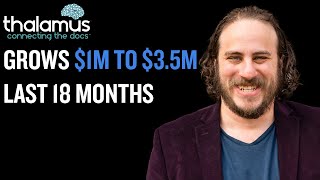
Hospital SaaS for Residencies Grows $1m to $3.5m Last 18 monthsMar 3, 2022

[00:00] Hey, folks. My guest today is Jason Reminick. He's an MD, MBA, MS, and is the CEO and founder of Thalamus, the premier cloud based recruitment platform for hospitals and physicians. He began his residency interview season stuck in New York City during hurricane Sandy, if you guys remember that. And after three canceled interviews and spending weeks trying to reschedule, he and his co founder brainstormed a better way to manage medical residency recruitment. Since then, it's what he's [00:22] been committed to, innovating around physician recruitment to ensure the right doctor is recruited to the right hospitals to treat the right patients. Jason, you ready to take us to the top? [00:31] >> Absolutely. Good [00:32] >> to Thanks be for having me. [00:34] You bet. So what's the model here? So does this act like more like a recruiting agency where you take a percent of first year salary or is it more like a SaaS platform? [00:41] >> It's a SaaS platform. So we manage a very Byzantine, very complicated, frustrating process of students applying from graduating medical school to their residency training positions around the country. And previously, this was all done manually by email and phone call and our platform works in that hospitals use it either single programs being internal medicine, pediatrics, OBGYN, etcetera, or entire hospital enterprises. It integrates with the common application system, central clearinghouse everyone's using to accept applications. They pull [01:14] >> their data in, they invite the candidates to interview, applicant gets an email to create a profile, and then they're brought to a calendar within seconds to schedule their interviews in real time, kind of like OpenTable, but instead of booking a restaurant, they're booking a residency interview. Back on the hospital side, it's a process specific applicant tracking system. It allows them to manage the process, score candidates, build face sheets, and eventually decide who's Who's gonna the The [01:36] >> hospital's paying. [01:37] Yeah. And so what are what's the average hospital paying you right now per month to use the technology? [01:42] >> So it's an annual license. It ranges depending on the size of the program anywhere from a few $100 to a few thousand dollars. Hospital system wise, that can be tens of thousands up to hundreds of thousands depending on what hospital and how large it is. [01:58] Well, just simplify that for me, right? If you take your average hospital, what are they paying you per year? [02:02] >> Probably around $50,000 to $75,000. [02:05] Okay. And how many people are they placing for $50,000 a year, probably? [02:10] >> They're interviewing probably, depending on the size, about 40 or 50,000 people. And from that, they'll place around between a thousand and 2,000. [02:24] Okay. Got it. So it's almost if they're paying 50 k a year, it's almost a dollar per interview, and then they're placing a thousand to 2,000 of those interviews. [02:34] >> You wanna do the math that way? Sure. [02:36] Yeah. Well, yeah, I mean, that because that's your key value metric, right, is number of interviews done, right, or something like that. [02:42] >> Yeah. We're actually trying to decrease the number of interviews given that this this kind of niche market, but that's an interesting discussion in itself. That's a [02:48] ton of people, by the way. I mean, 40 to 50,000 interviews by one hospital in a year? [02:54] >> That's the challenge. And so hospitals may have a hundred, hundred and fifty programs in various specialties of various sizes. And right now, over the last five to ten years, the number of applications a single candidate is sending out has increased by 5x. It was around 15 when I applied in 2012. It's now jumped to 70. And so applicants are spending thousands of dollars to have their data sent to different hospitals. And then hospitals will interview, depending [03:21] >> on the size of the program, anywhere from 50 to 1,000 candidates per program. Sometimes they fill as few as one to, let's say, 10 spots. And so we've done a lot of research that's showing that about, depending on the specialty, between 15 to 35% of interviews could be eliminated overnight, and everyone could end up in the same place anyway. And that's the amount of over interviewing that's going on right now as well. [03:42] I see. When did you launch the business? What year? [03:45] >> 2012 2013. [03:46] Was just starting my my my medical residency started Very it back [03:51] cool. So you get your first customer signed up, obviously. And then how many customers are you serving now today? [03:56] >> We're serving over 2,000 residency and fellowship programs across 200 over 200 hospital systems. [04:03] Oh, what's going on there, YouTube? Good to see you guys. Now imagine this. You love watching these interviews with SaaS founders. But imagine if we took all of the valuation data out from over 2,807 interviews I've done manually Saves you a lot of time. Well, we've done this. We've built it into the beautiful interface inside of Founderpath. Check this out. I'll show you how you can access this in a second. But you log in, you connect [04:26] your Stripe account, you see your valuation real time, you can see what it it changed over the past eighty eight days and even set goals for valuation this year. Now the secret evaluation is there's many different ways to value a SaaS business. So the reason you're gonna see three or four different valuations inside of your Founderpath dashboard, this is all free by the way, is because depending on who's doing the buying of your SaaS company, you're [04:50] gonna get a different valuation. A VC is gonna pay a different valuation, Private equity firm is different. If you're gonna do a minority sale, that's different. And if you sell the whole business, that's a different valuation. You can see all those when I hover over here, right? So the teal is what a VC would pay. Yellow is what private equity And red is if you sold the whole thing outright. Now what's cool about this is this [05:12] is not built off random data. Again, you guys hear these interviews on YouTube. All these datas are built from real time valuation data points founder share with us on the show. So traction 1,200,000 seed round 3.7 raise. They sold 22% of their business. Go in here and filter by the event. Maybe you only wanna see companies that have sold the whole business. Well, here are a bunch that have been acquired the valuation and the multiple. Maybe [05:38] you're going out right now and you're raising your seed round. We'll go in here and look at all this recent seed deals that went down, what they raised, what valuation they raised at and what percent that they sold. There's never been a larger dataset of SaaS valuations than what you can get now inside of Founderpath. And we're thrilled to bring it to you. All right. We're gonna go back to the YouTube video here in a second, [06:00] but if you wanna check this tool out, if you wanna jump in and sign up, you can check it out for free to get your valuation at this link. This link, founderpath.com/products/valuations. Or if you go to founderpath.com and hover over products, click on get your valuation here, and go ahead and sign up to give it a whirl. Again, all that valuation data live right inside the platform. I hope to see you there. Alright. Let's jump back [06:26] into the interview. Okay. So 200 hospital systems. Got it. So, I mean, can I take 200 hospitals times $50,000 a year? You're doing, like, 10,000,000 a year in revenue? [06:36] >> Not not that much. We're we're in the in the kind of the 4 to 5 range we're talking still yeah. [06:42] That's still that's still nice traction. What what was your first which year was your first million dollar year? Do you remember? [06:48] >> The first million dollar year was the first pandemic year. [06:51] We Was that 2021 [06:53] >> 2020? 2020. So it was the entire process shifted to virtual, and we extended our platform to include a virtual interview platform that not only builds the schedules for everyone and handles that volume of interview, but also then creates all the video links, builds the schedules and everyone can just interview and not have to move people in and out of breakout rooms. We built our own video platform, and that really accelerated the growth of the business. [07:21] So just to confirm, if you're doing between 4 and 5,000,000 revenue right now, let's call it a run rate of 4,500,000, you're doing something like $375,000 a month in revenue? Yes. Right around there. Cool. Yeah. And how many across all 2,000 programs and all 200 hospitals, how many total interviews were done over the past twelve months? [07:40] >> Total hospitals that were done in over the last twelve months Interviews. [07:44] Interviews. [07:45] >> Interviews. We sent out about 200,000 invitations to interviews, probably completed about a 150,000 of those. [07:54] Okay. A 150 k interviews. Interesting. [07:57] >> Over 20 over twenty million minutes of video interviews as well. [08:02] Okay. Got it. I guess the reason I asked, you said it earlier that someone paying you $50,000 a year is doing 50,000 interviews. But if you have 200 customers times 50,000 interviews, that should be a number of interviews in 10,000,000 interviews. You just told me the last twelve months you did a total of 150,000 interviews. It's a big difference. [08:25] >> Not all of the hospitals are necessarily using us for all of their interviews, but that's how many people they're interviewing. [08:32] Oh, I see. I see. I see. So so of the 40 to 50,000, that one hospital might do in a in a year, how many might they use you for? [08:40] >> I'd say our largest hospital is just doing about 10 or 20,000 interviews with us. [08:44] I see. I see. Why don't they use you for all of them? [08:46] >> It varies depending on size and just the number of people that they're interviewing overall. So [08:54] I mean, but if you're if you're providing a lot of value, then people are happy. Why wouldn't they wanna get the whole system on you as fast as possible? [09:00] >> It's it's technology adoption and just changing practices that that have existed from prior. [09:06] Who are you replacing? [09:08] >> We are replacing emails and phone calls predominantly and some older software systems that don't integrate with the other other platforms. [09:16] Mhmm. Mhmm. Interesting. Okay. So, again, you get going back in 2013. You're scaling nicely. It took you, I guess, what is that seven years to break a million in revenue, but now scaling rapidly. Can this growth keep up even when the pandemic slows down? [09:29] >> I think so. Sort of the longer term play for us is we really think we can help in terms of improving recruitment process, making it more diverse and equitable for hospital systems, which has been a major challenge, helping to drive more strategic decision making rather than inviting so many candidates to interview and and doing a much more targeted interview. Also for the candidate, allowing them to end up in a hospital that works better for them as [09:51] >> well. [09:52] Mhmm. Now, Jason, have you bootstrapped the business or did you decide to raise capital? [09:55] >> We've raised capital. [09:56] Okay. When did you decide to raise and how much? [09:59] >> We've decided to raise [10:02] >> we've had a seed round in 2019 where we raised $1,500,000. We did prior to that about $1,500,000 in friends and family kind of pre seed funding and a little bit of bridge funding. And then we're just completing an $8,000,000 series a raise. [10:20] And so where do you plan to spend that 8,000,000 and why do you need it? Why does this company require capital? [10:26] >> We're looking to scale in the hospitals that we work with. As I mentioned, we're growing across the enterprise of many of them and we have many other hospitals still to hit. But we also think that the data piece is kind of key here. And so helping hospitals recruit smarter and then from there, as broken as the recruitment cycle is in the residency side, when you get to the attending physician space, [10:53] >> it's even more broken. So hospitals are spending upwards of $250,000 per single physician hire. It usually takes six to twelve months to fill the position and they lose about $2,500,000 in revenue, billable revenue for every position they don't fill every six months. And so coming out of training as a physician, you usually approach with close to 100 different job opportunities. They're usually non targeted. I don't practice right now, but I still get offers to go practice [11:22] >> surgery in rural Kansas and I'm not a board certified surgeon and I have not ties to Kansas, but someone's paying for our data. And so we think there's a way from medical school all the way beyond to help doctors and hospitals make that connection better. [11:35] Vision's interesting. We'll see sort of see what happens. How many hospitals are there that you think are in your addressable market? [11:42] >> Depending on how you measure a hospital, between 600 and a thousand. [11:45] Okay. So you're at 200 now. That's that's a high amount of penetration. So I assume the story to validate a series a valuation is once we get the hospitals, we'll sell them more and increase ACV? [11:55] >> Yeah, I think the hospitals, but there's a whole recruitment problem we're trying to solve as well. And this goes a lot of different directions because to become a physician in The US, you have to go down this very particular regulated pipeline. And so we're we're excited about the possibilities for the future. [12:12] Mhmm. Now most folks in their series a are sell selling between 10 to 15% of their business. Are you sort of in that average range, or did you do something super unique? [12:20] >> No. We were we were kind of a little bit in that average range, a little bit to the higher side of the range. But yeah. [12:25] Okay. But it felt the process felt fair to you? [12:28] >> Absolutely. [12:29] Okay. Got it. [12:29] >> I think we have I think we have the right investors who are really aligned with our mission and really excited to be working with them. [12:35] Mhmm. Okay. Cool. So maybe call you sell 15% of the business, something like that, which would put sort of valuation maybe around $50,000,000 to $55,000,000, something like that after you're all said and done. [12:45] >> Sure. [12:47] Well, not sure. Is is I mean, I'm asking a question. [12:50] >> I I I'm I prefer not to disclose our valuation. [12:54] Well well so I'm just going up on numbers you just gave me. Right? So you I said 10 to 15. You said 15%. I'm just multiplying what's 8,000,000 15%. Right? What does 8,000,000 make up? That's 15% of it. It would be about a 50,000,000 valuation. [13:05] >> Right. I understand. We're we're a little bit below that. [13:09] Okay. Okay. Fair enough. Fair enough. Yeah. But the reason I asked this is because if you have a big vision, you wanna go get all these hospitals, right, Solve a lot of problems besides just recruitment for them. Wanna obviously hold on to as much equity as possible. So how are you thinking about dilution and managing it? [13:22] >> I think with every deal and every time we raise capital, we've looked at where we feel the business is gonna be, who the partner is, what value they provide to the business, what seller rent that allows in terms of the capital coming in, and how much runway that gives us and how much firepower it gives us to grow and and meet sort of our KPIs and OKRs to grow the business on the trajectory we think it's [13:41] >> gonna work. And so that's that's kind of how we weigh that, and and I think we've been well aligned with our investors along the way. [13:47] Why is the multiple though so low? Mean, I'm gonna give you credit here. You've gone from a million dollar run rate, right, nineteen months ago to like a $4,500,000 run right now. That's incredible growth, over 400%. I mean, I interview thousands of founders. Right? Most founders of that kind of growth right now are raising at multiples in the 35 to 45 x range. You raised at a multiple of 10 x. Right? 4,500,000 run rate, 45,000,000 valuation. [14:09] Why why why did investors not like this business more? [14:13] >> Yeah. No. I am I'm getting caught up in my numbers here, so I apologize. I didn't get much sleep last night, and I'm I I'm I'm I'm not where I should be on this. [14:24] And Totally cool. [14:25] >> If we could redo this, like, it's [14:28] just Jason, we we we don't we don't redo we don't redo interviews. This is all we take this, we edit out any uhs and ums, and we get it out there. But it totally open to correct it, though. Right? So are you saying revenue's lower or valuation's not high enough? [14:39] >> No. Our revenue was about three last year. We're expecting six this year. [14:43] Oh, I see. I see. Okay. [14:44] >> So Yeah. [14:44] Yeah. So revenue is a little bit lower than four and a half right now. Yeah. Yeah. See. I see. Okay. Cool. So your evaluation model is a little bit higher, but still it's not 40 x. Why didn't they like your story? I mean, I like your story. Why didn't they like your story? What were they hitting you on? [14:56] >> I don't I think everyone's just hitting us on market and what the market's gonna be, and I think we're building a new kind of business. So it's been interesting from that perspective. [15:05] Okay. Okay. Interesting. And are you doing this alone, sole founder, or you've got some cofounders? [15:09] >> Got a cofounder. She's my mentor from medical school named Susie Karen, practicing anesthesiologist, and we kinda live both sides of this problem. [15:18] Very cool. And how many folks full time are on the team besides you two? [15:23] >> 20. 20. [15:24] Wow. How many engineers? [15:26] >> Six. [15:27] Did you decide to keep those sort of stateside or you went to sort of outsourced options? [15:31] >> We've been both in in many in different times of the business. So [15:35] Okay. And tell me more about that. When did you switch away from outsource to sort of development work? [15:40] >> We still use some outsource, but we have we've been growing the core team internally. And so it's it's kind of where we've been pointing. [15:46] Do you recommend that to others starting out? Start off with outsource labor sort of development wise and then move to internal as you build some revenue? [15:53] >> I think it depends on the [15:57] >> growth of the business and what what kind of product you're building. I think it worked well for us early on, and and we've kind of supplemented it as well over time. And it kind of, you know, it can accelerate development cycles or or sort of supplement the the internal workforce as well. [16:11] Makes total sense to me, Jason, on that note. Let's wrap up here with the famous five. Number one, favorite business book? [16:17] >> Favorite business book is [16:21] >> I would say, I'd say Lean Startup. I think it's just a really great philosophy. [16:26] Number two, is there a CEO you're following or studying? [16:29] >> Not one in particular, but different parts of different CEOs. [16:33] Number three, what's your favorite online tool for building Thalamus? [16:38] >> Twilio. [16:39] Number four, how many hours of sleep do get every night? [16:43] >> Usually, between six to eight hours. Last night, closer to four. [16:48] Okay. Fair enough. And what's your situation? Married, single, kids? [16:53] >> Married with one two year old. [16:54] Oh my gosh. You're super busy. How old are you? [16:57] >> Yep. I am 37. [16:59] >> 37. [17:00] Last question. Something you wish you knew when you were 20. [17:02] >> How quickly 37 would come. [17:05] Guys, there we have it. Launched in 2013 after challenges finding his own residency program. Jason is now building a platform to make residency programs at hospitals more efficient. He's working with 200 hospitals that pay on average $50,000 per year. Had his first million dollar a year during COVID, the first year of their pandemic in 2020, has since scaled up above $3,000,000 in AR. Just closed his series a $8,000,000 round. Prior to that, had about 2,500,000 raised [17:28] between his seed and pre seed. Team at 20, as they look to scale, Jason, thanks for taking us to the top. [17:33] >> Thank you. [17:36] One more thing before you go. We have a brand new show every Thursday at 1PM Central. It's called Shark Tank for SaaS. We call it deal or bust. One founder comes on, three hungry buyers. They try and do a deal live and the founder shares back end dashboards, their expenses, their revenue, ARPU CAC, LTV, you name it, they share it and the buyers try and make a deal live. It is fun to watch every Thursday 1PM [18:01] Central. Additionally, remember these recorded founder interviews go live. We release them here on YouTube every day at 2PM Central. To make sure you don't miss any of that, make sure you click the subscribe button below here on YouTube, the big red button, and then click the little bell notification to make sure you get notifications when we do go live. I wouldn't want you to miss breaking news in the SaaS world, whether it's an acquisition, a big [18:23] fundraise, a big sale, a big profitability statement or something else. I don't want you to miss it. Additionally, if you wanna take this conversation deeper and further, we have by far the largest private Slack community for B2B SaaS founders. You wanna get in there. We've probably talked about your tool if you're running a company or your firm if you're investing. You can go in there and quickly search and see what people are saying. Sign up for [18:45] that at nathanlatka.com/slack. In the meantime, I'm hanging out with you here on YouTube. I'll be in the comments for the next thirty minutes. Feel free to let me know what you thought about this episode. And if you enjoyed it, click the thumbs up. We get a lot of haters that are mad at how aggressive I am on these shows, but I do it so that we can all learn. We have to counter those people. We got [19:04] to push them away. Click the thumbs up below to counter them and know that I appreciate your guys'support. Alright, I'll be in the comments. See you.

Data and Sources

All figures on this page are taken directly from interviews or are estimates from public sources and proprietary models. Not financial advice. Read full disclaimer.

Claim this profile