
2024 Revenue
$250M
Team
1.8M
Churn
8%
Founded
2002
How Atlassian CEO Mike Cannon-Brookes grew to $250M revenue with a 1800900 person team in 2024.
Atlassian is a team collaboration and productivity software company founded in 2002 and headquartered across seven countries. The company bootstrapped for 13 years before completing its IPO in December 2015, making it one of the most notable bootstrapping success stories in enterprise software. Atlassian raised no primary capital before going public, instead conducting two secondary rounds with Accel in 2010 and T. Rowe Price in 2013 to provide employee liquidity.
Jay Simons, president of Atlassian, told Latka in September 2020 that quarterly revenue was just shy of $250 million, reflecting a decade of consistent annual growth in the 35 to 50 percent range. The company serves customers from small teams to Fortune 500 enterprises through a low-touch, high-velocity sales model built around removing human friction from the buying process.
Atlassian's product portfolio spans structured project tracking through Jira, collaborative documentation through Confluence, and flexible task management through Trello, which the company acquired in January 2017 for its 100 million active users. Trello was the 18th acquisition in Atlassian's first 15 years, reflecting an M and A cadence the company built as a core competency starting as early as 2005.
Last updated
Atlassian Revenue
Atlassian's quarterly revenue was just shy of $250 million as of the September 2020 interview, as Simons confirmed to Latka. When Simons joined the company in 2008, annual revenue was just over $20 million, establishing a multi-year growth arc across more than a decade.
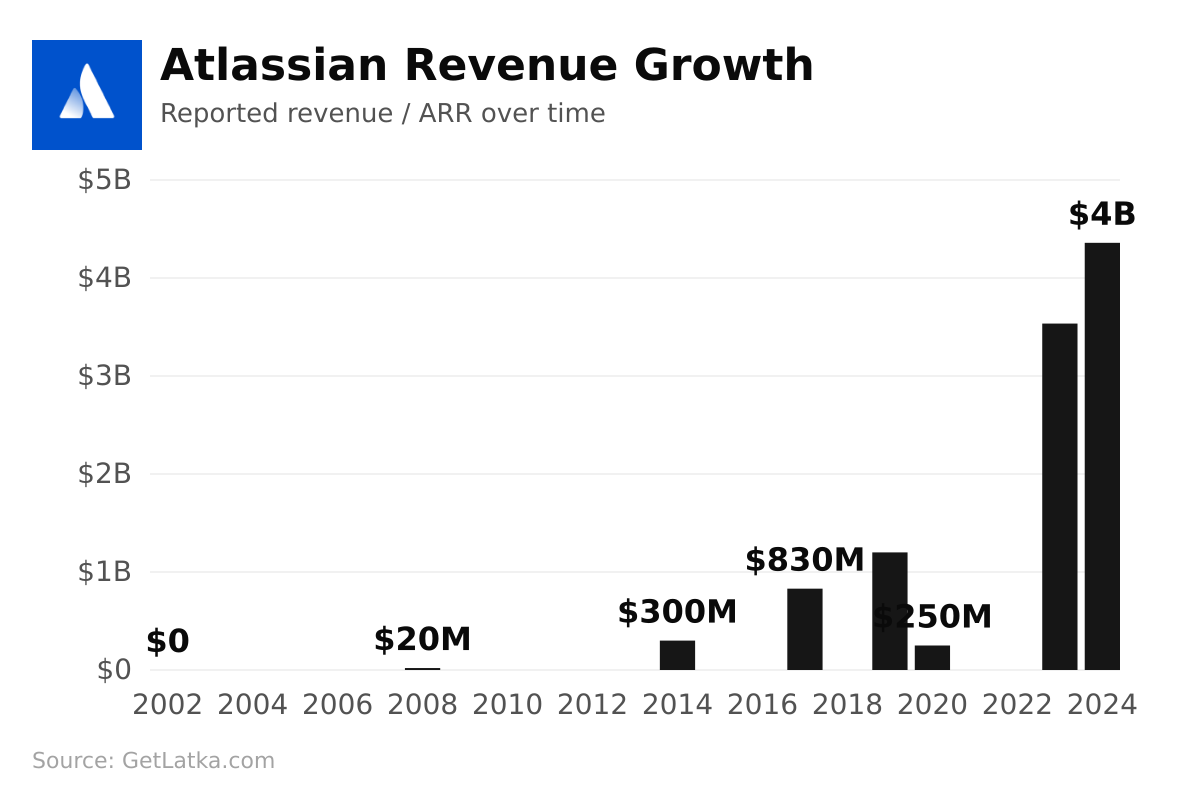
| Year | Milestone | Quote |
|---|---|---|
| 2024 | Atlassian Hit $4.4b revenue in December 2024 | |
| 2023 | Atlassian Hit $3.5b revenue in December 2023Source | |
| 2020 | Atlassian Hit $250m revenue in September 2020 | |
| 2019 | Atlassian Hit $1.2b revenue in March 2019 | |
| 2017 | Atlassian Hit $830m revenue in December 2017 | |
| 2014 | Atlassian Hit $300m revenue in April 2014 | |
| 2008 | Atlassian Hit $20m revenue in June 2008 | |
| 2002 | Launched with $0 revenue |
Simons told Latka the company has grown at a consistent 35 to 50 percent annually over the past decade, describing it as steady and durable rather than the hyper-growth triple-triple-double-double pattern seen at some early-stage companies. He noted the company stabilized into that band after the initial ramp from the first few hundred thousand dollars to the first million and beyond.
Applying the lower bound of that stated trailing growth range to the most recent quarterly figure implies annualized revenue of roughly $1 billion. A GetLatka forward estimate for fiscal 2021, using the stated 35 percent floor as the ceiling and a deceleration-adjusted 25 percent as the floor, would place annual revenue in a range of approximately $1.1 billion to $1.25 billion. This is a GetLatka estimate based on the trailing rate Simons stated; Atlassian did not provide forward guidance in this interview.
Atlassian Valuation, Funding Rounds
Atlassian bootstrapped for 13 years from its 2002 founding before raising primary capital through its IPO in December 2015, which Simons described as one of the best bootstrapping success stories in enterprise software. The company conducted two secondary rounds before going public, neither of which brought primary capital into the business. The first secondary round was completed with Accel in 2010, and the second with T. Rowe Price in 2013, both structured to provide liquidity to employees rather than fund operations.
| Year | Round | Amount | Valuation | % Sold | Quote |
|---|---|---|---|---|---|
| 2014 | Secondary Market | $150M | $3.2B | 5% | |
| 2010 | Secondary Market | $60M | $400M | 15% |
Simons told Latka that Atlassian used the T. Rowe Price relationship deliberately as preparation for public markets, treating the institutional investor as a representative sample of the scrutiny the company would face as a public company. Atlassian then operated as if it were already public for a couple of years before the December 2015 IPO. Total primary capital raised before the IPO was zero, as Simons confirmed.
Founder / CEO
Jay Simons is president of Atlassian and has been with the company since 2008, when he joined as vice president of sales and marketing. At the time of the September 2020 interview, Simons was 45 years old. He has overseen Atlassian's revenue growth from just over $20 million in annual revenue in 2008 to quarterly revenue just shy of $250 million in 2020, and has led the company's global expansion, freemium model development, and major acquisitions including Trello.
Simons did not discuss prior companies or exits before Atlassian in this interview. Net worth was not discussed; any estimate would require ownership percentage data that was not provided. Atlassian's IPO in December 2015 represents the primary liquidity event in the company's history that Simons referenced, but no personal equity stake or valuation figure was stated.
Mike Cannon-Brookes
Scott Farquhar is the Co-Founder and Co-CEO of Atlassian, a collaboration software company that helps teams organise, discuss and complete shared work. More than 150,000 large and small organisations, NFPs, and government agencies across the world, including companies like ANZ bank, Spotify, Twilio, Mercy Ships and Visa use Atlassian’s collaboration products to help their teams work better together.
Q&A
| Question | Answer |
|---|---|
| What's your age? | - |
| Favorite online tool? | - |
| Favorite book? | - |
| Favorite CEO? | - |
| Advice for 20 year old self | - |
Customers
Atlassian's starter license program is structured as a freemium offering in which the company donates all proceeds from starter licenses to charitable causes. Simons described the model as a disruptive approach to freemium. The average selling price when Simons joined in 2008 was approximately $1,800 annually per account.
For customers spending $50,000 or more annually with Atlassian, logo retention is 98 percent year over year, a figure Simons said the company has shared publicly. The company serves customers ranging from small teams to large enterprises, which Simons described as the Fortune 500,000, encompassing both very large and very small organizations. Free trial conversion to paid was described as a single-digit percentage of new onboards per month, which also served as the minimum sample size threshold for in-product experiments.
We do not have customer count information for Atlassian yet.
Atlassian Business Model
Atlassian generates revenue through software subscriptions across its product portfolio, using a low-touch sales model that removes human friction from the customer path. Simons told Latka the company replaced live demos with recorded versions, compiled self-serve RFP answer libraries, and built an in-product experimentation framework to optimize conversion and activation without high-calorie human sales effort.
Gross logo churn is approximately 2 percent, as Simons stated in the interview. Net dollar retention is north of 100 percent, driven by a viral expansion motion in which one user invites another and one team invites another, increasing both stickiness and revenue per account over time. The company's products, particularly Jira and Confluence, function as systems of record for project management and knowledge, which Simons cited as a primary driver of retention.
Atlassian built its in-product experimentation framework approximately six years before the 2020 interview, around 2014. Experiments require a statistically significant sample, which Simons described as thousands of users, representing a single-digit percentage of new onboards per month. The company operates a blood-pact rule with its product team: if an experiment produces the same positive yield twice, the winning variant is rolled out to all users. Profitability was not discussed in the interview. The company completed 18 acquisitions in its first 15 years, with the third product acquisition occurring in 2005, three years after founding.
Point-in-time figures shared on the GetLatka podcast, each linked to the exact moment it was said on camera.
Average revenue per user (2008)
$1,800
“ASP I pay s be at the time was probably like 1,800 bucks annually”
Watch at WatchNet dollar retention (2020)
100%
“revenue retention year-over-year revenue retention is going to be north of 100 percent”
Watch at WatchGross churn (2020)
2%
“logo retention like if the companies actually use our product from year to year it's 98 percent of them that basically return they spend more than 50 grand”
Watch at WatchFree trials / month (2020)
single-digit percent
“it was in you know the thousands of users and so like as a percentage would be single-digit percent”
Watch at WatchAtlassian Employees & Team Size
At the time of the Trello acquisition in January 2017, Atlassian had approximately 1,800 to 1,900 employees, as Simons recalled. Trello had approximately 100 employees at the time of acquisition. Simons noted that integrating Trello's remote-first culture into Atlassian's distributed but office-centric structure required significant adaptation on both sides, including changes to meeting norms, hackathon formats, and end-of-year events to accommodate remote participants equally. Current headcount as of the September 2020 interview was not stated.
Atlassian employs approximately 1.8M people as of 2026, up from 8.8K in 2023, including 217 sales reps that carry a quota.
| Year | Milestone |
|---|---|
| 2024 | Reached 10.7K employees (June 2024) |
| 2023 | Reached 8.8K employees (July 2023) |
| 2020 | Reached 5.8K employees (December 2020) |
| 2020 | Reached 4.9K employees (September 2020) |
| 2020 | Reached 5K employees (June 2020) |
| 2019 | Reached 4.2K employees (December 2019) |
| 2018 | Reached 3.3K employees (December 2018) |
Frequently Asked Questions about Atlassian
What is Atlassian's revenue?
Atlassian generates $250M in revenue.
Who is the CEO of Atlassian?
The CEO of Atlassian is Mike Cannon-Brookes.
How much funding does Atlassian have?
Atlassian raised -.
How many employees does Atlassian have?
Atlassian has 1.8M employees.
Where is Atlassian headquarters?
Atlassian is headquartered in Sydney, New South Wales, Australia.
Compare Atlassian to the industry
Atlassian operates across multiple industries. Browse revenue, funding, and growth data for Atlassian in each sector below.
Full Interview Transcripts
Atlassian interviewSep 12, 2020
hello everyone my guest today is Jay Simon's he's responsible for all revenue generating activities at Atlassian including customer success and retention operations and marketing he joined in 2008 as vice president of sales and marketing to lead at the Alaskans pioneering efforts to develop a high velocity low touch sales model he's overseen the company's global expansion introducing of its starter license program a disruptive approach to freemium where the company donates all proceeds to Gerard will cause it's also growing worldwide customer community and programs in 2011 Atlassian introduced its cloud-based offering Atlassian on demand and evolution its fast-growing SAS platform he's now president of the company Jay are you ready to take us to the top already it's a long right we're excited so sorry I'm excited to have you on so I want to touch on a few things here you know you joined first you've been with them you know the company over a decade he joined first as in sales you're now president I want to pick up actually right at the Trello acquisition so you mentioned with these guys you know you run into a 100 million active users you both share the same goal why did that deal make a lot of sense for you guys couple reasons that I think first of all the the two companies shared the same mission of you know really changing teamwork and unleashing the potential of what people are trying to do together at work and I think had very similar cultures and then there was like just good product fit in the portfolio if you think about what Trello is trillo's you know sort of like a digital whiteboard we can kind of rearrange cards on it and at one end of the opposite spectrum is JIRA product of ours that is very structured to manage collaborative project tracking management and then the other end of that spectrum is a product of ours called confluence which is just a bank blank page teams can ride on so I think it kind of fits snugly in between very structured very unstructured to help people do different things this was with January 2017 right yeah about a year and a half so you and your team and your board he put together the proform as you say here's what I think it's gonna look here's what the crossover is gonna look like how is it panning out as is the pro forma becoming true is it generally working how you expected it is you know the integration with with Trello inside of a lot anything is is now if you ask Trello and Alaskans it just feels like they've always been here which i think is a you know a good signal for an acquisition into performance like we've exceeded our expectations you know we signaled to the street what we thought our revenue expectations was and we're in front of that and it's good yeah things are great I'm gonna force you to roll the circle over roll the ball over and show me the dead patch underneath what was one supported one surprised even a little sweat one surprised you didn't expect after the acquisition weather was the integration or the cross selling or whatever you know one was Trello famously was a was a remote first company and that last name wasn't and Atlassian is a very distributed company we have offices and you know now seven different countries around the world but being distributed is very different from being remote and there's a lot that we had to learn and we were much bigger there were a hundred hundred you know hundred people when we acquired them a year and a half ago and we were sort of roughly I don't know 1800 1900 probably and and so to you know bring onboard a company that has a very remote first culture is used to like they had pretty hard rules around when you joined the zoom or when you joined a meeting and there were maybe five people in a room everybody went to five different places and joined a zoom from five different locations and so the people that were outside of the office were on equal footing to the people that were and that required us to kind of change and recalibrate how we think about connecting to people that are remote and people that are in the office so did you adapt that principle across your agent or folks or did you kind of force them to kind of stick in your system we did it's a little bit of meeting in the middle and and I think like we've learned new habits around embracing and connecting to remote teams I'll give you another example like we have a ritual called snippet which is basically a quarterly hackathon you know ship it's for us even though we had people that worked remote were really an office centric tradition and you know after acquiring Trello we had remote ship it's like a remote only ship it we used to do a week we still do an annual end of year you know a little bit of an annual end of year let your hair down day and again that was an office specific thing where people do scavenger hunts and a whole bunch of things and we plan those now for remote participation where everybody that's remote can participate almost as a kind of a single team so there's been I think a lot of learning on both sides I want to go in because I think your brain is uniquely positioned to speak about the freemium you know you led sales marketing you know this is your model and a lot of people struggle with a freemium model or they think they have one but they don't actually because of some some loops they haven't recognized it so I want to talk about in a second let's work backwards though so today what what's the last report it run right you guys are at our last quarterly revenue was just shy of 250 million 250 okay good and that's quarterly quarterly yeah okay so take me take me back I believe it's what 2008 when you're joining in a low touch sales model I don't think you're you're doing an inside sales approach with quota and trying to sell big ACV things you're more like a no touch $20 month kind of thing is that true and if so what were you is your first focus coming in that first year so when I joined we were just a little over 20 million in annual revenue and you know the model was very oriented around low touched I mean it was a little bit higher touch kind of in the beginning and and you know part of my job was to continue to figure out how to remove friction from the customer path and so even when I joined it like there was basically a team we called them product advocates we still have them today there were a little bit more of a customer success team but their orientation was it but you're a trying alaskans product will tell you hey there's anything that we can do to make this easier for you answer questions that that you're not finding the answers to in your own let us know we'll bend over backwards now that team did a lot of can I can I schedule a demo can I do X can I do Y for like a $30 a month kind of account yeah I mean ASP I pay s be at the time was probably like 1,800 bucks annually and so you know we're ian strim ended that we thought man it's like it's it's super high-calorie actually to do a demo just for an individual customer even if they're they're you know worth more than 1,800 bucks annually and you know we started to do things like let's record the absolute best demo we could possibly give and anyone that wants it will just point them online and again this is you know a little bit more common today but we try to figure out how can we automate a lot of this kind of higher higher calorie you know higher higher intensity you know human touch and make it really easier for the customer to get that stuff on their own and that's the the part of the model we've continued to scale you know ten years later that's a huge nugget in terms of just taking your top salesperson who gives the best demo with the highest conversion ranges automating it and removing the rest of touched there I wanted I'm gonna dig in here because the biggest that what I see a lot of people going from like twenty to thirty to forty million bucks in ARR where they've got a you know a monthly are poo under a hundred bucks a month they just actually the CEO gets a dopamine hit right from doing these demos it feels really good so that it's really difficult to remove it from the process and they just resist resist resist but you know you just gave one great example doing the recorded demo are there can you point to any other examples you guys did to remove human touch from again a low ASP sale RFU's is another one you know like we've been selling it to the enterprise for a long time and you know you often get a lot of requests for hey help me fill out this you know this RFP document or this questionnaire that I basically have to provide to my boss to justify the purchase or just the adoption of this particular technology we would say we don't do that but we've we've taken every RFP question that we've ever been asked to submit and we've compiled basically an answer to all of them and we'll let you basically copy and paste you can search for whatever the thing your your RFP is trying to answer like what we do with security or what we do with scale or you know whatever the question is the best answer we could possibly give is right there you can copy and paste it in yourself now listen early on some customers actually didn't like that they were like well you're right your competitors are gonna fill this out up for me and we had to have have kind of the fortitude to say like we're we're basically just not structure to do that at scale we're trying to win thousands and thousands and thousands of customers you're important to us but if you need somebody to fill out a document as part of the process we might not be the right fit for you and that might be you know a deal that a customer wins now like we had a couple of things in our favor like we had great product at the most affordable price point competitively and that actually does a lot of work and so customers when they look at man this is a great product of the best price okay it might be worth me filling out the RFP it that's or you know requirement on my side yep walk me through so going from twenty million in a hour when you joined what did you guys get you right before you you were promoted to president do you remember a are around that time I mean we have have pretty consistently as a company grown somewhere between 35 and 50 percent over the last decade you know really steady durable growth but we were never really a triple triple double double double maybe in the in the you know the first handful of years when you go to you know a couple hundred thousand the first million to the next million but then you know we quickly stabilized into you know a pretty steady flywheel that basically grew in that consistent banda thirty five to fifty so let's talk about the flywheel I would say usually ask really specific questions about kak pay back are provide only that's a good use of our time I think what's more effective question for you is Malcolm Gladwell wrote the book right ten thousand hours you're an expert there's a lot of people arguing the reason an Amazon or Facebook are becoming very monopolistic is because they can run the most tests at one time so ten thousand tests and win so what I want to ask you is how did you scale your testing velocity in your marketing channels you know at that you know twenty twenty million in a are up to a hundred million a are to quickly pick winners and losers and then launch new experiments a lot of work and a lot of effort I mean you know it's sort of easy like we started really early on I think as a company in marketing doing you know experimentation and a/b testing in sort of all the channels that most fear listeners would just had not around we were maybe a little bit later stage in adopting and building you know growth experimentation muscle we're in product as a modern SAS company you have the ability to you know ingest thousands and thousands of thousands of either existing or potential users or tire kickers and figure out like what are the tweaks that we can make in product or in funnel or part of the experience that's going to you know increase yield or increase lift from all these people that we're trying to ingest and I would say you know we probably you know ran headlong into that endeavor about six years ago you're talking like a viral coefficient K one factor like invite sent out and from that kind of thing all of that stuff and then you know just in product when we're building a feature and we want to expose that feature to some segments of our customer base to figure out what is the impact of that particular feature we rearrange the onboarding experience what's the impact on activation you know there's I think a lot of young SAS companies don't necessarily have the capacity if you throw a bunch of energy you know and and and resource and time at fixing that especially if they're growing if you're kind of growing gangbusters and you have a bunch of people that are coming in you know like the dial turning to figure out how do we really tune this for kind of maximum yield that probably doesn't come to later and so I think we are in that bucket but then you actually like we built basically an experimentation framework that was deeply embedded in product and the first operators of that in product were marketers like marketers that were deeply technical where you could say hey product has basically built you know a set of features and capabilities in the product we're gonna have the the latitude and the ability now with the way we built our experimentation framework to kind of tweak them to say I'm gonna take this feature and sort of expose it in a slightly different way or I'm gonna rearrange the onboarding experience for this particular cohort and then measure what happens happens next and by the way we had an agreement we had a pact with product where if we ever experiment we would run twice if we produced the same positive yield twice we had basically blood pact that said okay that gets written that way for everybody now so I love that rule what cohort would you yeah you probably said at minimum it has to be exposed to this kind of cohort like this volume of users or this many on boards what was that it was a sample size that would be statistically significant like 5% of new on boards per month what was that actually do you know probably varies by experiment but I you know I would say it was in it was in you know the thousands of users and so like as a percentage would be single-digit percent yeah let's shift to so help me understand when when you're think about going public what was the month by the way near December I think it was one of the last IPOs in 2015 yeah but oh there's nothing like there's nothing like the holidays to you know be a forcing function on this kind of stuff so to late 2015 I assume because of your role you were involved obviously aggressively in the going public conversation there's a lot of people maybe not back then but today they're saying there's so much money in the market we can really I peel but actually you know provide liquidity the early folks that stay private why did you decide that that was not an option for you and and really going public was the best what we already provided liquidity so you know maybe someone unusually for the company lastly I think is one of the best bootstrapping success stories of all time I mean the first time that we raised primary capital was when we went public in 2015 13 years after founding we did to sit we did two secondary rounds we did a secondary round in 2010 with Excel and then we did a secondary around with T rowe Price in 2013 and so we sort of like her already basically allowed employees to you know to participate in liquidity the company I think going public was was really about operating as a best-in-class company and we were ready you know we basically had on boarded an institutional investor in tear a price to understand what an institutional investor is going to ask us and you know how will they operate with us as sort of a shareholder in the company what are the kinds of things they'll push us on or want to understand more deeply because they're a representative sample of everybody that we're about to expose ourselves to and then we operated as if we were a public company for a couple of years so we're ready and then I think you know we had we felt like we have a big market we're still growing into we've got great durable growth we've got a business model that I think is a huge advantage in terms of how we operate and what we're trying to do and there was little downside I think it accompanied to new audiences and there's a you know a rigor and a discipline of operating as a public company that I think on the whole is good I want to quickly focus on churn as we wrap up the last few minutes here you know at this at the price point now you're talking right sub you know hundred bucks ish per month people would say what's the SMB space you know nine I ten actually go out of business churn is really just bought in frustrates the heck out of a lot of founders um what what what enabled you to get churn so low you know two or three things and then I want to compare you a bit to Constant Contact which was much smaller than you today but they were in the marketing space and they could not figure out churn and I wonder the fact that you're in the DevOps space does that fact make you so much more stickier well we're in the team collaboration space and if you if you look at our products one thing that makes a sticky is they quickly become systems of record like jeers a system of record for what people need to do and who needs to do it when it needs to need to be done by confluence the system of record for content that is created as part of sort of like the knowledge corpus of a business or a team and so it's it's and it becomes part of your workflow the way that you create and share something or the way that you create a MANET manage a project is sort of in these products and I would say that you know the churn you know there's dimensions of churn like certainly turn is going to be higher for really small companies and small teams but remember like we're surveying and we talk about serving the fortune 500 thousand we which includes really really really big companies and really really small ones you know you know we've like any company you work on figuring out like cohort by cohort by cohort what's going to actually improve retention and it could be different things you know within different segments of your customer base you know one thing that we've shared publicly is is retention at a local level for companies that spend 50 grand or more with us is 98 percent like its rudimental or revenue retention year-over-year revenue retention is going to be north of 100 percent but you know logo retention like if the companies actually use our product from year to year it's 98 percent of them that basically return they spend more than 50 grand and you know with our products you know we started a team level and so we can land inside of a big company at a very small unit but because we're collaboration software there's a they're sort of a you know a viral effect where one user invites another user one team invites another team and the more teams that get invited this stickier we become which is part of like what all of our growth momentum our growth motion is how do we get people to invite their colleagues how do we get people to share more how do we people to create collaboratively because that just is going to increase retention and expansion you know Jay last last question before we wrap up with the famous five your public company you have public markets you have cash on hand obviously acquisitions there's an interesting way to grow do you typically have any active acquisition talks going on not the companies but just in general do you I mean I would say if you look at our history we've done you know Charlie was the 18th acquisition in in our 15 years and so you know the short answer would be yes like I mean I think we're we're we built you know M&A as a muscle really really early on I think the third product and maybe 2005 you know three years in the company company's history the third product that we added the portfolio was acquired on top of two organic products that we built and so if you look over history there's a preview pretty regular cadence of basically building you know organically and adding in organic growth and technology into the you're talking bitbucket source tree HipChat all these guys yeah yeah yeah very good and follow-up question on that you know your public company people play arbitrage I've seen public CEOs all the time it's hard to resist you know negotiating a price on a company where you're paying an AR multiple that you know once it's part of your company the public markets are going to pay a premium for that AR over what you paid it's just pure financial arbitrage how do you resist the urge to fall for those traps and then how do you know when to give in to that urge because you know the product is such a strategic fit well I mean we're we're not just looking to buy revenue I mean we're looking in some cases to buy you know technology that's additive to our strategy companies and cultures that are added it to our strategy and you know I mean like you the public markets are going to do what the public markets are going to do I think we're gonna value what we think we can do with you know with a product or a company or a technology or a market opportunity and basically value it accordingly like the market is gonna you know inform some of that stuff what happens in the public market after we gobble something we're add something you know the company is is out of our control very good Jay let's wrap up with the famous five number one what's your favorite business book being the most recent favorite business book is measurement matters by John Doerr we're a big consumer and producer of okay harsh and so it was really relevant number two is there a CEO you're following or setting preferably an undercover one most people don't know about uh I mean I would say Ben Thompson of strattera might be an odd categorized CEO but technically he is one and the guy I just basically spouts wisdom it's one of the only blogs that I read I totally agree with you number two is there as their favorite online tool you've got for scaling your business besides one of your own I'm I'm consuming a lot of read - Ari - yeah Ari - what is that it's a you know data visualization data reporting interesting and so it's just you know we look at a lot of data here number four how many hours asleep rating every night six and what's your situation married single kiddos married two girls 13 and 10 oh wow you got a full house and how old are you Jay forty five last question what do you wish your 20 year old self knew that that the model the model is the business guys I don't think we could add it on a better note coming from a guy that really says we want to focus on system of record companies he says the model is the business the system is the business makes a lot of sense Jay joined first focused on sales and marketing over a decade ago now president of Atlassian again walked us through how they ran how they ran experiments early on on cohorts you know blood oaths they had with our product team in terms of moving products to the front of line how they thought about acquisitions now as a publicly traded company again how they think about growth and scaling and all the different metrics they're checking out Jay Simon's thank you for taking us at the top thanks I think
Data and Sources
All figures on this page are taken directly from interviews or are estimates from public sources and proprietary models. Not financial advice. Read full disclaimer.
Claim this profilePeople Also Viewed

CrossCountry Consulting
Consulting company specializing in finance, operations and technology advisory services to create present and future enterprise value

Adastra
For over two decades, Adastra Corporation has transformed businesses into digital leaders, helping global organizations innovate, achieve operational excellence, and create unforgettable customer experiences, all with the power of their data. At the forefront of Artificial Intelligence, Data, Cloud, Digital and Governance services, Adastra delivers solutions to enterprises to leverage data that they can control and trust, connecting them to their customers – and their customers to the world. In North America, we have offices in Toronto, Calgary, Burnaby, Texas, Florida, New York City, and California. In Europe, we have offices in Frankfurt, Wolfsburg, Munich, Darmstadt, Hannover, Magdeburg, Prague, Bratislava, Vienna, Thessaloniki, Sofia, Varna and Plovdiv. We also have offices in Bangkok, Chiang Mai and Pune. More information can be found at https://adastracorp.com.

Fortra
Fortra provides advanced offensive and defensive security solutions that deliver comprehensive protection across the cyber kill chain. With complete visibility across the attack chain, access to threat intelligence spanning the globe, and flexible solution delivery, Fortra customers can anticipate criminal behavior and strengthen their defenses in real time. Break the attack chain at fortra.com.

Hypertype AB
Hypertype's AI detects the most relevant information from you or your company's emails, document and Notion and then auto-generates custom replies to each incoming email with just the click of a button.

apna
Apna is India's largest professional networking platform dedicated to helping India's rising workforce unlock unique professional opportunities. It serves as a platform for job seekers and employers, connecting them effectively.

IBS Software Services
Developer of software for travel, transportation, hospitality, and logistics industries. The company creates business products and services in airline passenger services, airline and airport operations, airline cargo and logistics, oil and gas logistics, travel and cruise management and ocean transportation.