Each Tuesday, we reverse-engineer a real SaaS company's revenue, profit, CAC, funnels, and its top growth tactic.
Sign up to access all features
Sign up with GoogleSign up with LinkedInAlready have an account? Log in
GetLatka is trusted by 200k+ founders, researchers, and marketers.
No contracts, cancel at any time
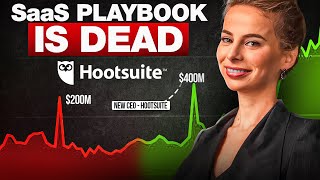
Hootsuite is a Vancouver-based social media management platform founded in 2008 by Ryan Holmes. The company serves businesses ranging from small and medium-sized organizations to large enterprises, providing tools for social media scheduling, analytics, and engagement across major networks. Hootsuite generates revenue exceeding $200 million annually, with the business trending toward $400 million by the end of 2024.
Irina Novoselsky joined as CEO in 2023 and within 18 months has led a significant reacceleration of the business. In less than 12 months under her leadership, Hootsuite grew its enterprise core from 8 percent growth to 22 percent growth. The company operates with a predominantly inbound model, with 95 percent of new business arriving without an outbound sales force.
Hootsuite previously pursued a Goldman Sachs-led exit process targeting a valuation of $7.75 billion, though that transaction was not completed. The company has since refocused on organic growth and is undergoing a broad transformation of its customer journey to align with the buying behaviors of millennial and Gen Z buyers, who Novoselsky projects will represent 75 percent of all buyers by 2025.
Last updated
Hootsuite's revenue exceeded $200 million at the time of the September 2024 interview, with the business trending toward $400 million by the end of 2024. Novoselsky stated at SaaS Open that the company is "almost $400 million" in revenue, with 95 percent of that business arriving inbound.
Hootsuite reached a $690M valuation in 2014, set during its Series C round.
Hootsuite has raised $299.9M in total funding across 6 rounds, most recently a $50M Debt Financing round in 2018.
| Year | Round | Amount | Valuation | % Sold | Source |
|---|---|---|---|---|---|
| 2018 | Debt Financing | $50M | - | - | |
| 2014 | Series C | $60M | $690M | 9% | |
Cofounder
Ryan Holmes founded Hootsuite in 2008, building the company from an agency model into one of the most recognized social media management platforms globally. Holmes is listed as CEO in the known people roster, though Irina Novoselsky has been leading the company as CEO since 2023.
Novoselsky described herself as originally from the USSR and as a Ukrainian refugee who developed skills in pattern recognition and human behavior that she applied to her research on Gen Z buyers. She is a millennial by generation. She joined Hootsuite approximately 18 months before the September 2024 interview, arriving with a mandate to reaccelerate growth. She stated she applied a playbook of focused execution she had used previously, growing the enterprise core from 8 percent to 22 percent growth in less than 12 months.
As part of her research into Gen Z buying behavior, Novoselsky personally interviewed almost 519 Gen Z individuals, covering topics including relationships, politics, economics, and business. Dario Meli is listed as a co-founder in the known people roster. Hercy C. is also listed as a co-founder. Net worth for any individual was not discussed in the interview.
| Question | Answer |
|---|---|
| What's your age? | 45 |
| Favorite online tool? | - |
| Favorite book? | - |
| Favorite CEO? | - |
| Advice for 20 year old self | - |
Hootsuite does not operate a meaningful outbound sales force. Novoselsky stated that 95 percent of the company's business arrives inbound, with customers coming to the site and converting through a demo request flow. The company is in the process of transforming that customer journey toward a self-service, product-led model.
Customer count, pricing per seat, and average revenue per account were not disclosed in the interview. The company serves customers across SMB, mid-market, and enterprise segments, as reflected in the known people roster which includes account executives and customer success managers across each tier.
Hootsuite serves 18M customers.
Hootsuite generates revenue through a subscription-based social media management platform. The company's go-to-market motion is predominantly inbound, with Novoselsky confirming that 95 percent of new business arrives without outbound sales activity. The company is actively transforming its customer journey away from demo-request conversion toward a self-service, on-demand model inspired by companies such as monday.com.
Novoselsky cited customer acquisition cost as a key metric under pressure across the SaaS industry, noting that executive social presence reduces CAC by almost 20 percent. She described rising CAC, lengthening sales cycles, and declining sales productivity as industry-wide trends she observed before and after joining Hootsuite. Gross margin, burn rate, runway, churn, net revenue retention, and LTV were not discussed in the interview.
The company's enterprise core growth rate serves as the primary internal performance metric discussed. That rate moved from 8 percent to 22 percent within less than 12 months of Novoselsky's arrival, representing the central business model outcome she highlighted at SaaS Open in September 2024.
Hootsuite's team size following layoffs of approximately 20 percent of its global workforce in October 2025 stands at roughly 900 employees. The known people roster reflects a broad organization spanning software development, sales, customer success, product management, marketing, finance, legal, and people operations across multiple geographies including North America, EMEA, JAPAC, and LATAM.
Headcount figures prior to the October 2025 reduction and team composition by function were not discussed in the September 2024 interview.
Hootsuite employs approximately 900 people as of 2026, down from 1.4K in 2024, including 236 sales reps that carry a quota. It serves 18M customers that rely on its solutions.
Hootsuite generates $400M in revenue.
Hootsuite was founded by Irina Novoselsky.
The CEO of Hootsuite is Irina Novoselsky.
Hootsuite raised $299.9M across 6 rounds.
Hootsuite has 900 employees.
Hootsuite is headquartered in Vancouver, British Columbia, Canada.
Hootsuite operates across multiple industries. Browse revenue, funding, and growth data for Hootsuite in each sector below.
[00:00] I remember back in the day, we were all using Hootsuite. Ryan Holmes got the company going within an agency model, which is very popular for a lot of most successful software companies. How many of you guys, your companies, how many of you started as an agency? Some form of professional services. Proposify, yep yep, AJ, yeah. A lot of agencies at the start. HootSuite was in the news like crazy, and then there were rumors about a, you [00:22] know, could they IPO and then they hired Goldman to try and get a $7,750,000,000 dollar exit done. That didn't happen. Well, Arena, has coming in now leading as CEO since 2023. She's reshaping the business. Revenue is now over $200,000,000. You'll see her revenue graph, and she's teaching exactly how you should focus on customers first and how she's doing this to reinvigorate Hootsuite. So on that note, please help me give a warm round of applause to the [00:47] CEO of Hootsuite, Irina Nobelski. [00:57] You ready to go? Freaking? You're on. Can you all hear me? Thanks for being here. Good to see Take it away. [01:03] >> Have Exciting to hear the story behind SaaS Open. Hello. I am really excited to be here in a room full of CEOs and successful leaders. As Nathan mentioned, I started at Hootsuite about eighteen months ago, and I started with a pretty similar mandate that I have started before, which is how do you reaccelerate high growth? And so I came in with the same playbook of focused execution, and I went to work, and we did it. In [01:32] >> less than twelve months, we took our enterprise core from 8% growth to 22% growth. But that's not the most interesting thing that happened. In this process, we started to unlock some insights that will materially change and fuel not only our growth, but every single person's business in this room. And it is a dynamic that is absolutely changing how we do business. And it is there's a new buyer emerging with a very different customer journey and a [02:02] >> very different buying pattern, and that new buyer is the Gen z buyer. And so in order to share what I did next, I have to give you a little background. I'm originally from The USSR, and so as you can imagine, I'm part spy. [02:17] >> And so part of that spy, I had to put to work, but also I'm also an Ukrainian refugee kid, yes, that showed up and had to figure out how do I blend in to society with my salami sandwiches and almost every owl vowel in my name. And so I became part anthropologist, studying humans, understanding patterns, how do you fit in? And so I took my spinous, I took my anthropology, and I went to work. I'm a [02:47] >> millennial. I thought I understood the Gen Z person. We're close. We're similar primates. We're not. We couldn't be more different. And so I did what most anthropologists do. I went and I studied them in their natural habitat. I met with almost five nineteen Gen Z and I asked them what they think about relationships, politics, life, economic, business. And what emerged was a really interesting insight. How we conduct business today is no longer going to work in [03:19] >> the future, and the material trend and stat that really shook me when I heard this was that by next year, literally in three months, 75% of all buyers will be either millennials or Gen Z. And all the playbooks that we have on growing SaaS businesses were built by older generations for older generations that will not work with this new buying generation. And so I went to work to understand what will. And as part of that, I [03:50] >> don't know if some of you have seen some of these stats in your businesses, but as I've been looking around different businesses and whether it was in my finance career or my operations career, there was trends emerging I haven't seen in a really long time in SaaS, which is the buying cycle is materially increasing. Sales productivity was going down even though they were doing the same things, and CAC was really growing. And what I was seeing [04:16] >> a lot of my peers doing is doing the same old against the same problems. They were throwing more budget. We need more SDRs, more BDRs, more salespeople. That'll fix the productivity. AI, just throw AI at it. It'll make it better. Do you know what it does? Nope. Just do it. Throw more budget. It's clearly more expensive. I need more marketing budget. And one of the things that TLDR on all of my research, basically the SaaS playbook [04:41] >> as we know it is dead. And we have a moment in time, and especially all of you in the room who are building your businesses from the ground up, have an ability to build it in a way that is materially change the trajectory of your business and allow you to become one of the future magnificent seven. The rest of us have to turn a whole engine to go adapt to what is happening. But if you don't [05:02] >> adapt, the future does not exist the way it is today. I want to share a little bit before I get into kind of some of the what do you do with your business, I want to share a little bit about what I learned in my spy ness, in my investigations, in talking to these Gen Zers. And it was very different than the assumptions of going in. It's a generation of contradictions. They were born with cell phones [05:26] >> in their pocket, yet they don't use them to talk. [05:30] >> They won't work at a job that is a 100% remote, yet they don't want mandatory return to the office. They use artificial intelligence for work, but they do not trust it. They want authentic intelligence. They do not trust things that they do not see, know or have a relationship with. They want a relationship, they just don't want to talk to you. And it is a completely different way of interacting. And if you're sitting there and thinking, [05:59] >> that's interesting, but what does this b to z era have to do with me and my business? Well, they're going to be 75% of your buyers. They are your business. And when you think about what's happening is we have to change the playbook for it. And when you look at their patterns and how they do business, it is completely different than any of the patterns of the generations before them. 62% of Gen Z employees are involved [06:23] >> in buying decisions today. How many of you have Gen Z employees that are telling you, hey, we have to look at this. There's this trend that's happening. There's this software that we're looking at. How many of you are getting that insight? It's almost half the room in here. They were already one of the first champions in what we all know to be an eight, nine, 10 person b to b SaaS buying journey. They're the ones that [06:45] >> get that software in the door to have put on the table to have the conversation. Here's the stat that's really alarming, is 65% of the B2B search starts on social, not on Google. [07:03] >> Over the last few generations, Google search has declined almost 30% from Gen Z from Gen X to Gen Z. If you were putting money behind Google, great. That's not where they're going to start their search. So you are one derivative away from getting the most on the investment that you're making. And then the other part that really was the moment for us is they don't want to be sold to. If you want to be in control, [07:31] >> you have to put them in control. And it is a very different buying pattern and journey than we all have in our businesses today, or most of us have. And that is 60% of the process for buying b to b SaaS is done before a Gen z person gets on the phone or talks to a sales rep. [07:48] >> That's 60% that you might not be influencing, that they are going and consuming content in order to get that knowledge. And here's the fun fact. Even though they're known as the TikTok generation with six second attention spans, on average, 50% of them are consuming at least 13 pieces of content before they get on a phone with a sales rep. By the time they get on the phone with a sales rep, they already know what they're doing. [08:15] >> Are you in that 13 piece journey with Are you providing your content where they consume it? It's a completely different way of doing business, and it's the social self-service generation. They grew up being lurkers on social media. They're there going through Netflix, having content easily at their fingertips, and they're used to being in control. I mentioned they don't want a relationship and they don't want to talk to you, but they want to be able to find [08:43] >> it on their terms at their pace. It's opposite of our push model that we've grown up with in SaaS playbook. Call them, email them, cold email them, throw some artificial intelligence to make that cold email better, keep calling them. They did an activity in the product, call them again, ping them again, email them again. Don't stop till they return a phone call. They're not going to return your phone call. They just don't want to talk to [09:03] >> you. They want you to make their life easier as they go through their journey and they can manage it at their own time. Well, that's what's driving these longer sales cycle. They're getting the tea on you. They're doing the 13 pieces of content to hear what is happening, what's your product doing, what is going on. They're not reading your emails, they're going to Reddit. They're going to peer reviews. They don't join social media because of the [09:27] >> town square, they join it because they're trying to find their community, their tribe of people they respect, who they think is authentic, to give them an honest review. They want to go and see what their B2B friends are buying for that software to solve that problem. It's a very different way of attracting an audience. They also can smell the BS faster than anybody. They're a generation that is 50% less likely to answer any kind of cold [09:51] >> emails and cold outreach. They're a generation that wants to hear what their friend is referring, what is being said, who the B2B influencer for that product is saying, and what your company is saying about them. Two out of three of these buyers want a fully digital experience to do their whole purchase, and that goes for 20 ks ACV deals all the way up to 50. [10:17] >> What's interesting on the high CAC piece is they're not a trad kind of generation. They don't believe in traditional search. They also almost 50% of them have ad blockers. They view ads as the least authentic thing you could do. They want it, but they're okay hearing the ad from someone they trust. And as a result, we're seeing so much more target and the cost is getting driven up based on targeting and personifying and really going after [10:45] >> the right audience. I was talking to a B2B CEO who recently got a $2,000,000,000 valuation, and maybe not so recently, in 2021, and he listened, and as I was sharing some of my insights, he kind of sat back and said, Irina, this is great. I agree. I see it with my kids who are Gen Z, but let's be honest, I'm a B2B CEO, I'm a B2B software provider. I don't sell to consumers. [11:14] >> How many of you in this room are human? [11:18] >> One, we got one. You sell to humans. There are 5,000,000,000 people around the world spending four hours, and they lie in surveys, we all know that, it's more, four hours a day on social media. Tell me what customer you are targeting that does not fall into that 5,000,000,000. I would love to know. Pull me aside and tell me what magical customer that you have somehow found that is not a consumer of social media. [11:50] >> If you want to be in control, you got to put them in control. And that's where it starts at the beginning. How do you win the research phase? And again, they want to know how to find you. That stat of 50% of them consume at least 13 pieces of content. Are you showing up in that journey? Do you understand what their journey is to make sure that your pieces of content are coming up in a way [12:14] >> so that when they pick up that phone call to talk to a salesperson, you're in that 60% that has made the decision to work with you. They're doing the SDR's job. They're also reaching out and trying to learn as much as possible from every different aspect of the business. [12:31] >> Death of the demo, demos as we know it, which is a push mechanism to get them to call us, and by the way, we're the worst at it. Fun fact, 95% of our business comes to us. I don't have an outbound sales force, and we're almost 400,000,000. [12:49] >> They come to us, and when they get to the product, they get to the site, do you know how I turn them into a lead? They click ask for demo. And so we are in the process of massively transforming our customer journey. They don't want to click ask for demo. They want to do the demo themselves. They don't want a perfectly scripted pitch. They don't want to hear you walking through the product. They're a high demand, [13:13] >> on demand generation. They want to watch what they want to watch, when they want to watch it, and they want to consume when they want to consume it. The company that has done it the best is monday.com. Has anyone been through their demo process? If you haven't, do it. Yes, of course you have. Go through their demo process. It is made for somebody that does not want to talk to a person. You can do the whole [13:37] >> thing without interacting with a human being, and we are in the process of massively changing our entire business model in order to do this. And you're saying, why would you do this? It's working. Sure. It's working today. You know what happens with trends? If we are early, we are day one of what is about to be happening starting January 1 for the next two, four, six, and ten years. If you don't adapt and pivot today, you're [14:01] >> going to miss what is going be happening in the future, and this generation is here to stay. They are just getting started as decision makers. And not only that, but they're also comparing you not to other b to b companies in this product experience. How many of you have been on Amazon? Come on. Really? Okay. Thank you. They live on Amazon. They're consumers of Amazon. They go, they buy, they try on, they return, and they never [14:26] >> get charged. [14:29] >> They're they're expecting that same kind of digital experience or that same type of consumer experience in the digital world. They don't know how to separate being a consumer from a customer. This is what they grew up with and they're taking those consumer expectations and bringing them to your business. [14:47] >> Last, social selling. How many of you are on LinkedIn? [14:53] >> Okay. Love it. Well, I did a little math and looked at all the speakers that are speaking over the next few days, and on average is about 10,000 followers for every speaker. The number one winner goes to Josh Aronoff. He has almost 400,000. So if you can corner him and find out what he's doing, you should. But the interesting thing that really exists is they don't want to be led to buy, but they will 100% follow [15:22] >> to sell. And social selling is an amazing tool. When you think about what that means for a CEO in the room, it is a whole vibe as they say. 78% of salespeople that leverage social outsell their peers. [15:40] >> 77% of buyers are more likely to purchase if they just see executive presence on social, let alone even what you're posting. The majority of the social world is lurkers anyway. Just getting a post out, just saying that you're on social allows them to understand what your company stands for, what values you have. And as they're doing their 13 piece content absorption to understand if they want to bring your b to b software into their business, this [16:08] >> is a key part of them seeing if you are authentic and have credibility. It is no longer an option to be on social and to actually engage as a CEO or as a leadership team. You have to be putting yourself out there because that is a key part of their buying journey. You have a customer who's knocking and asking to talk to you and you are not paying attention to them if you are not on there. [16:31] >> And the fun fact, when you're on it and you're using it, it decreases your CAC by almost 20%. [16:38] >> So some takeaways. When you go back to your businesses and assess how do you build a platform, a journey as you go and you take over the world, as you scale your businesses, as one of the things you'll hear over the next few days is I am sure you're gonna hear how people are using social media to do it. And what I'm here to tell you is you are day one of a trend that is about [16:58] >> to get really accelerated and fueled, and you have this moment in time to go back and materially adjust your business to these new buying patterns or you're going to get left behind. So how do you go back and assess, does my business match the needs of this new generation? Am I winning in the research phase? Do you even know the research phase of these buyers? Do you know the 13 pieces of content and how do you [17:21] >> surface them up, whether it's in Reddit, peer reviews, affiliates? Are you doing enough b to b influencing with your own employees? They are your best ambassadors to get your mat your message out. Are you using them and leveraging them in the authenticity that they bring to your brand? And third, maybe third, how do you stay relevant in the Gen Z experience when they don't want to talk to you? How do you think of selling your entire [17:47] >> product and your entire offering without interacting with a single human? They'll reach out when they want to, but how do you put them in control? And it's the opposite of how we think about our entire business. We've spent years figuring out how do we create touch points that force them to talk to us, that give us an opportunity to reach out to them, that trigger us to give them a phone call? How do you rethink that [18:13] >> entire landscape to think through how do I do it without them having to talk to me at all? If they want to, they'll find you. [18:23] >> And it's really about getting adapt or get ghosted, and they won't even tell you why they don't want to do business. And so adjusting is the name of the game. It's what we as CEOs do. And the takeaway I would leave you with, if you want control over your buyer and your buyer's journey and you want to drive your sales and accelerate your growth, how do you rethink it so that you put them in control? And [18:45] >> I run a social media company, so I have to do a selfie. Fun fact, they don't take selfies like the rest of us. I'm going do it the millennial way, but they do it the other way, which I can't even learn to do. But if you all will just say SAS Open on three, I'm going to take a little video. Ready? One, two, three. Sauce open. Thank you. It's a pleasure, and I look forward to you [19:10] >> all changing how you do business to grab Generation Z.
All figures on this page are taken directly from interviews or are estimates from public sources and proprietary models. Not financial advice. Read full disclaimer.
Claim this profileMidjourney is an independent research lab exploring new mediums of thought and expanding the...
Artificial Intelligence for Augmented Creativity. Runway is a comprehensive toolkit that enhances...
Handshake is a college career network that helps students and recent graduates find their next...
Redis Labs is a software company that provides a high-performance, in-memory data platform called...
Valuation
$690M
2024 Revenue
$400M
Customers
18M
Funding
$299.9M
Avg ACV
$22
Team · 2025
900
Founded
2008
| Year | Milestone | Source |
|---|---|---|
| 2024 | Hootsuite Hit $400m revenue in September 2024 | Watch[1] |
| 2019 | Hootsuite Hit $150m revenue in December 2019 | |
| 2018 | Hootsuite Hit $150m revenue in December 2018 | |
| 2018 | Hootsuite Hit $150m revenue in March 2018 | |
| 2017 | Hootsuite Hit $150m revenue in September 2017 | |
| 2009 | Hootsuite Hit $3.8m revenue in December 2009 | |
| 2008 | Launched with $0 revenue |
The company's enterprise core growth rate stood at 8 percent before Novoselsky's tenure began. Within less than 12 months of her joining, that rate accelerated to 22 percent. The 18-month period since she joined as CEO in 2023 represents the window over which this reacceleration was achieved.
GetLatka estimates that if Hootsuite sustains its 2024 enterprise core growth rate of 22 percent, forward revenue for 2025 would fall in a range of approximately $244 million to $488 million, depending on whether the base is the confirmed floor of $200 million or the stated target of $400 million. This is a GetLatka estimate using the trailing 22 percent growth rate as the ceiling and a deceleration-adjusted scenario as the floor. Profitability was not discussed in the interview.
| 2013 |
| Series B |
| $165M |
| $500M |
| 33% |
| 2012 | Secondary Market | $20M | $200M | 10% |
| 2011 | Debt Financing | $3M | - | - |
| 2010 | Series A | $1.9M | - | - |
| Year | Milestone | Source |
|---|---|---|
| 2025 | Reached 900 employees (October 2025) | betakit.comEstimated |
| 2025 | Reached 900 employees (October 2025) | betakit.comEstimated |
| 2024 | Reached 1.4K employees (October 2024) | |
| 2024 | Reached 1.6K employees (October 2024) | |
| 2023 | Reached 1.4K employees (November 2023) | |
| 2022 | Reached 1.4K employees (January 2022) | |
| 2021 | Reached 1.6K employees (January 2021) | |
| 2017 | Reached 1K employees (September 2017) | |
| 2014 | Reached 600 employees (September 2014) |
Interview with Irina Novoselsky, Founder
Recorded Sep 5, 2024